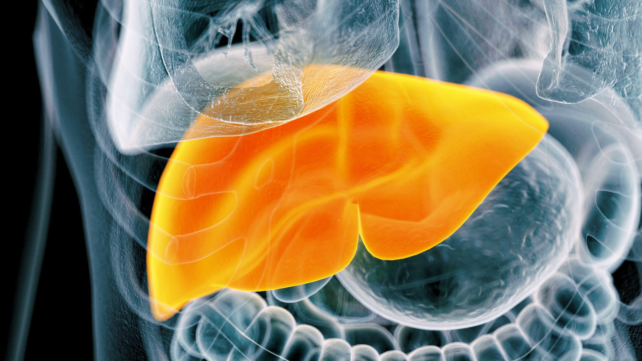
The liver clears substances from our blood, but parts of this system become less efficient as we age.
Scientists have now restored some of that lost function in older rats with an experimental drug, halving blood levels of a protein fragment linked to Alzheimer's disease.
The treatment also lowered cholesterol. After that second finding, the researchers discovered that the drug restored communication between neighboring liver cells.
The study, led by researchers at the University of Southern California, focused on protein fragments that can accumulate as plaques in the brains of people with Alzheimer's. Called amyloid-beta, these fragments also circulate in the blood, where the liver helps remove them.
Restoring the aging liver's clearance capacity could therefore lower circulating amyloid-beta, addressing one consequence of aging that might influence disease risk.
"Age is the single greatest risk factor for late-onset Alzheimer's disease," first author and USC liver researcher Sam de Leve told ScienceAlert.
To investigate, the team examined how substances reach the cells responsible for processing them. Much of the amyloid-beta in blood travels attached to fat-carrying particles. Large particles must pass through microscopic openings in the cells lining the liver's small blood vessels to reach its main working cells, called hepatocytes.
As the vessel-lining cells age, these openings become smaller and fewer. The researchers suspected that reopening them would help hepatocytes collect amyloid-beta from the blood.
They gave two-year-old rats an experimental drug called cinaciguat daily for two weeks, comparing them with untreated older rats and four-month-old animals.
The treatment restored the openings. Blood levels of amyloid-beta 40, one form of the protein fragment, fell by half, returning to youthful levels.
LDL, the cholesterol-carrying particles commonly called "bad cholesterol," dropped too. However, LDL particles are small enough to cross the vessel lining even when its openings are lost. Reopening those passages couldn't explain this result.
The team investigated whether the drug also affected communication between cells. They collected liquid in which vessel-lining cells from young or old rats had grown overnight, then added it to hepatocytes from young rats.
Liquid from young cells supported LDL uptake. Liquid from old cells provided no more support than ordinary culture medium. When the older donor rats had received cinaciguat, however, liquid from their cells supported uptake again.
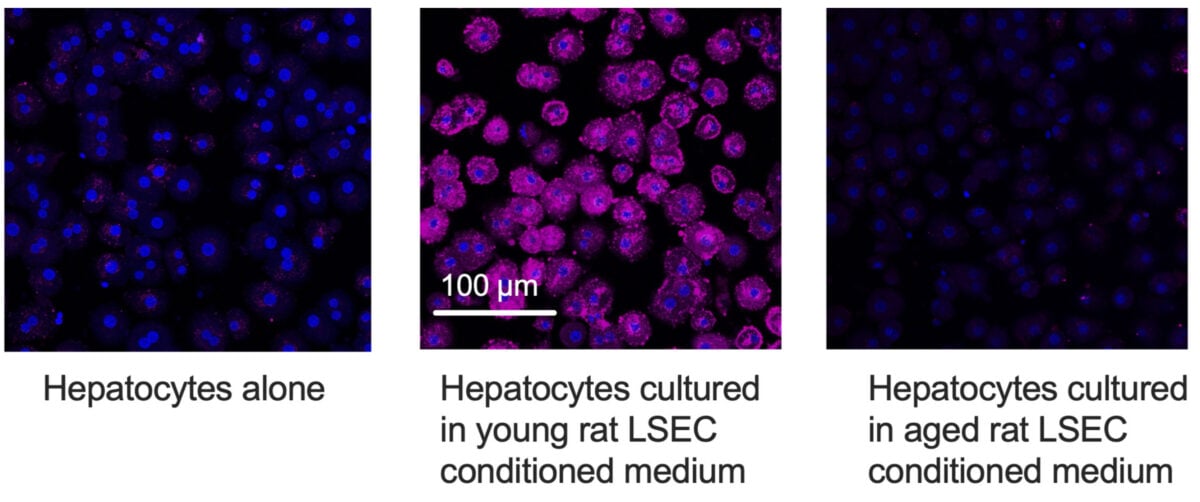
Treatment appeared to have restored a message helping hepatocytes maintain their specialized function. De Leve compared this to a scene in The Lion King: After his father's death, Simba runs from his future as king, until his father, Mufasa, appears to him in spirit.
"It's like Mufasa telling Simba to 'Remember who you are' in The Lion King," de Leve said.
In the liver, that reminder came through a growth factor, a protein that influences cell behavior, called HB-EGF. Older vessel-lining cells still made its precursor but weren't releasing detectable amounts of the soluble signal. Cinaciguat restored that release.
Adding HB-EGF directly to hepatocytes improved their uptake of LDL and amyloid-beta. Blocking it removed the benefits supplied by liquid from young cells.
The hepatocytes offered another clue. Two proteins that capture these substances were present in similar total amounts in older cells, but less of each was at the cell surface, where they work. Treatment restored their surface levels.
The results support a role for HB-EGF in this change, although the researchers didn't directly establish that connection.
De Leve explained that restoring the vessel-lining cells both reopened passages for large molecules and renewed their communication with hepatocytes.
"In youth, the hepatocyte is a specialist at maintaining appropriate circulating levels of LDL cholesterol and amyloid beta, but with aging, the hepatocyte becomes less efficient at clearing those substances," de Leve said.
Whether improving liver clearance could protect the brain remains unknown. Earlier mouse research has linked amyloid produced in the liver to changes in the brain.
This study examined healthy aging, using three to six independent biological samples per condition across different experiments. It didn't establish that treatment reduces brain plaques, improves memory, or prevents Alzheimer's.
The researchers say the approach should next be tested in an animal model of Alzheimer's disease. Developing a human treatment would also require further research into the effectiveness and safety of related drugs.
The research has been published in Journal of Biological Chemistry.
This article was fact-checked by Rebecca Dyer and edited by Rebecca Dyer. While we pride ourselves on our process, we are only human. If you spot a mistake, please let us know.