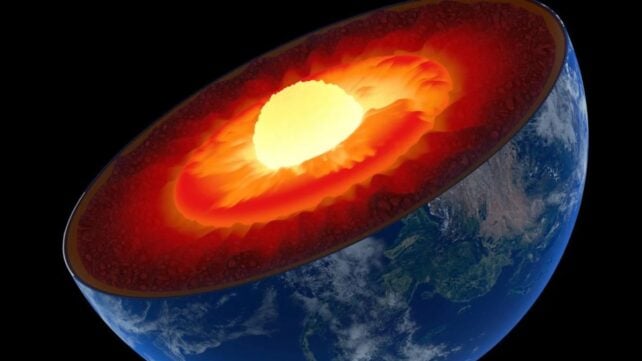
Our early Earth was a heavy metal album cover: a molten ball covered in a global lava ocean, spewing lethal gases while being pelted by the flaming space-rocks of our Solar System's violently chaotic afterbirth.
Over the next 4.5 billion years of hectic cosmo-geological time, it has settled down a bit, allowing humans, lemurs, and others to emerge.
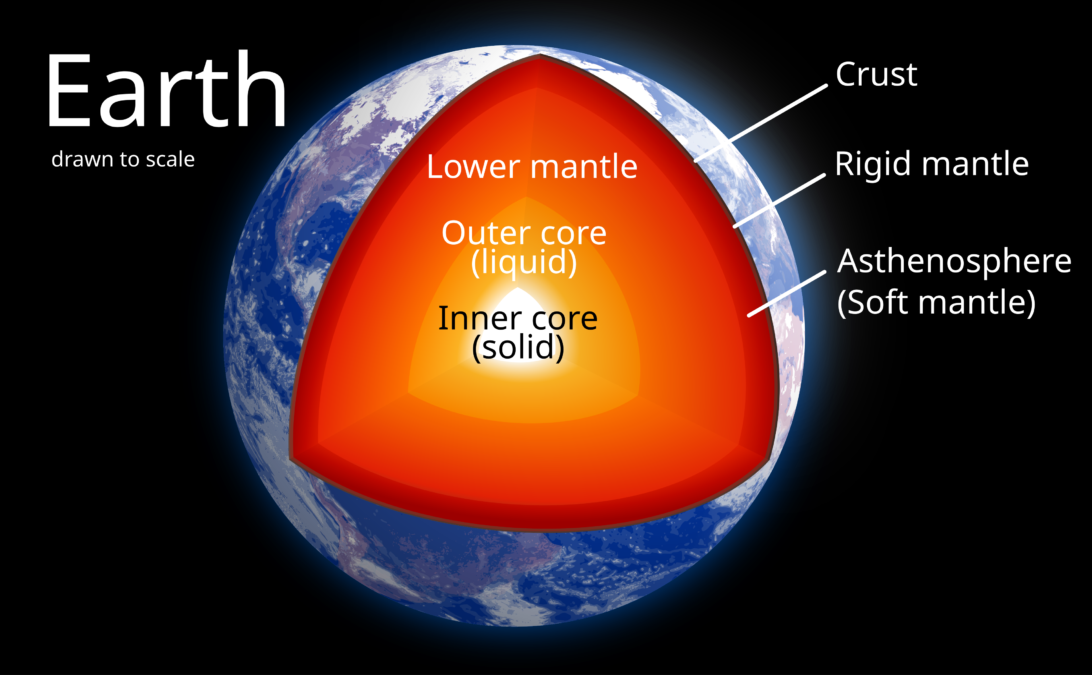
A vision of this hellish ancient reality remains, (hopefully) never to be glimpsed by human eyes: our molten metallic core, blazing about as hotly as the surface of the Sun.
But our core constantly sends chemical messengers up through its layers, including the space-borne ingredients of its birth, locked away for about one-third the lifetime of the Universe.
This includes the hydrogen that was drawn in from the giant cloud of gas and dust that formed the Sun, which continues to ooze up from the core and turns into water in the mantle and crust – not a splashy-sloshy water, but a water trapped in minerals.

Accordingly, a team of geoscientists from the University of Science and Technology of China, in Hefei, wanted to determine a scientifically popular, age-old (technically Earth-old) question:
Are the chemical differences in the deep mantle relics of our planet's crystallization from a magma ball, or evidence that the core and mantle have exchanged chemicals since time immemorial?
In a study published in Science Advances, the researchers used machine-learning-boosted "path-integral simulations" to explore the quantum action of molecules and atoms.
Are the chemical differences in the deep mantle relics of our planet's crystallization from a magma ball, or evidence that the core and mantle have exchanged chemicals since time immemorial?
Importantly, this allowed them to analyze the inner-Earth transport of hydrogen, which is an especially quantum-quirky atom due to its lightness.
They thus checked the ratio of deuterium to hydrogen, which measures the proportion of a heavier hydrogen isotope called deuterium to the regular ol' hydrogen, to see whether the lighter hydrogen was leaking upward through molten plumes erupting on the surface.
The crystallization model, however, demonstrates that mineral-melt fractionation is pretty weak, so it would produce an even D/H distribution in the ancient mantle.
"Collectively, these results indicate that magma ocean crystallization yields a primitive mantle with an essentially homogeneous hydrogen isotope composition, despite large variations in pressure, temperature, and model assumptions," the researchers found.

They found that the most important factor was the magma ocean's starting hydrogen isotope composition – other variables, including the initial water content (estimated at up to two ocean masses), had little influence on the result.
The reason is literally chaos, because the conditions were too violently energetic for deuterium and hydrogen to be neatly sorted through Earth's layers.
For comparison, it's much easier to assemble a jigsaw puzzle on a bucolic train ride than while corkscrewing through the stratosphere in a Blue Angels Super Hornet.
Ocean island basalts (OIBs) offer evidence of Earth's core oozing, because they're formed by upwellings from near the boundary between the core and mantle.
These lavas erupt from places like Baffin Island, located in Nunavut, Canada, and from Iceland, located in Iceland.
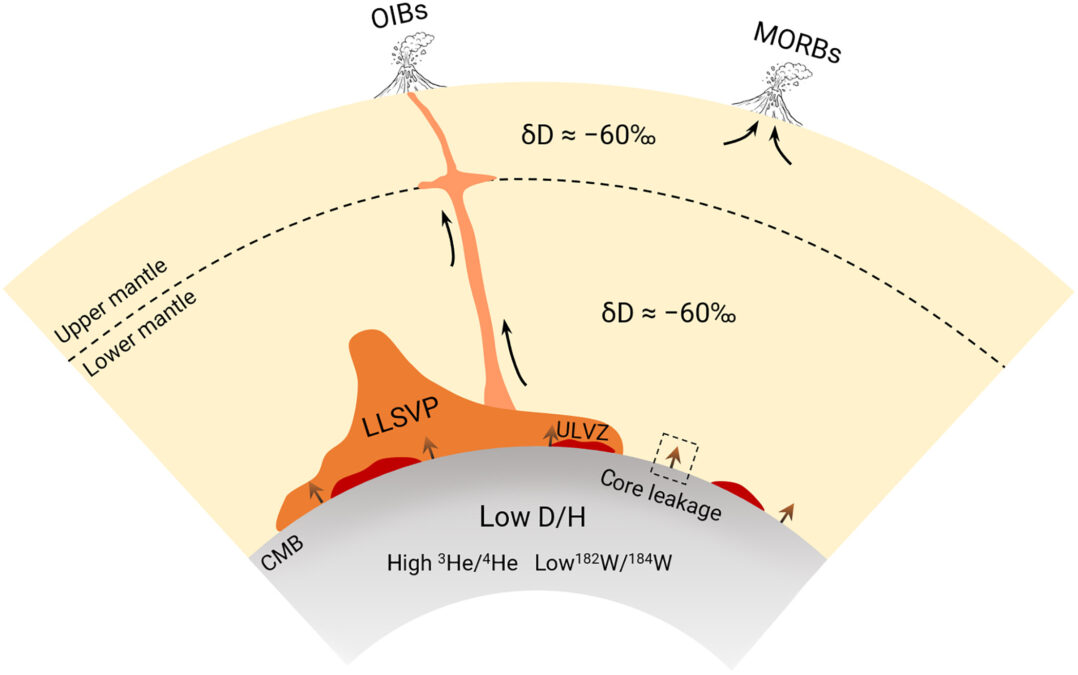
They also appear to bring the light hydrogen accumulated from the Solar nebula that created our Solar System, a geochemical time capsule from before everything we know existed.
As this hydrogen escapes upward from the core, it enriches the mantle and lowers its D/H ratio.
Helium isotope ratios provide another clue, as helium-3 is a lighter, primordial isotope from the Solar nebula, much of it courtesy of the Big Bang, while the heavier helium-4 is produced by radioactive decay in Earth's upper layers.
As a result, a higher ratio of helium-3 to helium-4 in the OIBs adds further evidence that it is likewise escaping from Earth's core.
Tungsten offers one more crucial puzzle piece, as this heavy metal was initially sequestered in the core as Earth's layer separated into a planetary bloomin' onion during crystallization. But now an anciently exiled tungsten isotope hitches rides on rising plumes, tracing the core materials as they're regurgitated upward through Earth's guts.
So, for a nightcap-based recap, the researchers' evidence includes a triumvirate chemical cocktail from the deepest, oldest depths of our world: these hydrogen, helium, and tungsten ratios trace our leaking core.
"These findings suggest that even if primordial deep-mantle reservoirs once existed, the hydrogen isotope signatures in the present-day deep lower mantle are unlikely to represent simple relics of early differentiation," the researchers conclude.
Instead, they "reflect dynamic modification by ongoing core-mantle exchange throughout Earth's evolution," the researchers conclude.
The research has been published in Science Advances.
This article was fact-checked by Fiona MacDonald and edited by Fiona MacDonald. While we pride ourselves on our process, we are only human. If you spot a mistake, please let us know.