With the continuously increasing demand for AI and cloud computing services, data centers are growing larger, more numerous, and more energy-hungry.
It's no wonder, with all the servers, storage devices, and other IT equipment they use to process, analyze, and transmit data.
In the US, server energy usage more than tripled between 2014 and 2023, and may double or even triple once more by 2028, accounting for up to 12 percent of the nation's grid load, according to forecasts.
And it's not just the computing itself: almost half of a data center's energy consumption comes from cooling and auxiliary activities.
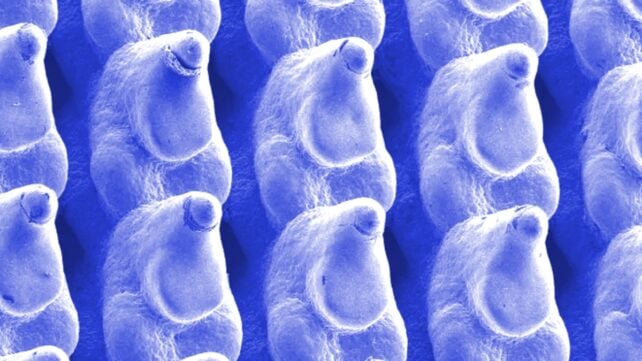
So, engineers have now developed a new, more efficient type of cooling system: a pure copper cold plate, with jaggedly jutting tips, that attaches to computer chips.
Fittingly, its design was aided by AI.
So how does this new system work?
Circulating air has been commonly used to cool computer chips for the past half-century. But as modern computer chips grow more powerful, they generate more heat, and circulating air is no longer sufficient to move that heat away.
Therefore, a circulating liquid coolant, which is denser than air, may be more effective at preventing overheating.
For perspective, this is why jumping into a pool on a warm day can chill you so effectively, even if the water is also warm-ish.
"Cooling is the bottleneck in computer-chip design," says Behnood Bazmi, a mechanical engineer at the University of Illinois at Urbana-Champaign (UIUC).
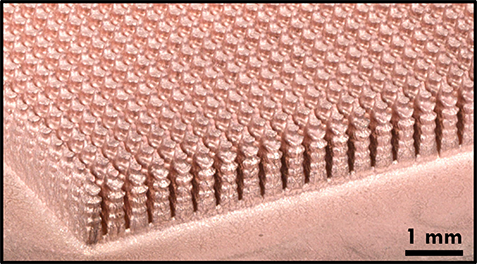
To address that, engineers from UIUC, in collaboration with US-based manufacturing company Fabric8Labs, devised a novel direct-to-chip cooling system composed of copper plates that attach to computer chips.
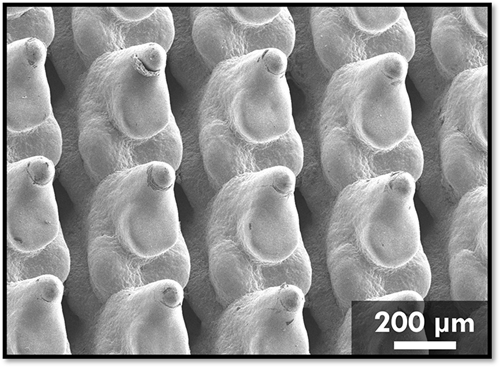
These plates have 'fins,' or projections that protrude to increase contact with the circulating coolant and enhance heat transfer efficiency.
While conventional cold plates often employ fins in simple shapes such as rectangles or cones, the fins designed here have jagged edges and pointy tips to increase surface area.
The researchers used a technique called topology optimization to design more efficient heat-moving shapes. This technique begins with a basic rectangle and then uses a mathematical algorithm to alter its form through multiple iterations.
Its cooling properties, and how much energy is required to push fluid through it, is calculated each time and honed through virtual trial-and-error.
This technique helps to alleviate the thermal-hydraulic trade-off issue. Improved fins reduce pressure drop, decreasing the power required to pump cooling fluids through the structure.
"Topology optimization ends up converging on a design which is optimal in maximizing thermal performance and minimizing pumping power," explains Nenad Miljkovic, mechanical engineer at UIUC.
Yet this design presents another problem: intricately shaped fins are harder to manufacture. Similarly, the multi-functional metal copper has favorable thermal conductivity but doesn't lend itself particularly well to fabrication methods such as conventional 3D printing.
As a result, previous cold plate designs have been made of aluminum alloy or stainless steel, which exhibit less favorable thermal properties.

Seeking a solution, the researchers partnered with the fabrication firm Fabric8Labs, based in San Diego, to create the copper cold plates using an emerging technique called electrochemical additive manufacturing (ECAM).
In contrast to subtractive manufacturing, which whittles materials down into their desired shapes, additive manufacturing (such as 3D printing) builds them up by laying down successive layers of material.
Rather than melting copper, ECAM employs electrochemical plating to construct the copper plates layer by layer.
"ECAM can manufacture pure copper parts with very fine detail – down to 30 to 50 micrometers, less than the width of a human hair," says Miljkovic.
The resultant pure copper plates, with their pointy, jagged fins, provide a solution to two of the significant issues mentioned above, the researchers say.
First, they could deliver up to 32 percent better cooling than conventional plates with simple rectangular fins. Second, they could reduce pressure drop by up to 68 percent while offering the same level of cooling.
The researchers also estimate that incorporating this cold plate technology across an entire "high-density, next-generation" data center could cut its cooling costs to just 1.1 percent of total energy use.
For comparison, conventional air-cooling methods currently account for around 30 percent of a data center's energy use.
Related: New '3D' Computer Chips Could Extend Moore's Law, Study Shows
Future uses need not be limited to data centers, or even electronic applications: "Our workflow can be applied to a wide range of cooling challenges across different length scales," concludes Bazmi.
This research was published in Cell Reports Physical Science.