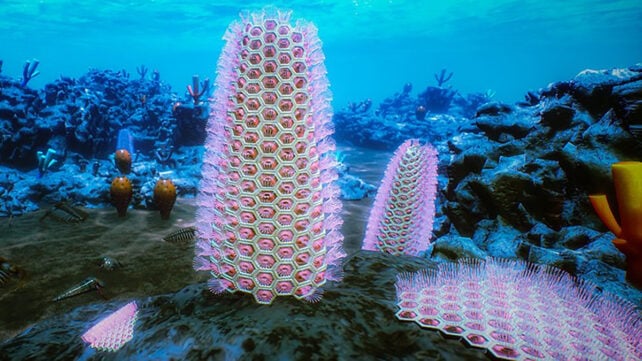
The Cambrian explosion was one of the most dramatic chapters in the history of evolution.
Around 540 million years ago, a sudden, astonishing burst of diversification effectively marked the beginning of most animal life on our planet.
The fossil record rapidly became much richer, revealing strange new animal body plans with hard shells and spines, appendages, eyes, and specialized mouthparts.
But there's been a long-standing mystery about where one key group of organisms fits in.
Those organisms are bryozoans, or 'moss animals': tiny, filter-feeding invertebrates that live in colonies, attached to rocks and reefs in honeycomb-like structures.
Before now, bryozoans were the odd ones out in the history of natural evolution, because unlike every other animal group, they apparently weren't invited to the Cambrian explosion party.
The earliest bryozoan fossils we had were dated to the Ordovician period, 50 million years later.
Now, thanks to some "remarkable" and "extraordinary" fossil discoveries described by researchers led by a team from Northwest University in China, it's been established that bryozoans were around during the Cambrian explosion.
We may need to rethink their ancient evolutionary family tree, too.
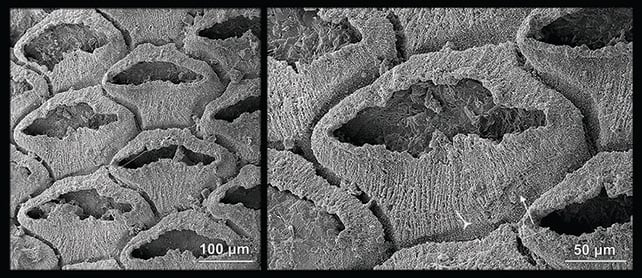
What makes the fossils so special is not just how well they were preserved, honeycomb structures and all, but that their internal soft tissues remained in place – after more than 500 million years.
"It is extremely rare to find fossils where such delicate structures are still intact," says paleobiologist Lars Holmer, from Northwest University.
"Thanks to the special chemical conditions during fossilization, we have been able to study the anatomy in detail and definitively confirm the Cambrian origin of bryozoans."
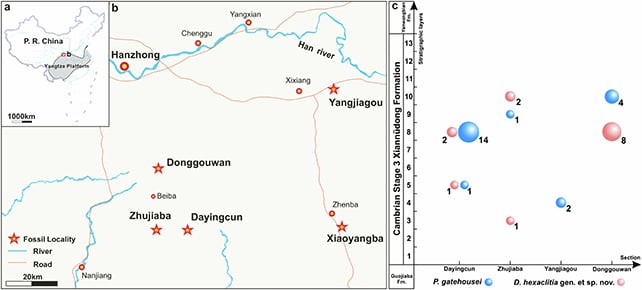
These 38 brilliantly preserved fossils were discovered in rocks in the Xiannüdong Formation in southern Shaanxi, in China.
Through detailed microscopic imaging, two species were identified: the previously known Protomelission gatehousei and the newly described Dayingomelission hexaclitia.
By being able to analyze muscle fibers, membrane sacs, and individual colony members within the skeletal structures, the researchers confirmed that these species were part of the bryozoan group. There had previously been some debate over whether P. gatehousei was in fact a type of algae.
That issue seems settled for now, but the researchers also believe there are wider implications: Both species appear to belong to the Stenolaemata group, one of the three main classes of living bryozoans.

Follow the trail back, and the suggestion is that P. gatehousei and D. hexaclitia were already relatively advanced forms of this group. That pushes the origins of the bryozoans even further back – not only were they present during the Cambrian explosion, but they may in fact pre-date it.
"These aren't just simple precursors," says paleontologist Baopeng Song, from Northwest University. "They are complex, modular colonies."
"The combination of skeletal architecture and internal anatomy provides definitive evidence that these are true bryozoans, and that the phylum was already diversifying during the Cambrian radiation."
Now that this gap in the fossil record has been filled, further research can be carried out, including searches for similar fossils that match these specimens at other sites worldwide, and may tell us even more about these creatures.
The bryozoan colonies themselves can be just a few centimeters or inches in size, made up of many microscopic individuals, and they generally prefer warm and tropical waters. In modern times, nearly 6,000 different living species are known.
Related: Moroccan Cave Fossils Capture a Crossroads in Modern Human Evolution
It's a lineage that stretches further back than scientists thought – or at least had evidence for – and there's likely more to uncover about how these and other animals rapidly diversified and dispersed half a billion years ago.
"Bryozoa has been the elephant in the room of Cambrian paleontology for a long time," says paleobiologist Timothy Topper from Northwest University.
"Every other major animal phylum had a Cambrian representative, except bryozoans. These fossils finally close that chapter for good."
The research has been published in Nature.