
Older adults with a history of falls may have a much higher risk of developing dementia, according to a review of studies involving almost 3 million people.
Researchers from Changchun University of Chinese Medicine found that having a single fall after the age of 40 was linked to a 20 percent higher risk of a future dementia diagnosis, compared to people with no history of falls.
For people who experienced multiple falls, the risk increased by 74 percent.
"Recurrent falls may serve as a potential clinical marker for identifying individuals at higher risk," the authors write in their published paper.
The team outlines three potential mechanisms behind this newly confirmed association.
Their review isn't declaring that falls cause dementia; while that could be a factor, it may also be that falls are an early symptom, or that experiencing a fall could lead patients to behaviors that increase the risk of dementia.
Both dementia and falls are health problems commonly associated with aging, and many studies have examined the link between them.
There's evidence that similar neurological issues may be involved, and older adults with dementia have been found to have more frequent falls than those without. But what has been less clear till now is whether falls precede dementia.
"This study provides the first quantitative evidence, based on a systematic review and meta-analysis, demonstrating an association between a history of falls in middle-aged and older adults and the subsequent risk of dementia," the team writes.
They identified over 35,000 records before narrowing them to 7 studies that met the inclusion criteria.
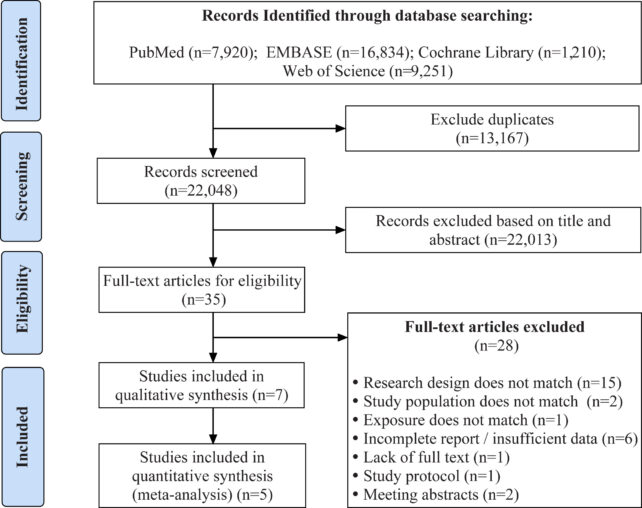
Across the seven included studies, there were more than 2.9 million participants, all aged 40 or older and without dementia at baseline.
Five of these studies followed similar methodologies, allowing their data to be pooled for meta-analysis.
Four contributed to an analysis of the incidence of dementia among middle-aged and older adults with a history of falls.
Close to half of the participants across those four studies had a history of falls, and 11.6 percent of that cohort later received a dementia diagnosis. Among those with no history of falls, only 7.7 percent went on to develop dementia.
A separate, adjusted risk analysis of the association between falls and future dementia included three out of the five studies.
Across these three studies, a single fall was associated with a 20 percent higher risk of future dementia, while multiple falls were associated with a 74 percent higher risk.
The team also conducted a systematic review of the association between falls and future dementia, using four studies that met the inclusion criteria, but could not be included in the adjusted risk analysis because their methodologies were incompatible.
Their results still showed an intriguing link.
One study found that participants who were injured in a fall had a 21 percent higher chance of being diagnosed with dementia within a year.

Another found that in the four years before a dementia diagnosis, the risk of falls causing an injury rose steadily and peaked in the year of diagnosis.
"These findings strongly align with our meta-analysis results, suggesting that falls are not merely coincidental but serve as an early clinical marker of accelerating neurodegenerative decline," the researchers write.
So why would falls and dementia be connected?
The researchers suggest three possible mechanisms that may be working in tandem.
First, the most obvious and direct: Falls cause injuries that could lead to dementia. This is certainly possible, the team says, especially with head injuries that are already linked to increased risk of dementia.
It could be that falls drive or speed up the progression of the disease, and that tracks with the finding that more falls led to an increased risk of dementia.

Another possibility is what the team calls the 'common cause hypothesis'. Essentially, neurodegeneration may already be underway long before a formal dementia diagnosis, and these issues can increase the risk of falls too.
This also aligns with the study's observations: Those who fell more often could have had a more advanced stage of the disease.
And finally, the team suggests that a vicious cycle could be at play.
Older adults who have a fall often develop a fear of further falls, which can lead them to reduce physical and social activities – both of which can be protective against cognitive decline.
Without those activities, dementia can progress faster, which leads to further falls, which leads to greater fear, which leads to more withdrawal from protective activities, and so on.
Of course, no single factor is likely the sole explanation for all links between falls and dementia. Any mix of these (and others) could be at work.
Related: Scientists Reveal The Optimal Amount of Sleep to Lower Dementia Risk
Detailed studies could help tease apart which factors are more likely in specific cases, which could help in clinical practice.
"Clinicians should maintain heightened vigilance for cognitive decline in middle-aged and older adults with a history of recurrent falls to facilitate early detection of dementia," the team writes.
If future studies confirm that falls can contribute causally to dementia risk, reducing falls in at-risk patients could potentially form part of a dementia-prevention strategy.
And if someone begins to suffer falls, it might be a good sign to begin cognitive evaluation.
The research was published in The Journal of Post-Acute and Long-Term Care Medicine.