
Hundreds of millions of years ago, our world looked very different from the way it does today.
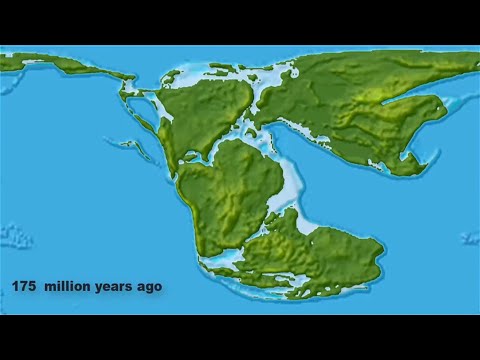
The continents were joined together in a supercontinent called Pangea, which broke apart into landmasses that drifted away from each other as Earth's tectonic plates rearranged beneath them.
Though we may not feel it, this process is still occurring today – and scientists think they may have found hints of a new tectonic boundary opening under Africa.
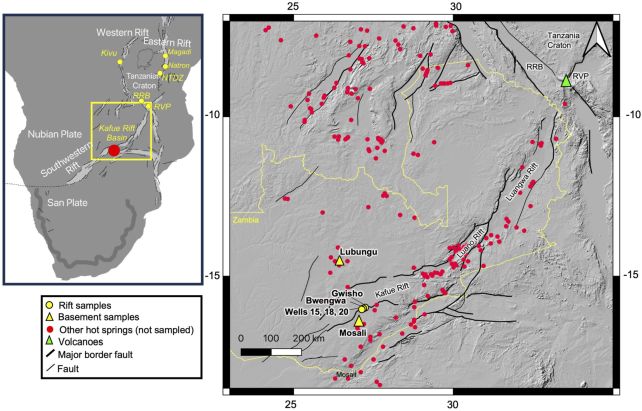
In a region called the Kafue Rift in Zambia, scientists have found that isotopes of helium bubbling up through geothermal springs appear to have come from deep within Earth's mantle – a potential early sign of active tectonic rifting.
"The hot springs along the Kafue Rift of Zambia have helium isotope signatures which indicate that the springs have a direct connection with the Earth's mantle, which lies between 40 and 160 kilometers [25 to 100 miles] below the Earth's surface," says geologist Mike Daly of the University of Oxford.
"This fluid connection is evidence that the fault boundary of the Kafue Rift is active and therefore the Southwest African Rift Zone is too – and may be an early indication of the break-up of sub-Saharan Africa."
Earth has undergone a dramatic evolution since its formation 4.5 billion years ago, from an inhospitable wet rock to the thriving biosphere it is today – the only place in the Universe we know for a fact life emerged.
One of the processes that helped shape that habitable world is tectonic activity.
Earth's shifting plates recycle minerals through the crust, reshuffle continents and oceans, drive volcanic and geothermal activity, and help regulate the long-term cycling of carbon between the planet's interior, oceans, atmosphere, and living organisms.
One day, Earth will cool to the point that its tectonic plates will freeze in place, but that's likely billions of years away. The ground beneath our feet today may feel solid, but our world is still constantly shifting, shuffling, and changing.
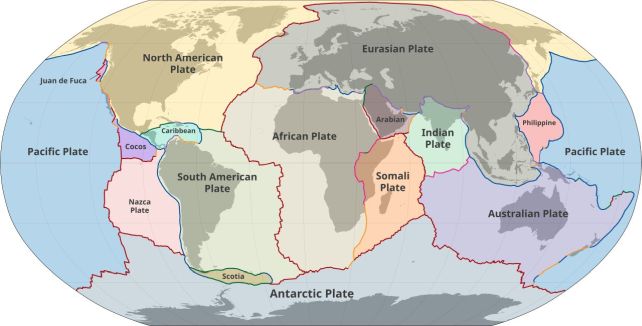
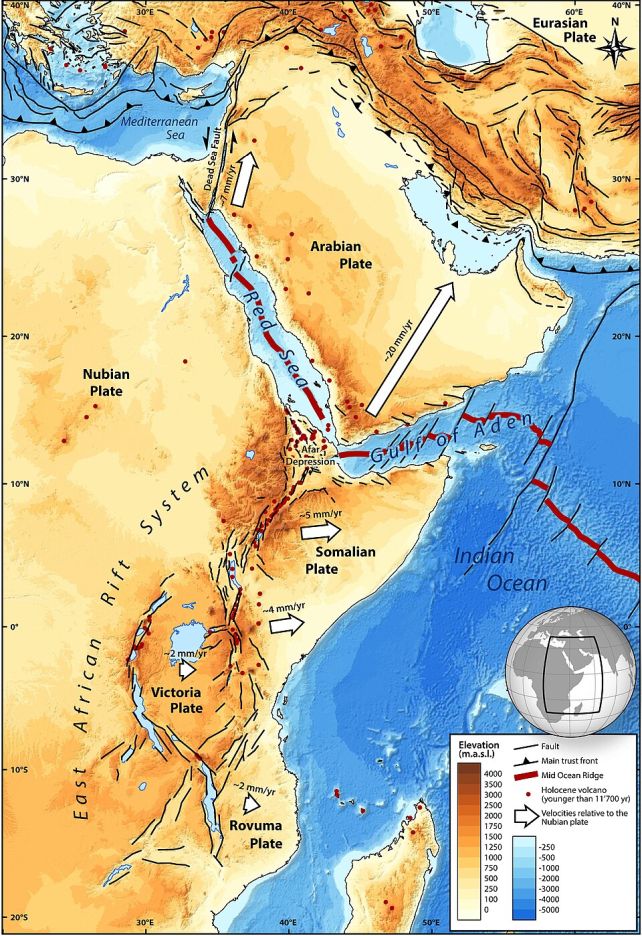
The African continent is already known as a hotbed of rifting. From the Afar Depression that borders the Red Sea, down the Eastern side of the landmass runs the East African Rift, where the Somali Plate is pulling away from the African Plate.
.svg)
The Kafue Rift is part of a rift system that stretches 2,500 kilometers (1,553 miles) in a diagonal slash across the center of Africa, and may ultimately connect to the Mid-Atlantic Ridge, the boundary where the African Plate abuts the South American Plate.
Scientists have suspected that it may mark the beginnings of a new plate boundary as the African Plate fractures in two, but have lacked evidence.
"A rift is a large break in the Earth's crust that creates subsidence and associated elastic uplift," Daly explains.
"A rift may become a plate boundary, but commonly a rift's activity ceases before the point of lithospheric break-up and plate boundary formation."

One way to look for evidence is to study ratios of isotopes – variations of atoms with the same number of protons, but different numbers of neutrons – that can reveal whether gases originated deep within Earth rather than near the surface. These isotope ratios are a clue that points to a direct link to the mantle – one that warrants a closer look.
Led by geologist Rūta Karolytė of the University of Oxford, the researchers took samples of the gas bubbling through the waters of hot springs in Zambia, six inside the Kafue Rift region and two outside it.
They were looking for the unusual isotope ratios that hint at a mantle origin – which find them they did. In the hot springs of the rift region, the team found helium isotopes that, they say, indicate fluid transport from deep beneath the crust.
There was also a fainter signature of mantle-derived carbon dioxide. In more developed rift systems, carbon dioxide tends to become more abundant as mantle activity increases.

Meanwhile, samples from outside the rift zone only showed crustal signatures.
"The data is consistent with early stages of active lithospheric rifting, supported by previous geophysical observations globally," the researchers write in their paper.
Related: Earth's Crust Is 'Dripping' Under The Andes, Scientists Say
If the formation of a tectonic boundary is starting to kick off in central Africa, the process will be a slow one, taking millions of years. However, it may represent a resource that could be tapped – geothermal energy, for example, and hydrogen and helium gases.
Indeed, the research was partly funded by Kalahari GeoEnergy Ltd, a company that is actively invested in finding geothermal resources.
It's important to remain cautious, though. The study only sampled one region of the much longer rift system; more samples from other parts may help confirm the team's findings.
"If similar mantle-derived helium anomalies are detected in hydrothermal fluids along other segments of this extensional zone," they write, "this would demonstrate that mantle connectivity characterizes the entire boundary zone, providing further compelling evidence for an emerging plate boundary capable of continental separation."
The findings have been published in Frontiers in Earth Science.