Discovering alien worlds around distant stars is hugely skill-reliant but also part cosmic lottery.
One has to look from the right perspective, at a specific star, at the right time to catch a fleeting glimpse of an exoplanet.
In a stroke of serendipity, astronomers have now observed an exoplanet do something they'd never seen before – it disappeared.
Planets don't usually disappear, so was this an observational fluke, perhaps suggesting that another telescope needs eyeglasses, as Hubble did in 1993? Was it evidence of a real Death Star erasing an exoplanet from existence?
The real reason is just as exciting, and its unprecedented vanishing trick is described in a paper recently published in The Astrophysical Journal Letters.
The exoplanet in question, called TOI-2535b, has a hidden companion, and these two planetary siblings are gravitationally nudging each other into a complex orbital shuffle around their stellar parent, named TOI-2535, a 9.7 billion-year-old K dwarf star slightly smaller than the Sun and located roughly 1,100 light-years away.
The K dwarf is known to host this "hot Jupiter" TOI-2535b, which may be about the mass of our cold Jupiter but spirals so close to its star that it completes an orbit in just over eight days - 10 times more quickly than our innermost planet, Mercury.
Based on its movement through space, TOI-2535b also appears to have (at least) one as-yet-unobserved sibling planet, possibly around the size of Saturn.
The two planets' gravitational tug-of-war has forced each of them into oddly tilted, wobbling orbits like no other.
Each 'wobble cycle' may take 30-50 years to complete and changes how the planets cross their star from our perspective.
"In our own solar system, all the planets essentially orbit in a single plane, with mutual inclinations of only about a degree (with the exception of Mercury)," astrophysicist Samuel Yee, a 51 Pegasi b Fellow at UCLA, tells ScienceAlert via email.
"A 'flat' system is what we expect, since planets form out of a similarly flat protoplanetary disk. The two planets around TOI-2535 have mutual inclinations of at least 5 degrees, larger than most other planetary systems containing multiple planets."
The disappearing act is therefore due to our position in space and how we observe evidence for exoplanets.
Astronomers first found evidence of TOI-2535b in 2019 using NASA's Transiting Exoplanet Survey Satellite (TESS), via the transit technique, a detection method responsible for picking out approximately 4,800 out of nearly 6,500 confirmed exoplanets.
It relies on a straightforward principle. As an exoplanet or other body passes (transits) in front of its parent star, it blocks a bit of that star's light, producing a telltale dip in brightness, like an interstellar Bat-Signal or a moth flitting in front of a flame.
Over the following seven years of observation, which employed numerous space and ground telescopes, astronomers saw TOI-2535b passing from across its star's midline to ever higher along its face, eventually only grazing the stellar disk and then passing out of sight by March 2026.
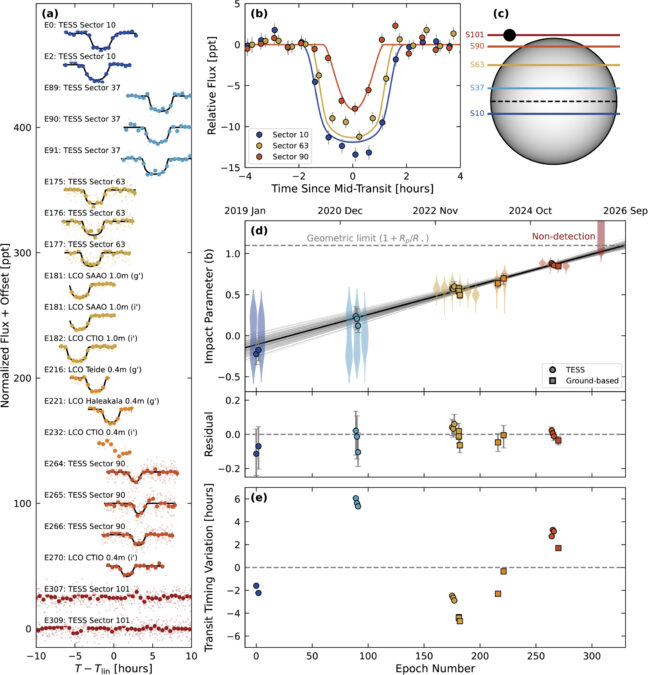
Closer to cosmic home, this exciting orbital interplay gifts us eclipses: "If the Moon's orbit around the Earth was perfectly aligned with the Earth's orbit around the Sun, we would see an eclipse every month," explains Erik Petigura, an astrophysicist at UCLA and the study's second author.
https://samuelyeewl.github.io/assets/img/toi2535_press_hd_with_data.mp4
As seen in the video, TOI-2535b will keep on appearing and disappearing from our view over the following decades, and its hidden companion may soon pop up as well, providing more precise constraints on the characteristics of both bodies.
Additionally, the researchers modeled 1 million years of this planetary setup, comprising 50 million orbits of TOI-2535b, finding that the planets' orbital resonance may actually keep them stable and protect them from destroying or flinging each other into space.
Plus, this work offers a potential explanation for hot Jupiters, with a twist.
"For the TOI-2535 system, which contains two closely-interacting short-period giant planets, this is probably not how it formed," Yee explains via email.
"Instead, they likely migrated in through the protoplanetary disk. However, how their inclinations got excited remains an open question."
Finally, this reminds us of the ephemeral-ity of astronomy: who knows how many more planets we'll see emerge or vanish into thin space.
"There are a couple of cases where we have seen the transits appear," Yee tells ScienceAlert, "so there are planets coming into and out of view from our perspective all the time."
The research has been published in The Astrophysical Journal Letters.
This article was fact-checked by Fiona MacDonald and edited by Fiona MacDonald. While we pride ourselves on our process, we are only human. If you spot a mistake, please let us know.