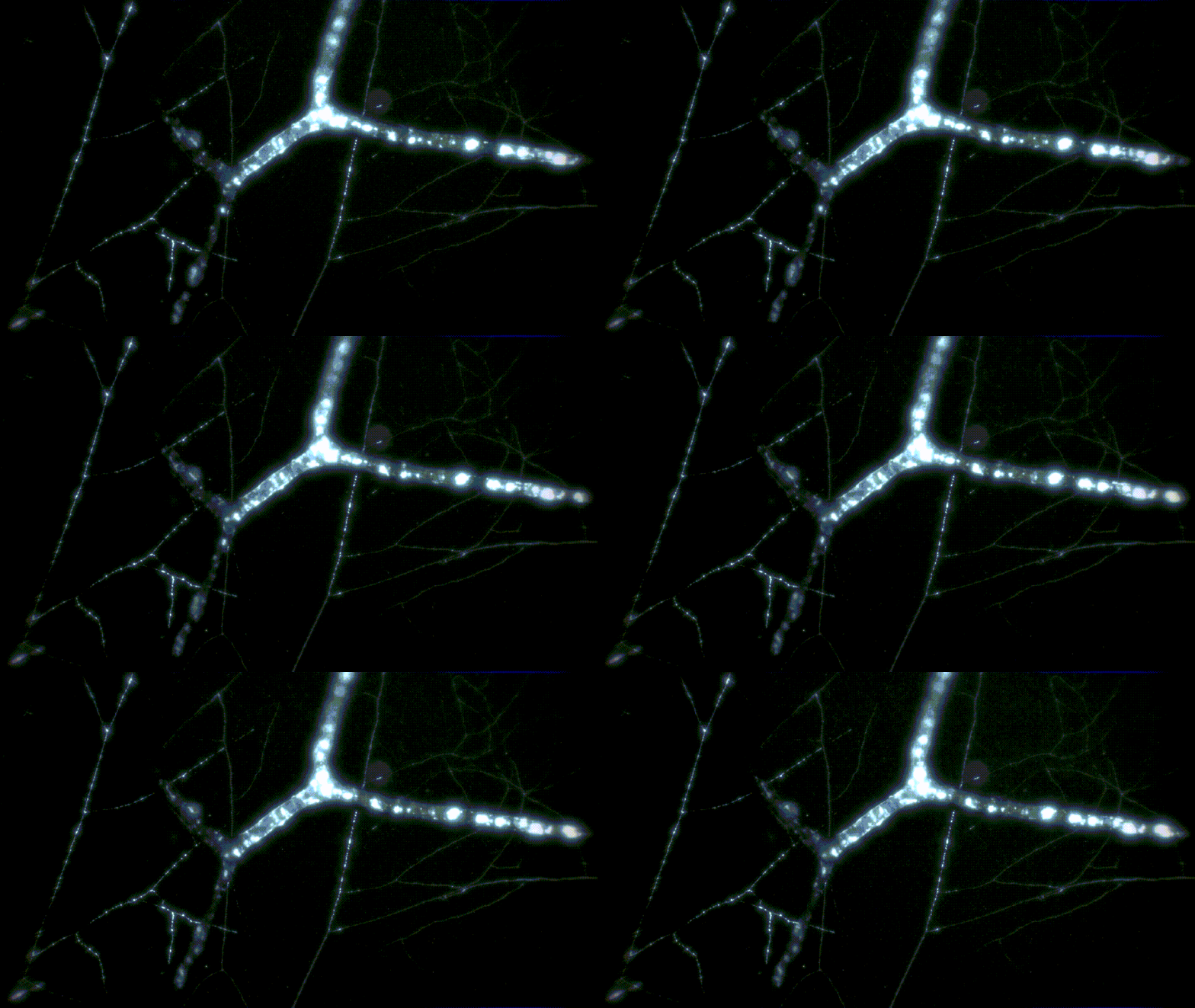
The ground beneath your feet is not quiescent.
It zings and pulses with frenzied activity, much of it driven by a partnership between plants and fungi that dates back at least 450 million years.
This is the mycorrhizal network – a vast system of fungal filaments locked in a mutual exchange with the plant life that carpets our planet, transporting nutrients from the soil and receiving in return the carbon produced by plant photosynthesis.
It's large, and it's vital. Around 70 percent of all plant species rely on mycorrhizal symbiosis.
Now, for the first time, scientists have compiled a global map of this hidden infrastructure, revealing an underground network of arbuscular mycorrhizal fungi (AM) threads that stretches an estimated 110 quadrillion kilometers through Earth's soils.
That's long enough to travel the 150 million-kilometer (93 million-mile) distance from Earth to the Sun nearly a billion times.
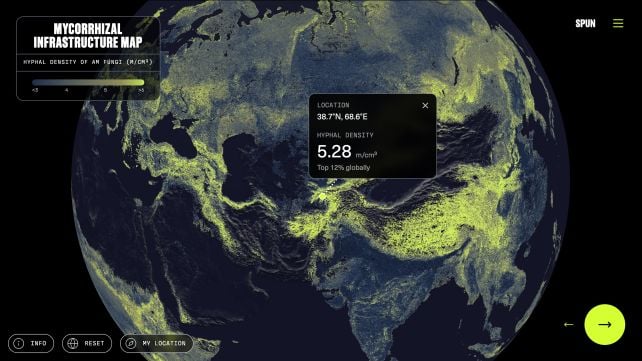
"It is hard to overstate the importance and enormity of these fungi," says evolutionary ecologist Justin Stewart of the Society for the Protection of Underground Networks (SPUN) and the Vrije Universiteit Amsterdam.
"There could be up to 10 meters (32 feet) of mycorrhizal network in just a teaspoon of soil."
Fungal networks consist of underground threads called hyphae that run below the surface of the ground in forests and other plant communities, and they are often critical for helping these communities thrive.
They transport nutrients such as phosphorus as well as water that is usually beyond the reach of plant roots, in exchange for carbon from the plants.
This makes the 'wood wide web' an integral part of our planet's carbon cycle, but it's difficult to quantify the scope of the role it plays if we don't know how big the network is.
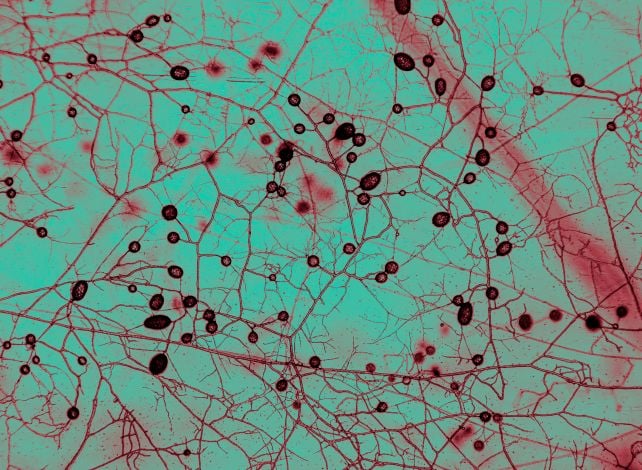
The work of Stewart and his colleagues was an ambitious effort to find out.
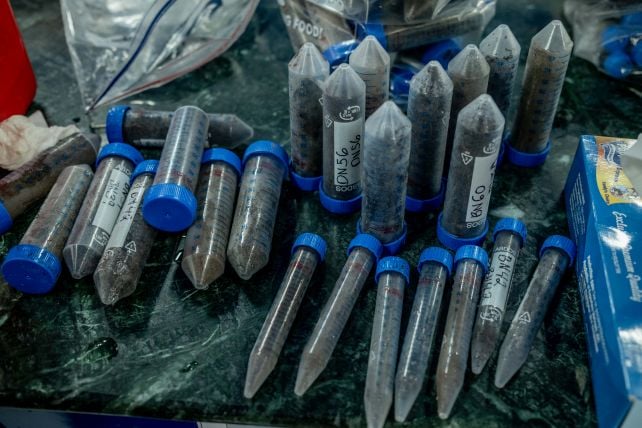
They assembled data from 322 studies representing more than 16,000 soil cores across nine different global biomes. These studies contained more than 4,000 measurements of AM hyphal densities that allowed the researchers to identify patterns in the conditions under which these networks are more likely to be found.
Then, they used machine learning to predict the density of unseen AM networks across the world, and robotic imaging to measure the thickness of more than 300,000 living fungal threads, allowing them to convert network length into biomass.
The results were huge.
"We have provided the first, to our knowledge, global estimate of AM hyphal densities, predicting 110 quadrillion kilometers of AM hyphae in the top 15 centimeters of Earth's soils," the researchers write in their paper.
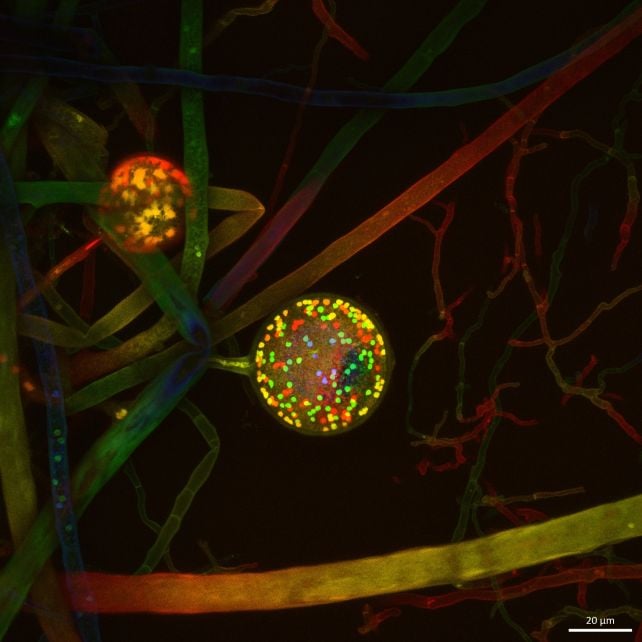
That network would weigh an estimated 300 million tons – that's four to six times the total living human biomass – and serve as a pathway for roughly 4 billion tons of carbon dioxide equivalent moving from plants into underground ecosystems each year.
But it was where these networks were strongest that presented the biggest surprise.
Rather than clustering most strongly in tropical rainforests, the highest densities were found in places like grasslands, prairies, steppes, and wetlands. An estimated 40 percent of the world's total AM fungal biomass is concentrated in these locations.
The researchers believe this is because herbaceous plants, such as grass, channel more carbon to mycorrhizal fungi than woody plants do.
A more worrying finding is that fungal network density was, on average, 47 percent lower in cultivated croplands.
This is likely related to the use of fertilizers such as phosphorus and nitrogen, as well as fungicides and farming practices that limit fungal presence – but the long-term consequences could be a reduced soil capacity for carbon storage and nutrient transport.
However, there's a lot we still don't know.
Large parts of the world remain poorly sampled, including deserts, tropical forests, and tundra. In addition, most measurements come from the uppermost soil, which means there are deeper layers that we understand little about.

All this makes it difficult to know exactly how much of the underground network has yet to be accounted for, and it's worth noting there is much we don't yet understand about the 'wood wide web'.
Related: This Weirdly Smart, Creeping Slime Is Redefining Our Understanding of Intelligence
Still, this effort represents the most complete map to date – shining a light on the hidden activity in the darkness beneath our feet, and showing us how much more we have to learn.
"Mycorrhizal fungi have shaped life on earth for hundreds of millions of years, but we still understand too little about how the infrastructure of these living transport systems is distributed across the planet," says mycologist Merlin Sheldrake of SPUN and the Vrije Universiteit Amsterdam.
"This study is an exciting step towards understanding how this planetary circulatory system operates and suggests ways that we can better work with fungi to help address many of the unfolding challenges of our times, from food security to climate change."
The research has been published in Science.