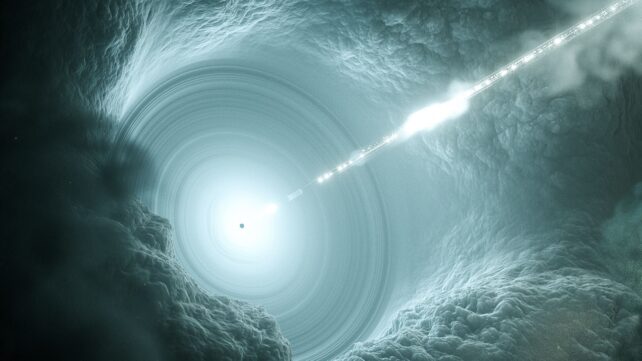
No matter how free we are, human existence will always be confined.
We cannot escape the dimensions of the classical Universe – three spatial directions and the inexorable march of time.
But gravity may not be bound by the same rules that apply to flesh and stone. It may bleed into a hidden, fifth 'dark' dimension beyond the brane to which matter is bound.
And if such a demesne exists, there may be objects whose gravity reaches into it, warping their geometry in ways that could give us a window into a plane our minds can barely perceive.
Such a window could take the form of primordial black holes – microscopic, but incredibly dense objects thought to have formed in the extreme conditions shortly after the Big Bang.
In fact, according to a new study led by physicist Luis Anchordoqui of Lehman College in the US, in a Universe with a dark dimension, all primordial black holes (PBHs) must be five-dimensional – barring some exotic, unknown new physics at low energies. They can't help themselves otherwise.
You're probably already familiar with the concept of black holes – ultra-dense objects that form from the collapsed cores of massive stars after they run out of fuel and go supernova. At the extreme heavyweight end of the scale are the supermassive versions around which galaxies revolve.
At the other end are the PBHs.
These comparatively dainty objects are too small to have formed from a stellar core; instead, physicists theorize that they were born from overdensities in the swampy primordial soup of the early Universe, in the first eyeblink of time after the Big Bang.
They remain hypothetical – no primordial black hole has ever been conclusively detected – but physicists are very interested in them. As relics of the infant Universe, they could preserve clues about conditions at a time in cosmic history we have very little ability to observe directly.
They've also long been considered a possible ingredient of dark matter, the mysterious source of extra gravity shaping how matter moves and clumps throughout the Universe.
And, according to Anchordoqui and his colleagues, if PBHs are small enough to probe physics on scales where an extra dimension becomes relevant, they could potentially tell us something about the dimensional structure of spacetime itself.
This is where the brane comes in.
Imagine you're holding a sheet of paper with a stick figure drawn on. That figure can move up and down and side-to-side, but it is stuck in two dimensions – it cannot rise up off the sheet of paper, nor can it easily conceptualize the world beyond it.
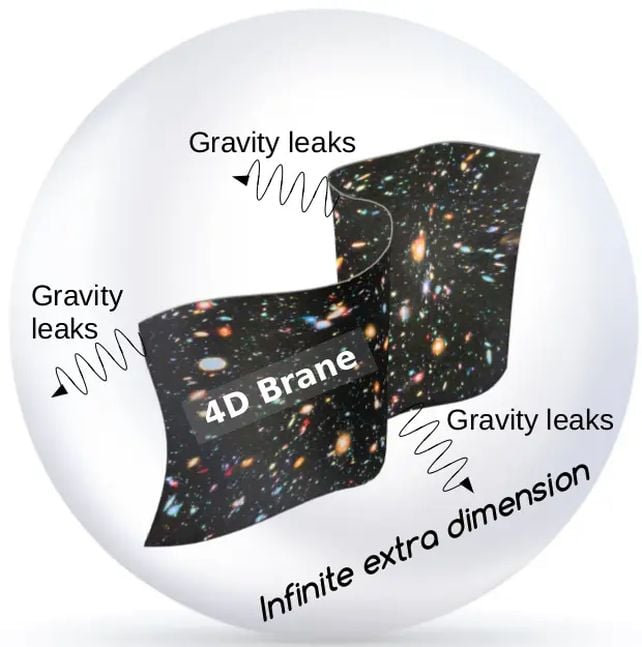
Now imagine that our own plane of existence similarly sits within a higher-dimensional space.
The three spatial dimensions we experience, together with time, form a four-dimensional brane embedded within a higher-dimensional space physicists call the bulk.
And just as the two-dimensional being has difficulty picturing a third spatial dimension beyond its plane, so too are we stymied when trying to imagine a fourth spatial dimension beyond our own.
The dark dimension scenario proposes that such a dimension exists, but is compactified to a tiny scale of roughly a micron. (Compactification basically means that, unlike the familiar dimensions of space, the extra dimension is finite.)
The particles that make up ordinary matter are stuck on the brane, unable to venture beyond it.
But gravity may not be subject to the same constraints.
And while a micron is pretty tiny to you or me – it's a millionth of a meter – to a sufficiently microscopic PBH, it's rather more significant.
Normally, physicists treat black holes as four-dimensional objects, whose extreme gravity strongly warps the three dimensions of space and one of time. It's a model that works very well for the macro-scale black holes we see throughout the Universe.
Shrink a black hole down small enough, though, and the picture changes. If the size of the event horizon becomes small compared with the scale of the dark dimension, the black hole's gravity can extend into that extra spatial direction.
That black hole is no longer confined to four dimensions; its geometry becomes five-dimensional.
Anchordoqui and his colleagues wanted to know what that would mean for PBHs – specifically, whether the different processes thought capable of producing PBHs in the early Universe would leave behind four-dimensional or five-dimensional objects.
There are several ways scientists think that the wild west of the early Universe could have birthed PBHs. The researchers focused on two: violent phase transitions as the infant Universe cooled, and the collapse of hypothetical spacetime defects called cosmic strings.
And whichever way they sliced it, the PBHs ended up in the fifth dimension.
For the first, it's important to know that the early Universe cooled extremely quickly, which may have resulted in abrupt phase transitions – like vapor condensing into liquid, or liquid flash-freezing into ice.
Rather than rearranged water molecules, though, the result would have been patches of primordial Universe stuff dense enough to collapse into itty-bitty black holes.
The researchers calculated, based on estimates of the temperatures involved, whether these PBHs would have been big enough to be four-dimensional. The answer was a big chunky nyet.
At their tiny size, the four-dimensional configuration would become unstable, forcing the PBHs to evolve into five-dimensional objects – a process known as the Gregory-Laflamme instability.
Cosmic strings provide a different route to much the same destination. These hypothetical defects in spacetime could have formed loops in the early Universe that contracted under their own tension and eventually collapsed into black holes.
Here, the calculations were even more decisive: Under the dark dimension scenario, PBHs produced by collapsing cosmic strings would be five-dimensional from birth.
The idea is not just a fun theoretical romp, though. That extra dimension would change how the black hole lives its life.
Black holes gradually lose mass through Hawking radiation, with smaller black holes evaporating especially quickly.
But five-dimensional black holes would evaporate more slowly than their four-dimensional counterparts – and the team calculated that some PBHs born from cosmic strings could have lifetimes comparable to the 13.8-billion-year age of the Universe.
Which means that there could still be some of them out there in the Universe around us, reaching the ends of their lives and completely disappearing in a puff of particles.
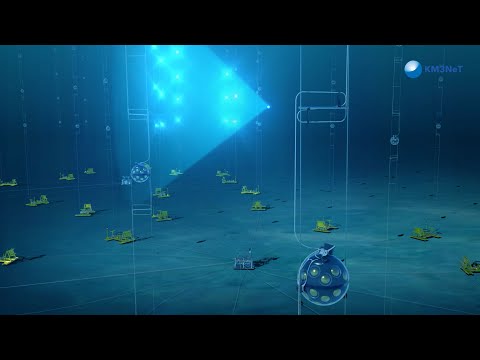
The researchers even suggest that such an evaporation event could potentially explain an extraordinarily energetic neutrino detected by the KM3NeT observatory.
A five-dimensional PBH could emit particles into the bulk, which could subsequently produce a neutrino on our brane – potentially explaining why no corresponding high-energy photon was seen from the same direction.
That's highly speculative. Neither PBHs nor the dark dimension have been demonstrated to exist, and the researchers acknowledge unresolved problems with interpreting the KM3NeT event this way.
But that's kind of also what makes PBHs so interesting.
If they exist, these tiny relics of the infant Universe may preserve information about physics operating at scales and energies we cannot recreate – and perhaps even dimensions we cannot enter.
We just have to catch one before it disappears forever.
The findings will be published in Physical Review D on September 28.
This article was fact-checked by Rebecca Dyer and edited by Rebecca Dyer. While we pride ourselves on our process, we are only human. If you spot a mistake, please let us know.