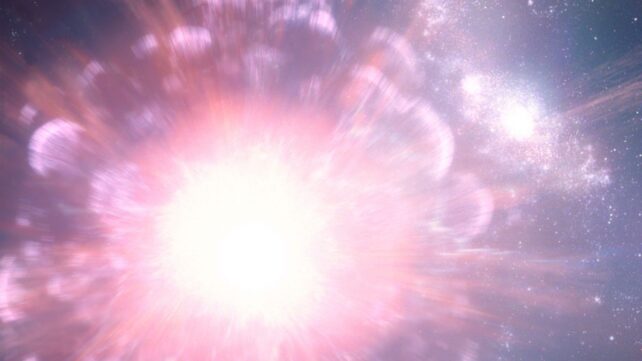
A faint, tiny flash of red light glimpsed at the Cosmic Dawn more than 13 billion years ago has smashed the record for the earliest supernova ever observed.
It appeared just 720 million years after the Big Bang, smack bang during the Epoch of Reionization, soaring past the previous record-holder, a supernova that exploded when the Universe was 1.8 billion years old.
And here's the kicker: The light from the new record-breaker wasn't even boosted by the massive gravitational bending of space-time usually needed to magnify light that distant.
It gets even wilder, though. According to a new analysis of JWST data, the event was just a normal, bog-standard supernova, with no peculiarities that would make it brighter than usual.
Related: We Finally Know What Switched on The Lights at The Dawn of Time
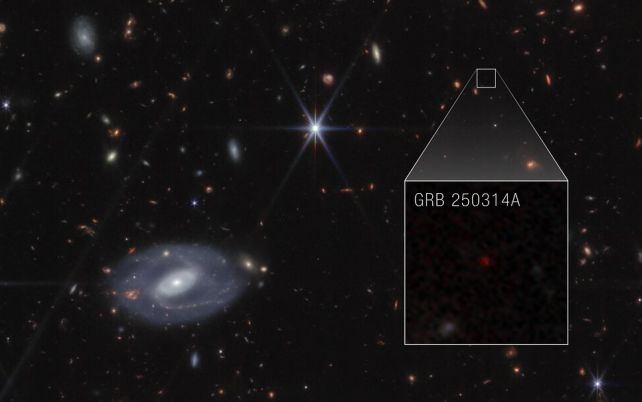
The discovery began with a detection made by the joint French-Chinese satellite, Space Variable Objects Monitor (SVOM), which monitors the sky from its Earth orbit to look for the brightest events in the Universe, gamma-ray bursts. These intense explosions of gamma radiation release more energy in a few seconds than the Sun will in its entire lifetime.
On 14 March 2025, SVOM's instruments detected a flash of light that, on closer inspection, looked like only the brightest peak of a long-duration gamma-ray burst seen across great distances, with the dimmer ends of the light curve trailing off beyond the detection threshold.
Follow-up observations using a range of instruments, including NASA's Neil Gehrels Swift Observatory, the Nordic Optical Telescope, and the European Space Agency's Very Large Telescope, pinpointed the burst and confirmed its distance: GRB 250314A was spotted at a redshift of 7.3, roughly 720 million years after the Big Bang.

"There are only a handful of gamma-ray bursts in the last 50 years that have been detected in the first billion years of the Universe," says astronomer Andrew Levan of Radboud University in the Netherlands. "This particular event is very rare and very exciting."
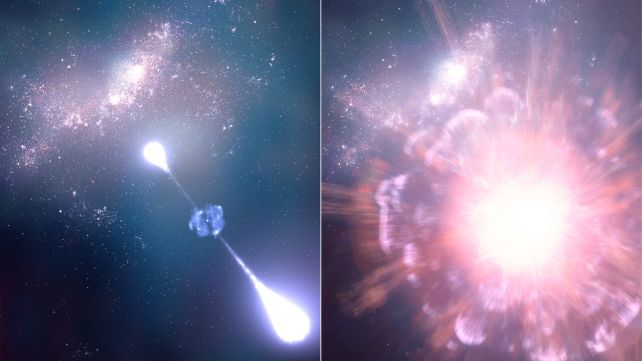
Gamma-ray bursts are broadly sorted into two categories. The long-duration bursts are associated with core-collapse supernovae, the violent deaths of massive stars whose cores implode under gravitational stress and transform into black holes or neutron stars.
This generates light across a range of wavelengths that typically peaks in brightness some time after the initial event, usually a few weeks.
So, once GRB 250314A had been identified and its distance across time and space confirmed, astronomers booked time with JWST to observe the source just when the separate supernova outburst should be peaking.
However, the expansion of the Universe creates a cosmic time dilation effect that the researchers needed to take into account, which meant that the supernova peak was observable a few months after the initial gamma-ray burst observation.
"Only Webb could directly show that this light is from a supernova – a collapsing massive star," Levan says. "This observation also demonstrates that we can use Webb to find individual stars when the Universe was only five percent of its current age."
Surprisingly, the observations from JWST revealed a supernova that was pretty much what we'd expect to see in a supernova from the nearby, recent Universe.
"We went in with open minds," says astronomer Nial Tanvir of the University of Leicester in the UK. "And lo and behold, Webb showed that this supernova looks exactly like modern supernovae."

This matters because the event took place at a critical time in the Universe's history, when radiation from stars and galaxies was still in the throes of ionizing the early Universe's thick, opaque fog of neutral hydrogen – a process that turned space transparent, allowing light to propagate freely.
Scientists have long wanted to know what these ionizing stars and galaxies looked like, and how they may have differed from the stars and galaxies that came later.
The supernova associated with GRB 250314A suggests that at least some of the stars during the Epoch of Reionization were similar to stars in more recent times.
This also suggests that we shouldn't expect gamma-ray-burst supernovae in the early Universe to be significantly brighter than more recent examples – a revelation that may lead to the discovery of more of these dim events, deep in the cosmic dark age.
Descriptions of GRB 250314A and the subsequent supernova have been published in Astronomy & Astrophysics, here and here.