
It's entirely normal and healthy to be a little self-involved from time to time. But for some individuals, a preoccupation with the self can become excessive, impacting daily life and relationships in pathological ways.
Narcissistic personality disorders are rare, yet their traits have long fascinated scientists.
Despite decades of research, it remains unclear what causes a grandiose view of the self and a strong sense of entitlement, whether it be family history, early childhood experiences, or a bit of both.
It's the classic nature-versus-nurture debate, and twin studies are among the best ways to untangle the complex knot of contributing factors.
Now, data from a large and extended twin family study in Germany suggests that narcissistic tendencies are impacted by genetics more than a shared family environment.
The findings challenge existing psychoanalytical explanations, which argue that 'cold', critical parenting, or praise that sets unrealistic expectations in childhood, play strong roles in driving the development of narcissistic personality traits.
"Narcissism runs in families," the researchers conclude, "but mainly due to genetics."
Their study considered the life experiences, personality traits, and genetics of more than 1,300 pairs of twins, plus their parents, partners, and any non-twin siblings in their families.
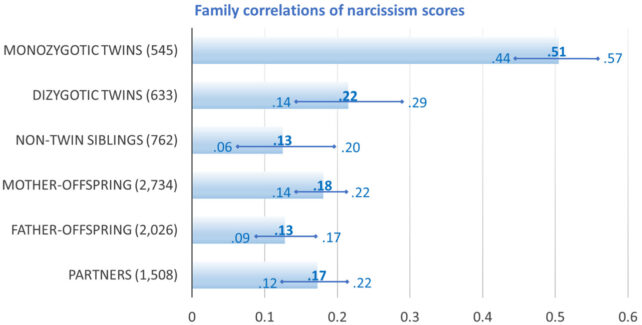
"Additive genetic effects act to make monozygotic twins more similar to each other than dizygotic twins," the authors explain.
"Furthermore, two kinds of environmental effects can be estimated, those due to environmental factors shared by both monozygotic and dizygotic twins and those due to factors not shared by twins."
Each participant took a personality test, where they were asked how much they agreed or disagreed with a series of statements.
Adult participants were asked to rank, on a scale of 1 to 9, how much they agreed with statements like "I tend to want others to admire me"; "I tend to want others to pay attention to me"; and "I tend to seek prestige and status."
Younger participants ranked on a scale of 1 to 5 how much they agreed with things like "I am really a special person" and "I am good at getting people to do things my way."
Ultimately, parents and children were similar in their narcissism scores, but the authors of the study say this association was "entirely genetically driven".
Shared environmental factors, like parenting styles or socioeconomic status, played only a "minor role".

_edited.jpg)
There are different types of narcissism, but traits often include an extreme sense of self-importance, a need for admiration and attention, and an inability to fully connect and empathize with others.
Psychologists often explain these traits by arguing that they cover up for insecurity or low self-esteem, developed during childhood. Treatment often includes 'talk therapy', aka psychotherapy. But perhaps these traits have less to do with learned behaviors than is assumed.
There needs to be a "fundamental shift in the search for the sources of narcissism – with regard to genetics, relevant environmental factors, and the interplay of genes and environments," write the authors of this new twin study, led by psychologist Mitja Back from the University of Münster.
To the team's knowledge, no genome-wide association studies have ever included measures of narcissism. This means we have little way to say how genetic variants may impact narcissistic traits.
A twin study from 1993 included just 175 pairs of twins, and it found that genetic heritability was estimated to be around 60 percent.
But this new study is much larger. It reveals that genetics and individual environmental factors (experiences not shared by both twins) each explain 50 percent of the variance in narcissistic traits.
For instance, interactions with peers at school during childhood are formative influences but often differ greatly between siblings.

In contrast, there was no evidence that shared environmental experiences, such as the home environment, were tied to narcissism. This could imply that parenting styles may not be a strong driving factor, after all – as long as they treat their kids the same way.
Further research needs to tease apart these various nuances.
Related: Narcissists Seem Drawn to Conspiracy Theories, But Why?
"More detailed knowledge of genetic and environmental factors and their interplay that drive individual differences in narcissism will further transform our understanding of narcissism," the authors conclude.
"This will be essential for developing more effective means for dealing with narcissistic individuals in applied contexts, such as in psychotherapy, the workplace, and everyday life."
The study is published in Social Psychological and Personality Science.