
The fundamentals of light continue to fascinate scientists and reveal new secrets – including how its effects can be counterintuitive.
Conventional wisdom suggests that light adds energy to heat up particles or set them in motion.
But scientists just caught light doing the opposite: acting as an invisible brake at scales almost too small to imagine.
In a new study published in Nature, researchers led by a team from Ruhr-University Bochum in Germany found that fluorescent carbon-mesh nanotubes move much more slowly when irradiated with light in an aqueous solution.
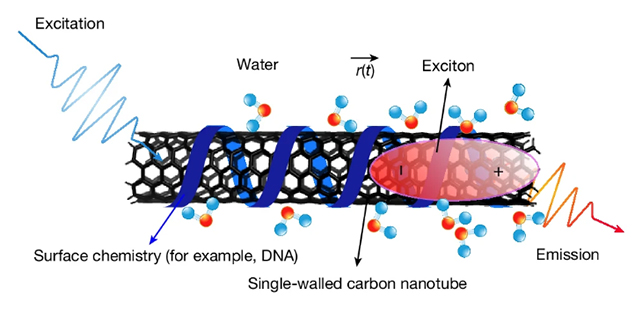
The brighter the light, the slower the movement, or specifically, the lower the diffusion constant, a measure of how freely a particle moves through a liquid.
This is at least partly due to 'quantum friction', the researchers determined.
Quantum friction is a recently discovered phenomenon, and scientists are only just beginning to understand what it can do.
"This discovery of light-induced quantum friction fundamentally changes our understanding of interfacial processes," says physical chemist Sebastian Kruss, from Ruhr-University Bochum.
"Our experiments show that the diffusion decreases when we increase the light intensity."

These nanotubes really are nano – 100,000 times thinner than a human hair – and the researchers suspended them individually in water.
A microscopic analysis showed that with added light, the nanotubes behaved as if they were moving in a thicker liquid.
The idea was to try and get a closer look at quantum friction, the drag that arises when fluctuating electrical charges inside a solid material couple with the molecules of a surrounding liquid.
As the nanotubes glowed and slowed down under the light, the researchers observed that excitons were being created inside the nanotube: paired energetic particles (made of an electron and a 'hole' where an electron used to be).
These excitons couple with the surrounding water molecules, transferring momentum.

"What's fascinating is that this effect vanishes entirely when we use nanotubes in which the electronic excitations that lead to the fluorescence – known as excitons – are slowed down at defects," says Kruss.
"This means it is the mobility of the excitons along the nanotube that is in direct exchange with the environment and creates this decelerating effect."
A technique known as terahertz (THz) spectroscopy was used to detect molecular-level activity.
THz uses electromagnetic waves to measure molecular energy and motion – in this case, the transfer of energy to water.

"A tiny but measurable transfer of momentum takes place," says theoretical physicist Marialore Sulpizi, from Ruhr-University Bochum.
"The water is not a smooth medium for the illuminated nanotube, but instead there is resistance on the surface that slows the movement."
From what we know of quantum friction so far, it differs from standard friction – the bumping and grinding of two surfaces against each other – in that it operates at the electron level. No actual physical contact is required: it's the fluctuating, interacting electrical charges that cause friction.
And that's what's in evidence here. As the moving charges within the nanotube interact with water molecules, everything slows down.
Essentially, the light acts as a brake on the material.
The experiments also reveal a blurring of the boundaries between solid physics and liquid physics at the nanoscale. It's well established that at the smallest scales, quantum weirdness begins – and this is the latest demonstration.
Related: Scientists Create The Thinnest Lens on Earth Using Quantum Physics
Real, practical uses could come from the findings if researchers can control friction with light.
Examples given by the study team include guiding the movement of nanorobots through a liquid, and precisely altering the conditions of chemical reactions.
"This knowledge that we can control the friction at the interface with the liquid via electronic excitation in the solid, opens up entirely new doors in materials science and nanotechnology," says physical chemist Martina Havenith, from Ruhr-University Bochum.
The research has been published in Nature.
This article was fact-checked and edited by Rebecca Dyer. While we pride ourselves on our process, we are only human. If you spot a mistake, please let us know.