
One of the most famous hominin fossils may not be as familiar as we thought. The specimen, affectionately dubbed "Little Foot", could represent an entirely new species.
Discovered in Sterkfontein cave in South Africa, Little Foot is believed to be the most complete skeleton of an ancient human ancestor ever found, but pinning down its identity and its age has been surprisingly tricky.
Scientists generally agree that Little Foot belongs to the Australopithecus genus, but disagree on which species. Some say it's a member of the well-known A. africanus, while its discoverers suggested it should be attributed to the dusty old category of A. prometheus.
Related: 'Lucy' Was Neighbors With an Even Older Human Ancestor, Fossils Reveal
A new study, led by paleoanthropologist Jesse Martin at La Trobe University in Australia, proposes that neither label is quite right.
"Our findings challenge the current classification of Little Foot and highlight the need for further careful, evidence-based taxonomy in human evolution," says Martin.
"We think it's demonstrably not the case that it's A. prometheus or A. africanus. This is more likely a previously unidentified, human relative."
Formally designated StW 573, the specimen earned the nickname Little Foot because the first traces of it were four small ankle bones, discovered in Sterkfontein in 1980. They languished in storage for over a decade before being analyzed by paleoanthropologist Ronald Clarke, who identified them as belonging to an Australopithecus.
Leading a team of scientists back to the cave in 1997, Clarke found the rest of the remains in the form of an incredibly complete skeleton partially embedded in the wall. It took another 20 years to fully excavate it from the tough, concrete-like rock in which it was entombed.
Once the body had been fully revealed, the team proposed that Little Foot wasn't an A. africanus, as initially thought. Instead, they attributed it to A. prometheus, reviving a long-defunct name originally coined in 1948 to accommodate fossils from a particular dig site in South Africa.
In the new study, scientists closely compared the anatomy of Little Foot to specimens of A. africanus, as well as the only fossil attributed to A. prometheus – a small skull fragment designated MLD 1.
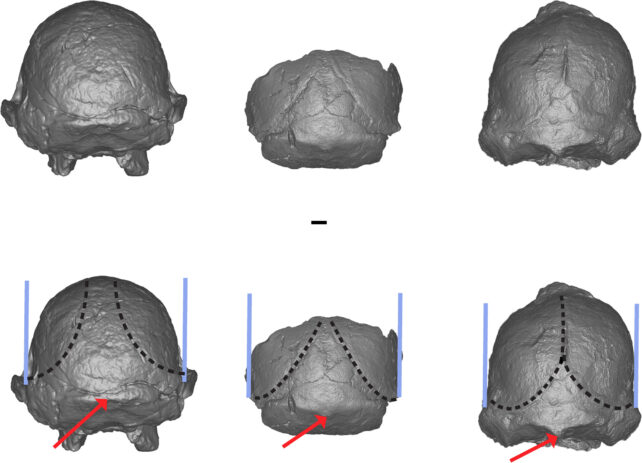
Using a 3D scanner, the team created digital reconstructions of Little Foot, MLD 1, and two A. africanus specimens, which were accurate to a resolution of 300 micrometers. They found at least five anatomical differences between Little Foot and MLD 1.
"There is, therefore, no morphological justification for aligning StW 573 with MLD 1," the researchers write, "and on this basis the assignment of StW 573 to A. prometheus is not warranted."

The team goes even further, however, claiming that MLD 1 doesn't differ in any meaningful way from known A. africanus specimens. As cool as the name is, A. prometheus should probably just be rolled into A. africanus as a junior synonym – something that many scientists already argue.
However, that still leaves the question of Little Foot's identity. The specimen didn't share many traits with MLD 1 and the other A. africanus specimens, leading the team to suggest it may belong to another, as-yet-unknown species of Australopithecus.
The researchers stop short of proposing a name or formal definition of the new species, opting instead to leave that honor to "the research team that has spent more than two decades excavating and analyzing the remarkable Little Foot specimen."
The research was published in The American Journal of Biological Anthropology.