
Dementia is often associated with older people, but it doesn't just appear out of nowhere.
Some risk factors may begin before we're even born, while others emerge as we progress through childhood into young adulthood.
According to research, that could be the best time to start intervention.
Previous studies have identified a variety of modifiable risk factors for dementia, but modifying them after neurodegeneration has set in isn't much help, encouraging researchers to look to life's earliest moments for actions that could one day make a difference.
A study conducted in 2023 by researchers in Sweden and the Czech Republic identified a handful of birth factors associated with a slightly increased risk of dementia later in life.
While some, such as sharing the womb with a twin, are beyond anyone's control, others – such as a shorter spacing between births, and falling pregnant over the age of 35 – may weigh into parental decision making.
You can watch a summary of some of the research in this video:

Another study published in late 2024 examined risk factors among younger adults aged 18 to 39 years.
A team led by the Global Brain Health Institute (GBHI) in Ireland convened a group of experts from 15 countries to help develop a lifelong plan to boost brain health.
"Young adulthood represents a pivotal window for intervention that could significantly reduce the risk of dementia later in life," said Francesca Farina, neuroscientist at GBHI.
"To secure healthier brain outcomes, young adults must be included as key partners in research, education, and policymaking efforts."
Of the risk factors identified by the researchers, some are related to lifestyle, including excessive drinking, smoking, physical inactivity, and social isolation.
Others are environmental, such as pollution exposure, traumatic brain injuries, hearing or vision loss, or a low level of education. And others, like obesity, diabetes, hypertension, LDL cholesterol, and depression, are health issues that may arise from lifestyle choices.
Ultimately, the researchers suggest many of the risk factors are steps we could take to help lower our risk of developing dementia, which may begin to grow far earlier in our lives than many people realize.
"Could the roots of dementia stretch as far back as childhood or infancy? Increasing evidence suggests yes, and that risk factor exposures in the first decade of life (or even while in the womb) may have lifelong implications for dementia risk," the team explained in an article published last year in The Conversation.
"Most dementia research understandably focuses on changes associated with [age-related cognitive] decline in later life. But there is increasing evidence that many of the differences in brain structure and function associated with dementia in older adults may have at least partly existed since childhood."
According to the team, there are numerous examples of this.
"In long-term studies where people have had their cognitive ability tracked across their whole lives, one of the most important factors explaining someone's cognitive ability at age 70 is their cognitive ability when they were 11," the study authors explained.
"That is, older adults with poorer cognitive skills have often had these lower skills since childhood, rather than the differences being solely due to a faster decline in older age."
Another potential signal is evidence of brain injuries or abnormalities in later life that may relate to incidents or behaviors in youth.
"Similar patterns are also seen when looking for evidence of dementia-related damage on brain scans, with some changes appearing to be more closely related to risk factor exposures in early life than current unhealthy lifestyles," the authors explained.
"Taken together, perhaps the time has come for dementia prevention to be thought of as a lifelong goal, rather than simply a focus for old age."
In their 2024 study, some of the identified risk factors may seem obvious. Drinking and smoking, for instance, are known to be bad for health in general, and sustaining a brain injury is a direct risk for later dementia.
But others take a more winding route – losing hearing or vision, for example, is also tied to dementia, possibly because of brain degeneration or social isolation.
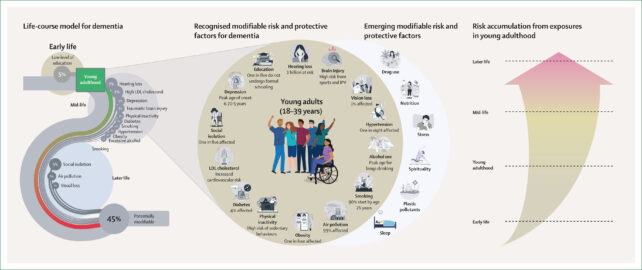
Knowing the risks is one thing, but mitigating them is tricky. The researchers suggest that the issue could be best addressed by identifying factors at the individual, community, and national levels.
Helping people at the individual level involves raising awareness of the importance of brain health and risks, the team says.
This could be done with public health campaigns and education at school, and funded through taxation of substances that negatively affect brain health, such as alcohol or cigarettes.

At the community level, the team recommends developing an advisory council of diverse young adults to "function as a liaison with local governments to provide contextual knowledge around brain health in the community."
And at the national level, the panel suggests creating and committing to a brain health charter to keep people on track for better brain health throughout their lives.
"There is a real appetite for young adults to learn more about their brain health – they are highly aware of cognitive and neurodiversity, with many identifying with diagnoses like ADHD or autism," said GBHI social gerontologist Laura Booi.
"This awareness drives their strong interest in understanding and improving their brain health."
Related: Weight-Loss Drugs May Reduce Buildup of Alzheimer's Proteins, Major Review Finds
The identified factors aren't static, either.
The team says that emerging factors require further study, including ultra-processed foods, drug use, screen time, stress, and exposure to microplastics.
The research was published in The Lancet: Healthy Longevity.
An earlier version of this article was published in December 2025.