If you want to know torment, speak to a sufferer of tinnitus.
More than one in 10 people are walking around with persistent and uncontrollable ringing, clicking, buzzing, or hissing that only they can hear – and no reliable treatment to help them switch it off.
But according to a new review published in Hearing Research, psilocybin, a compound found in magic mushrooms, could point to a new way to help turn these sounds down.
As unusual as that sounds, the potential effect actually has nothing to do with the psychedelic aspect of the drug.
Early evidence suggests psilocybin could actually rebalance the brain cells that process sound.
Notably, in a 2024 experiment that's awaiting peer review, Canadian researchers gave mice a dose of psilocybin and studied the effect sound then had on the animals' brain cells.
When given psilocybin, the mice didn't learn to 'tune out' familiar sounds as well as they otherwise did, suggesting a direct impact on the pathway believed to be interrupted in tinnitus.
"With further research, influences of psychedelics on sensory representations could be harnessed to target maladaptive sensory processing in conditions such as tinnitus," the researchers write in their pre-print paper on bioRxiv.
But before we get ahead of ourselves, let's take a step back and look at what we know about tinnitus so far.
While the condition remains a mystery with no direct treatments available, scientists have evidence that the problem isn't in the ears, but in the brain.
Research has shown that tinnitus has important links to sleep and the neurotransmitter serotonin, which is better known for its role in regulating mood.
Our best understanding of tinnitus is that somehow, in those with the condition, the brain gets stuck perceiving a phantom sound as new and important, rather than learning to tune it out.
This brings us back to the mouse study in Canada, where researchers at McGill University showed psilocybin impacted the same pathway in the brain.
But in this case, psilocybin stopped the brain from doing what scientists call "habituation" – where the brain files something away as background noise and no longer pays attention to it.
Instead, in mice genetically engineered to have their neurons light up when active under a special microscope, the researchers observed psilocybin preventing that habituation from happening.
When dosed with psilocybin, the mice kept hearing every sound as if for the first time, and their sensitivity to low-intensity sounds remained high. Whereas when the mice received only saline as a control, their brains filtered out repeated sounds and became less attentive to them.
But here's an important note: There was no evidence that psilocybin was causing wider impacts on sound processing. The psychedelic didn't appear to be 'rewiring' sound processing pathways in the brain, but rather had an effect on which sounds the brain filters out or pays attention to.
Of course, this is just one study in mice, and it's yet to be peer reviewed. But it's a link worth exploring further, according to a recent review published in the journal Hearing Research that looked at dozens of papers to assess psilocybin's potential impact on tinnitus symptoms.

The scientists behind the review, from Chinese PLA General Hospital, looked at several mechanisms where psilocybin and tinnitus overlap in the brain.
One of the most compelling is in the role of glutamate (a neurotransmitter that 'excites' brain cells) and GABA (a neurotransmitter that calms the brain down).
Previous research has linked tinnitus to an imbalance of this 'excitement/calm down' system in the brain. Basically, there's not enough GABA to calm the brain, allowing excitatory activity to build up.
This means hearing-related neurons can start firing on their own, without any real sound triggering them – and the brain interprets that internal noise as a real sound.
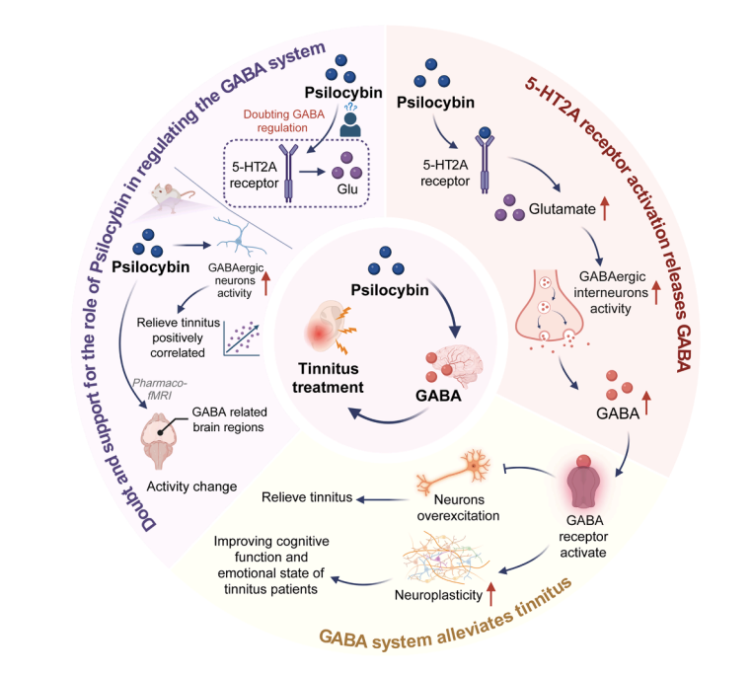
Among other mechanisms, the review authors point out that psilocybin is also known to mess with this pathway.
But instead of getting stuck with the volume knob up, psilocybin results in an increase in glutamate, which triggers the release of more GABA. Essentially, it resets the system.
All of this results in the brain getting less stuck in its ways – an effect that could potentially stop the brains of people with tinnitus from getting fixed on a phantom sound, the researchers suggest.
To be clear, none of this is a clinical trial that says psilocybin will definitely help tinnitus. Context is important.
Instead, it's an important review of the research so far that encourages scientists to continue researching this connection.
"Through these investigations, we can better understand psilocybin's therapeutic potential," the researchers write, "providing scientific grounds for developing novel treatment protocols and offering more effective therapeutic options for tinnitus patients".
And that's important. Right now, the best most tinnitus sufferers can hope for is an imperfect mix of antidepressants, anticonvulsants, or vasodilators – drugs that come with real side effects and only sometimes work.
Psilocybin, on the other hand, is already showing promise in human trials for depression, anxiety, and addiction, where single doses can have lasting effects.
Related: Tinnitus Is Somehow Connected to a Crucial Bodily Function
If we see more evidence that this compound can reshape how the brain decides what's worth listening to, millions of people living with tinnitus may finally be a step closer to the sweetest sound of all: silence.
The review paper has been published in Hearing Research.
This article was fact-checked by Rachel Garner and edited by Clare Watson. While we pride ourselves on our process, we are only human. If you spot a mistake, please let us know.