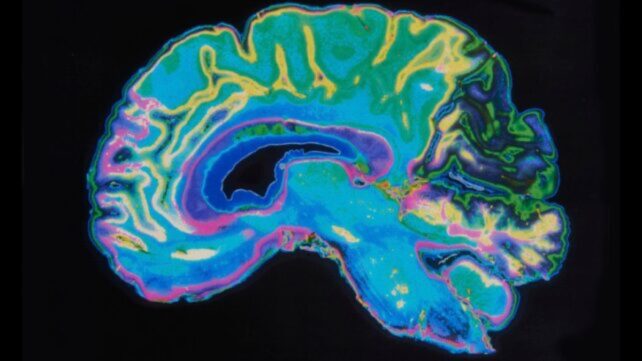
The female brain does something unexpected in the transition to menopause.
It's entirely natural for gray matter in the brain to gradually shrink as a person ages.
But when menopause arrives, the brain's normal aging seems to be temporarily altered.
The first brain scan study of its kind has now found that when the transition to menopause begins, the gradual loss of cortical volume that occurs with age inexplicably slows.
No one yet knows why that is.
"Surprisingly, whole brain gray matter change had never been examined across the menopause transition before," wrote lead author and cognitive neuroscientist Sophie van 't Hof from the Amsterdam University Medical Center in the Netherlands on LinkedIn, "so we did."
Van 't Hof and colleagues repeatedly scanned the brains of more than 1,000 participants at various stages in life, including those undergoing puberty, and those before and after pregnancy and menopause.
Each phase of life came with distinct brain changes.
During puberty and pregnancy, for instance, cortical gray matter loss was accelerated. Brain scans revealed widespread reductions in volume during these key transitional life phases.
That might sound concerning, but it signals that the brain is reorganizing its finite tissue for a new phase of life.
Menopause was different.
It showed a distinct pattern of brain changes that was in direct opposition to puberty and pregnancy.
When the transition to menopause first began, natural losses in total cortical volume and gray matter curiously came to a halt.
"Menopause, in other words, is defined not by what changes," wrote van 't Hof, "but by what does not."
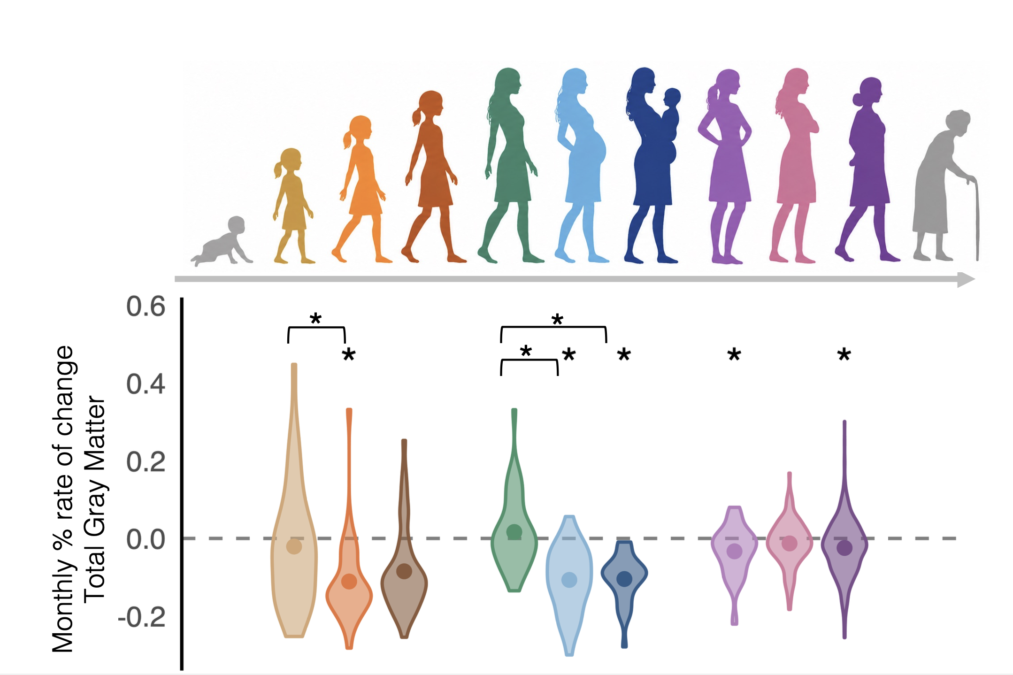
During puberty and pregnancy, the female body experiences profound hormonal changes, and there is an especially steep rise in estrogens and progesterone, which can bind to receptors in the brain.
At this time, the loss of cortical gray matter also accelerates.
When menopause begins, however, sex steroid hormones decline, as do gray matter losses.
Perhaps these two synchronous changes are somehow linked.
For now, however, that's just speculation. Brain scans can only reveal associations between neurological volume and the different stages of life.
They can't show that hormonal changes are causing brain remodeling, or vice versa.
In the current study, participants self-reported their stage of menopause, and their hormone levels were not measured.

That said, the brain scans were repeated over several years, which strengthens the results.
At the start of the study, some participants had not yet started menopause, but by the end of the study, they had.
In their brain scans, this transitional group did not show the same declines in gray matter as women pre-menopausal throughout the study, or those who were post-menopausal throughout.
These results were consistent regardless of a person's age, whether they were using hormone replacement therapy, or how many children they had.
Their brain patterns largely stayed the same.
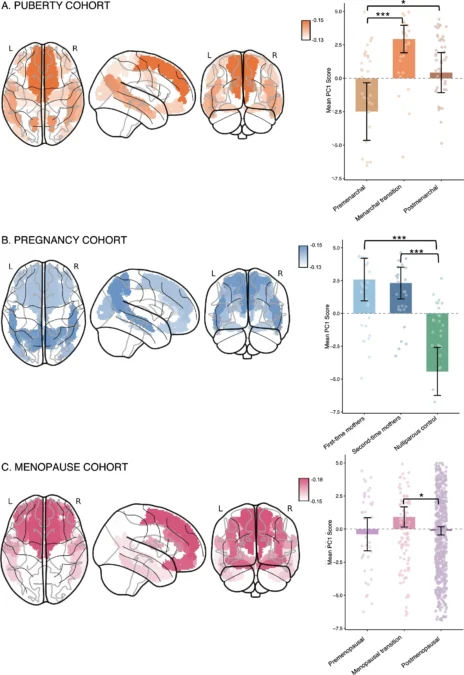
During the menopause transition, changes tended to occur in parts of the brain known to be influenced by estrogen, though estrogen receptors are widespread.
That is a clue, but in a press conference on the results, van 't Hof said "the exact implications are very difficult" to parse at this stage.
Today, very little is known about how menopause impacts the human brain.
In neuroscience research, only 2 to 6 percent of studies are conducted exclusively among females, and fewer than 5 percent treat sex as an analytic variable.
Just one other longitudinal brain scan study has examined the menopausal transition, and it focused solely on the hippocampus, which plays a role in memory and learning.
This 2018 study found that gray matter loss to the hippocampus accelerates during the transition to menopause.
The current research found something different.
This suggests a "possible attenuation of age-related decline" during the transition to menopause, the authors explain, though they add that "this interpretation should be treated as preliminary."
Related: Estrogen Loss in The Brain May Help Explain Women's Alzheimer's Risk
For now, they conclude, menopause seems to show a distinct degree of brain plasticity.
What that means for the female brain as it ages remains a mystery.
The study is published in Nature Communications.
This article was fact-checked by Rebecca Dyer and edited by Rebecca Dyer. While we pride ourselves on our process, we are only human. If you spot a mistake, please let us know.