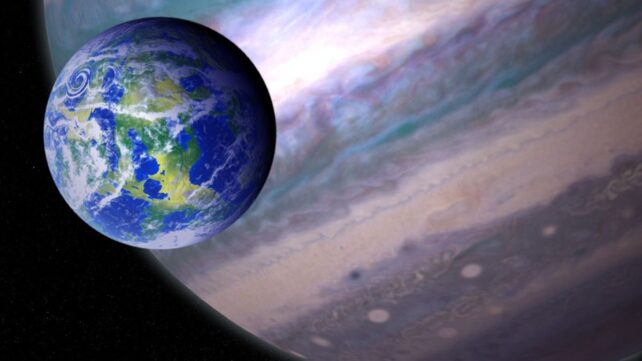
Planets drifting unmoored through interstellar space, with no star to call home, may still have moons that are warm enough to support life, a new study has found.
Through a combination of a thick hydrogen atmosphere and internal heating generated by tidal stresses from the gravitational interaction with its host planet, an exomoon could theoretically maintain liquid water conditions – a basic benchmark for habitability – for up to 4.3 billion years.
That's almost as long as the current age of Earth, ample time for complex life to emerge, develop, and evolve, says a team led by astrophysicist David Dahlbüdding of the Max Planck Institute for Extraterrestrial Physics in Germany.
"We discovered a clear connection between these distant moons and the early Earth, where high concentrations of hydrogen through asteroid impacts could have created the conditions for life," Dahlbüdding says.

Although planets are thought to usually form around stars, they don't always stay put. The early years of a planetary system can become gravitationally chaotic, and simulations suggest that a significant percentage of worlds get jostled out into interstellar space.
These rogue planets are very difficult to detect, but scientists think there are a lot of them out there. If there are 17 to 21 rogue planets for every star, as per a 2023 estimate, that puts the number of these wandering worlds in the trillions.
According to a 2025 paper, these rogue planets – at least the larger ones – can form their own systems of moons. It's also possible for a world ejected from a star's orbit to hang onto its moon, according to modeling.
Rogue planets themselves are not thought to be good places to look for life. One of the most critical ingredients for life on Earth is liquid water; there's no form of life that we know of that can exist without it.
To search for life, we must first search for the conditions suitable for liquid water. A world drifting through space with no star to warm it is unlikely to host those conditions – it's far, far too cold.
However, a star isn't the only thing that can generate warmth – and a rogue planet that has retained its exomoon might be able to warm that moon. During the process of ejection from a star, an exomoon's orbit around a rogue planet is likely to be shifted towards a more oval shape.
This means its proximity to the planet changes over the course of its orbit, which generates a push-pull of stresses deep in the exomoon's innards that heats it from within.
That, on its own, is not enough for habitability. There needs to be another ingredient that keeps the internal heat from radiating out into space. Previous models have solved this problem with a thick atmosphere of carbon dioxide that acts like a blanket, trapping heat inside.

However, in extremely cold environments, carbon dioxide condenses, allowing heat to escape relatively rapidly. A 2023 study found that a carbon dioxide atmosphere could maintain exomoon habitability for up to around 1.6 billion years.
This might be sufficient time for life to emerge, but insufficient for further development; it took until Earth was nearly 3 billion years old for life to evolve multicellularity.
So Dahlbüdding and his colleagues turned to an alternative model; what if, they asked, the atmosphere was not carbon dioxide, but hydrogen? Hydrogen stays gaseous even in extremely cold conditions and can trap heat effectively.
This is because, although infrared radiation mostly penetrates hydrogen without stopping, under high-pressure conditions, hydrogen molecules can collide with each other, creating complexes that absorb and trap thermal radiation.
When the team modeled exomoons with hydrogen atmospheres, conditions conducive to liquid water remained stable for up to 4.3 billion years in some cases.
Related: A Distant Spacecraft Has Confirmed That Earth Is Habitable
Of course, other conditions would need to be met for life to emerge and thrive, but as a starting point, this work shows that exomoon habitability is indeed plausible – that stars are not a requirement for conditions that could support life.
We don't currently have any instruments capable of probing the atmospheres of these moons, if we find any, but there are ways to test the idea further in the realm of theory.
"In future work, we will explore habitable configurations beyond a hydrogen-dominated atmosphere and test whether they are stable and can trap sufficient heat," the researchers write. "Increasing the complexity of the model … will allow us to better assess the habitability of these unseen worlds."
The findings have been published in the Monthly Notices of the Royal Astronomical Society.