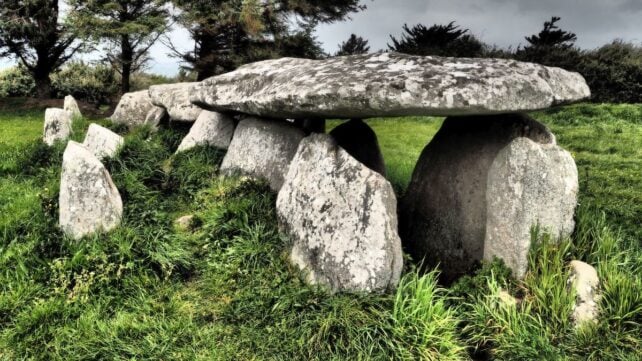
The growth of the human population has not always been a smooth ride, but has been punctuated by some strange fluctuations. At multiple points in our history, populations have dramatically imploded.
One such period occurred during the Neolithic, around 5,000 years ago, when communities collapsed across parts of Europe.
The reason – or reasons – for this widespread phenomenon have long remained something of a mystery, although several hypotheses for what scientists call the 'Neolithic decline' have been proposed.
Now, through the analysis of ancient DNA from 132 people interred in a tomb in what is now France, a team led by scientists from the University of Copenhagen is starting to piece together what actually happened.
"We can see a clear genetic break between the two burial phases. The people who used the tomb before and after the collapse appear to be two completely different populations," says geneticist Frederik Seersholm of the University of Copenhagen, the paper's first author.
"This tells us that something significant happened, like a major disruption that led to the decline of one population and the arrival of another."
The Neolithic decline took place around 3000 BCE. In the centuries prior, populations grew, hunting and gathering waned, technology proliferated, and agrarian societies blossomed.
However, something appears to have triggered a dramatic shift in population demographics. In many places, such as Scandinavia, local farming populations disappeared and were replaced by people with Eurasian steppe ancestry.
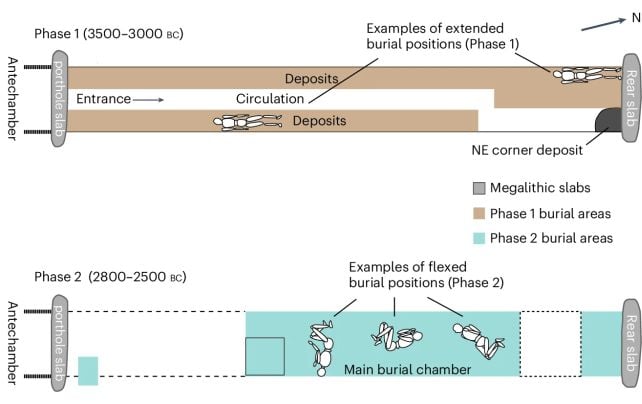
At a place called Bury, about 50 kilometers north of Paris in France, a large megalithic tomb known as a gallery grave, or allée sépulcrale, was used for collective burials around the time this upheaval occurred.
Although the effect of the decline in this region is less clearly understood than it is in others, the researchers thought it possible that the remains there might also show signs of the mortality event.
The tomb held the remains of hundreds of individuals, which previous analyses showed had been interred at two distinct phases, separated by a gap of several centuries, during which no burials occurred. This gap coincides with the period of the Neolithic decline.
The researchers extracted and sequenced 132 genomes from across both burial phases – and found the same pattern seen elsewhere in Europe. The population from before the Neolithic decline was genetically unrelated to the population that came after.
In addition, the first phase – from around 3200 to 3100 BCE – had an unusually high number of people who had died quite young.

"This kind of mortality pattern is not what we expect in a normal, healthy population," says archaeologist Laure Salanova of the French National Center for Scientific Research.
"It suggests that some catastrophic event may have occurred, such as disease, famine, or conflict."
The second phase, the researchers found, showed strong genetic ties to southern France and Iberia, suggesting a migration and resettlement from those regions into the Paris Basin following the Neolithic decline.
What caused the disruption remains unclear, but the evidence – including the new genetic clues – points to a perfect storm of multiple pressures rather than a single catastrophic event.
The researchers found DNA from several pathogenic bacteria in the remains, particularly in individuals from the first burial phase, including Yersinia pestis, the microbe that would go on to cause the Black Death thousands of years later, and Borrelia recurrentis, responsible for louse-borne relapsing fever.
Y. pestis has been found in other European remains from the time of the Neolithic decline, although its role in the event remains under debate.
"The presence of pathogenic DNA shows that infectious diseases were affecting human populations at this time," says genomicist Martin Sikora of the University of Copenhagen.
"While there is no strong case to say that plague alone caused the population collapse, the total disease load could have been one of several contributing factors."
Meanwhile, environmental data from the region shows forests regrowing during this period, reclaiming farmland – typically linked to a decline in human activity.
Related: The Black Death Shaped Human Evolution, And We're Still in Its Shadow
The relationships between the deceased were telling, too. Before the decline, the people buried were all closely related, implying a close-knit community made up of family groups.
After the decline, the relationships observed were looser, and more spaced out over time. This, the researchers say, may be indicative of a sparser population overall.
Taken together, the findings are strongly suggestive of a population under strain from multiple pressures, followed by a population turnover after those pressures eased.
Although it is not yet clear how closely this local pattern maps onto the broader Neolithic decline, it does paint a picture of a period of disruption that was widespread across the European continent.
"Continuing to develop clearer understandings of these regional foibles rather than reaching past them to grander narratives of change is bound to produce new, intriguing, and authentic accounts of Late Neolithic Europe," writes archaeologist Tom Booth of University College London in a related editorial.
The research has been published in Nature Ecology & Evolution.