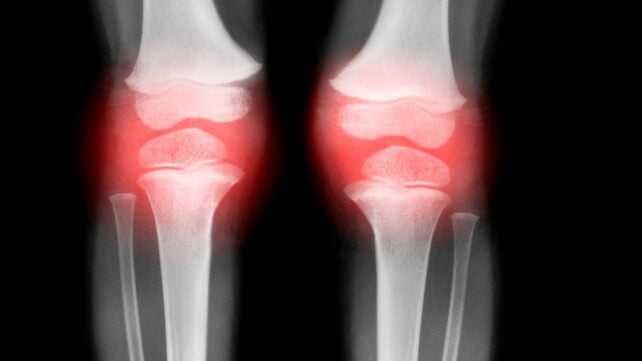
Pain, swelling, and stiffness in the knees can be downright debilitating.
As cartilage breaks down in these joints, it can significantly reduce freedom of movement and cause pain, even when standing still or sitting.
Surprisingly enough, core exercises may be a neglected form of treatment for knee osteoarthritis.
A randomized controlled trial in India has now found that working out the abdominal muscles may have a trickle-down effect for the knees.
Strengthening the abdomen won't stop cartilage from degenerating, but in this particular trial, when core exercises were added to typical rehabilitation programs, it improved physical function more than conventional exercises alone.
What's more, patients who did the core exercises also reported significantly less pain when moving about.
The findings are published in Scientific Reports, and while the study is small, the methodology was rigorously designed.
The trial involved 100 participants, aged 40 to 80, with mild to moderate knee osteoarthritis.
Roughly half the group were randomized to partake in conventional knee-focused rehabilitation for 12 weeks.
During the trial, this half of the group partook in 45 minutes of supervised exercise three times a week for four weeks.
Each session involved progressive strengthening, range-of-motion, and functional exercises, such as straight-leg raises and moves to strengthen the quadriceps.
Participants then continued these exercises at home on their own for an additional 8 weeks.
Meanwhile, the other half of the group was randomized to undertake a different rehabilitation program.
This one involved a mix of conventional knee-based rehabilitation exercises and progressive core-targeting exercises.
The core exercises included abdominal bracing, glute bridges, forearm planks, arm raises while lying down, heel taps, and alternating arm-and-leg movements similar to dead bugs.
After the 12-week intervention period, both groups demonstrated significant reductions in resting pain.
But it was the group that also partook in core training that demonstrated greater improvements in physical function tests and reported less pain when moving about.
Importantly, this group also reported greater improvements in their quality of life.
The authors of the study don't know why core training led to these benefits, but they suggest that an improvement in posture control may help stabilize the body's core during exercise, putting less strain on the lower limbs.
"Collectively," the team concludes, "these biomechanical adaptations provide a plausible explanation for the greater improvement observed in pain, physical function, and quality of life compared with conventional knee-focused strengthening alone."
The findings are supported by previous research, which also suggests that the core is a neglected part of knee pain.
In 2021, for instance, a peer-reviewed narrative review argued that despite preliminary findings that core training is beneficial for knee issues, more research is needed.
"Investigations that show it is safe and effective in older adults have not been adapted to/incorporated into treatment recommendations for those with knee osteoarthritis," the authors argued.
This year, the results of several randomized clinical trials have begun to roll in.
One trial among 48 patients with knee osteoarthritis in Pakistan, for example, also found that adding core stability training to knee exercises produced greater improvements in pain, knee mobility, and quality of life after 12 weeks.
Plus, a larger study of 100 patients found that adding core exercises to conventional knee rehabilitation was more effective than adding foot-and-ankle strengthening.
That seemed to be particularly true for outcomes like pain and physical function.
These randomized trials are small, but their findings suggest that exclusively targeting the joints during osteoarthritis treatment may not be the best move.
The whole body is connected, and the function of our extremities is founded upon the stability of our trunk.
Ab exercises may help cut to the core of the issue.
The research has been published in Scientific Reports.
This article was fact-checked by Rebecca Dyer and edited by Rebecca Dyer. While we pride ourselves on our process, we are only human. If you spot a mistake, please let us know.