A recently discovered brain network may be the core circuit underlying symptoms of Parkinson's disease.
The network is called the somato-cognitive action network (SCAN), and it was first outlined in 2023 and thought to be relevant for movement disorders.
Now, just a few years later, researchers have analyzed brain scans of more than 850 people and found that those with Parkinson's disease show hyperconnectivity between the SCAN circuit and other parts of the brain.
The fingers of this network connect six subcortical brain regions, all of which play a role in Parkinson's symptoms.
Among a smaller subset of 36 patients, researchers found that those who received brain stimulation targeting SCAN had faster and greater symptom relief than those who received deep-brain stimulation to other, adjacent regions.
About half of the patients who received SCAN-targeted stimulation experienced symptom relief, compared to just 18 percent in the other group – a 2.5-fold difference in response rate.
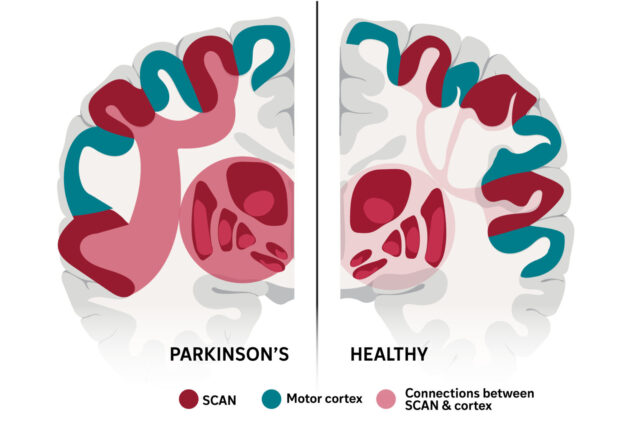
"This work demonstrates that Parkinson's is a SCAN disorder, and the data strongly suggest that if you target the SCAN in a personalized, precise manner, you can treat Parkinson's more successfully than was previously possible," says co-author and neurologist Nico Dosenbach from Washington University in St. Louis.
"Changing the activity within SCAN could slow or reverse the progression of the disease, not just treat the symptoms."
The researchers note, however, that the therapeutic potential of targeting the SCAN network needs to be further tested in larger, multicenter trials.
By the time someone is diagnosed with Parkinson's, they have typically lost up to 80 percent of dopamine-producing neurons in a part of their basal ganglia, which is responsible for motor control.
As a result, for many years, neuroscientists assumed that it was the basal ganglia and associated regions that were responsible for symptoms like slow movement, tremors, stiffness, and balance problems.

But perhaps there is a deeper network pulling the strings. At its very heart, Parkinson's may be a disease of the SCAN network, argue Dosenbach and colleagues. Dosenbach was part of the team that first described the network in a paper in 2023.
Related: Early Warning Signs of Parkinson's May Be Hidden in Your Blood
"For decades, Parkinson's has been primarily associated with motor deficits and the basal ganglia," explains senior author Hesheng Liu, a neuroscientist from Changping Laboratory in Beijing.
"Our work shows that the disease is rooted in a much broader network dysfunction. The SCAN is hyperconnected to key regions associated with Parkinson's disease, and this abnormal wiring disrupts not only movement but also related cognitive and bodily functions."
The study was published in Nature.