The agreed laws of physics put limits on how far photons can travel in space – but researchers just identified a photon that's broken those fundamental rules and achieved the impossible, traveling 2 billion light-years to Earth.
Space isn't actually as empty as you might think.
It's filled with cosmic microwave background (CMB) radiation, the faint afterglow left behind by the Big Bang, which interacts with high-energy photons and converts them into other particles.
There's no escaping the CMB if you're a photon packed with energy – but somehow it's happened. It's the equivalent of shooting an arrow through a dense forest 2 billion light-years across, and missing every single tree.
In a new study published in Physical Review Letters, researchers from the Italian National Institute for Astrophysics (INAF) and the Italian National Institute for Nuclear Physics (INFN) think they might have an explanation.
"We started from a very simple question: How did this photon survive a journey that, according to known physics, should have destroyed it?" says INAF astrophysicist Giorgio Galanti.
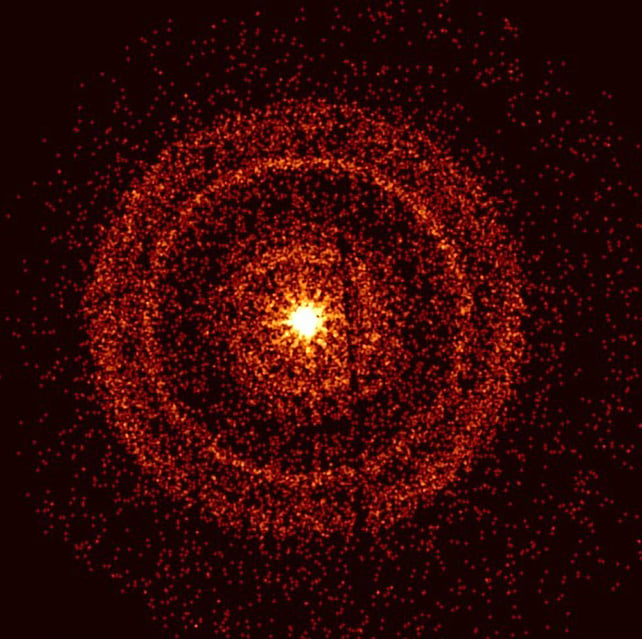
The full story starts in October 2022, with the observation of the brightest gamma-ray burst ever observed, GRB 221009A. These gamma-ray bursts are intense explosions of energy created by collapsing or colliding stars.
Within this exceptional gamma-ray burst was an exceptional photon, as identified by the Carpet cosmic ray detector located at the Baksan Observatory in Russia. Measured at 300 teraelectronvolts (TeV), it contained about 100 trillion times more energy than a visible light photon does.
Researchers have debated ideas about long-distance photon travel before, but only for a few tens of teraelectronvolts. This was something else.
"The new data from the Carpet experiment showed us that the explanations proposed so far were no longer sufficient," says Galanti.
"We therefore looked for a theoretical scenario capable of consistently describing what we observe, without resorting to arbitrary corrections to the equations."
Here's what the researchers propose: that part of what's happening involves axion-like particles or ALPs, which photons can in theory transform into before converting back again, avoiding CMB radiation along the way.
The idea of ALPs has been floated before, and it works for photons of a few tens of teraelectronvolts – but for a photon this energetic, the researchers calculate ALPs alone fall roughly 100 times short.
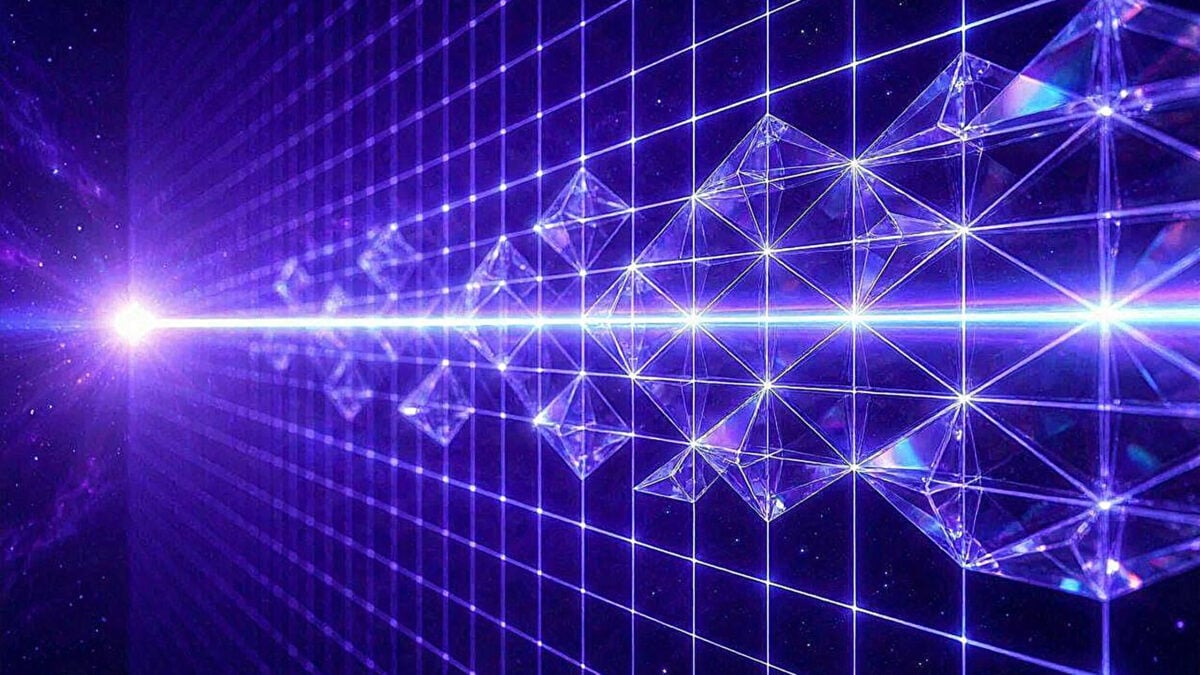
This study adds the concept of a violation of Lorentz invariance, one of the building blocks of special relativity.
Certain quantum-gravity models suggest that the rules of Lorentz invariance can start to bend at the highest energy levels, which would certainly apply here – and potentially make the Universe more transparent to the photon as it rockets through space.
As the researchers put it, it's almost like a fast lane for high-energy photons to travel along. The laws of physics aren't changing, but in extreme conditions, extreme effects appear.
"The most interesting aspect of our work is that, for the first time, it brings together two ideas that until now had been developed separately," says astrophysicist Marco Roncadelli, from INFN.
"If future observations confirmed this scenario, the Universe would become a natural laboratory for studying quantum gravity at energies enormously higher than those achievable by any accelerator built on Earth."
The proposed theory also fits with another observation from GRB 221009A: The 300 TeV photon arrived about an hour after lower-energy photons – a delay that a separate study found could also be explained by this kind of Lorentz invariance violation.
There's lots more work to do here, and plenty more data that needs gathering – for now this is a theoretical model, based on a single photon – but future observations of similar events should help to confirm how this strange physics anomaly can happen.
"Needless to say, our findings require further confirmations by future observations," write the researchers in their published paper.
"Only time will tell whether the above two clues are real discoveries."
The research has been published in Physical Review Letters.
This article was fact-checked by Rebecca Dyer and edited by Rebecca Dyer. While we pride ourselves on our process, we are only human. If you spot a mistake, please let us know.