
Physicists have conducted a worldwide hunt for dark matter. Literally – they turned Earth itself into a giant detector.
Weirder still, the experiment picked up dozens of candidate signals that fit predictions for certain types of hypothetical particles that could make up dark matter.
Those signals still need verification, and there's plenty of other things that they could be before they're dark matter particles. But it's a clever experiment with some tantalizing new clues to one of the most mind-bending cosmological puzzles.
There's plenty of evidence that there's more to the Universe than what we can see. Our models of how visible matter is spread and moves across the cosmos don't quite line up with its actual distribution and motion in the real world.
Physicists suspect that there's a whole realm of invisible matter out there, contributing its mass to that of the stuff we can see to produce the observed gravitational effects. Since it doesn't reflect or emit light, scientists gave it the evocative name of 'dark matter.'
But identifying a gap in the models and plugging it are two different things. And in this case, there's a whole range of potential plugs with different characteristics.
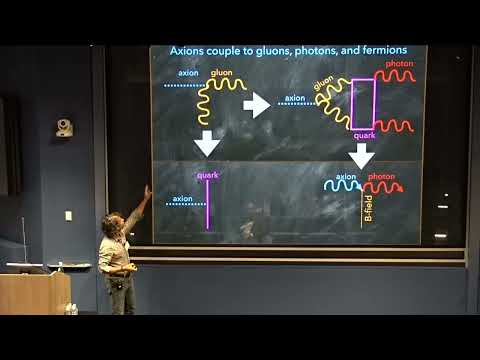
One of the most promising candidates is what's known as the axion. While these particles were first proposed in the 1970s to solve a different problem in particle physics, physicists soon realized that if they exist within a certain mass range, they could also plug the dark matter hole.
Unlike many other dark matter candidates, axions are predicted to interact with the electromagnetic force – and this could be what gives them away.
According to the models, axions should sometimes decay into photons in strong magnetic fields. As such, astronomers have been searching the cosmos for signatures around neutron stars or supernovae.
But according to a series of recent papers by physicists in Japan, maybe we can look closer to home.
"We asked ourselves whether we could use the Earth itself as a giant detector in the search," says theoretical physicist Atsushi Taruya, an author on all four papers.
"The Earth-ionosphere cavity acts as a natural resonator that amplifies electromagnetic waves right around the mass range we wanted to probe."
To find out, the researchers analyzed data on Earth's magnetic field gathered by the British Geological Survey between 2012 and 2022. If axions are indeed washing over and through the planet, the team hypothesizes, they should resonate between Earth's surface and the ionosphere, generating electromagnetic waves at a frequency that corresponds to the mass of the particles.
Since decades of previous studies have constrained the possible masses of axions fairly tightly, the researchers checked this decade's worth of data for signals within this narrow range.
After accounting for background noise, the team identified 65 axion signal candidates. Even after they tightened their statistical filters, they were still left with 25 candidates.

But axions aren't the only dark matter candidate that this technique could detect. Another contender is the dark photon, which is hypothesized to be a force carrier in the shady realm beyond the Standard Model.
Unlike the regular photons we're familiar with, dark photons might have mass, and could interact with magnetic fields in a similar way to axions.
In a follow-up study, the team used a similar method to search for dark photon signals in the same data.
And again, the researchers report candidate signals: as many as 342 using the loosest criteria, which narrowed down to 31 with a more stringent signal-to-noise ratio.
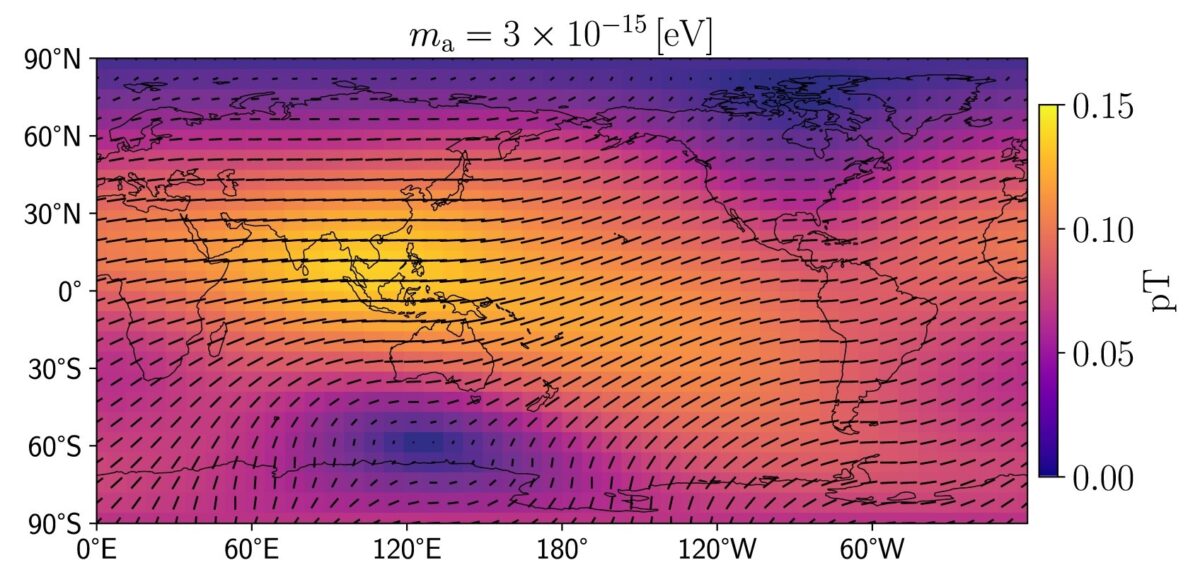
The problem, however, is that this method can't distinguish between dark photon and axion signals with the current data. One of the main differences is that axions depend on Earth's magnetic field to produce their signal, whereas dark photons would produce theirs with or without it.
That opens up a way to test which (if any) form of dark matter is currently streaming through Earth. If the signal looks exactly the same anywhere on the planet, it points to dark photons.
If the signal strength varies by location, however, it's more likely to be axions. That's because the strength of Earth's magnetic field varies by location. The researchers say that this should mean the axion signal would weaken near the planet's poles, and be strongest around Southeast Asia.
Related: Physicists May Have Found The Best Evidence of Dark Matter Yet
Unfortunately, the data was gathered from a single observatory in the UK, so the team can't get that global perspective. But future studies by other experiments could help shed more light on dark matter.
The three papers on axions were published in the journal Progress of Theoretical and Experimental Physics, while the dark photon study was published in Physical Review D.
This article was fact-checked by Fiona MacDonald and edited by Fiona MacDonald. While we pride ourselves on our process, we are only human. If you spot a mistake, please let us know.