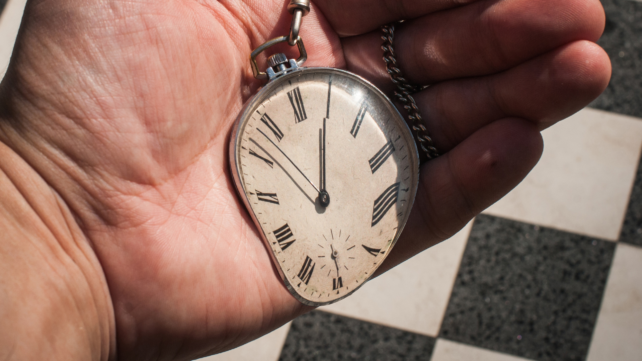
An ice cube as we generally know it is a crystal, its water molecules neatly arranged in an orderly hexagonal lattice.
As it melts, this order dissolves, the long-range crystalline arrangement giving way to fluid chaos. Yet even in this apparent disorder, the molecules retain some semblance of structure, interacting with their immediate neighbors.
This is a spatial arrangement. But what if something similar could happen to a crystal whose structure exists not just in space, but in time?
If a phenomenon known as a time crystal could melt in the same way as an ice cube, it could result in a state of matter known as a time liquid – one that retains short-range temporal order even as its long-range coherence dissolves.
If experimentally demonstrated, the time liquid could offer physicists a new way to investigate how matter responds to fluctuations in its environment – and how order can emerge from what should be disorder even when the usual rules governing time crystals no longer apply.
"The most striking aspect of discrete time liquids, both quantum and classical, is the idea that a discrete time crystal with a finite density of topological time defects can restore time-translation symmetry on average," write physicists led by Zuo Wang and Marios H. Michael of the Max Planck Institute for the Physics of Complex Systems in Germany.
Their findings, yet to be peer-reviewed, have been uploaded to preprint server arXiv.
Time crystals are one of the more fascinating phenomena in modern physics.
Picture the ice cube in your head – if you could shrink down to the molecular scale and look at it, its lattice would resemble a hexagonal jungle gym, with the pattern repeating in three-dimensional space.
A time crystal takes this idea a dimension further – instead of merely repeating a pattern through space, it repeats a pattern of behavior through time.
The researchers modeled their work on the principles of a type of time crystal called a discrete time crystal.
A discrete time crystal's repeating pattern is not just the normal oscillations of the atoms; it's driven by an external source like a laser, but ticks to a different beat. Think one beat of the crystal for every two beats of the source.
That crystal rhythm is really sturdy – it's not easily knocked askew by small disturbances.
But what happens when the driving force itself is unstable? When, instead of a steady beat, the crystal is subjected to a rhythm that fluctuates unpredictably?
This is what Wang and colleagues wanted to investigate, and this is going to get a little conceptually tricky, so bear with us.
The researchers developed a theoretical model consisting of a two-dimensional lattice of interacting spins – think of a sheet with a neat grid of tiny magnetic arrows like compass needles.
This lattice was coupled with an electromagnetic cavity. Imagine putting the sheet of arrows into a hollow chamber like a bell that contains an electromagnetic field.
Now imagine that, instead of striking the bell with a hammer, you heat it. Random thermal fluctuations cause the electromagnetic field to oscillate, and those oscillations influence the arrows, encouraging them to turn and interact with their neighbors.
Because the cavity has a natural resonant frequency, the fluctuations produce an approximate rhythm, even though nobody is deliberately keeping time.
The sheet of arrows is the system that can exhibit time-crystalline behavior. The fluctuating electromagnetic field is its driver.
And when the researchers ran their simulations, something surprising emerged. Under the right conditions, the spins began to tick at half the cavity's frequency, even though the fluctuations driving them were anything but regular.
But it wasn't like a normal discrete time crystal.
Although the spins maintained their distinctive rhythm overall, they occasionally slipped out of step, switching between two equivalent versions of their repeating pattern.
The researchers call these interruptions time-solitons – defects in the temporal order that disrupt long-range coherence without destroying the underlying rhythm.
We've assembled quite the imaginary laboratory, but bear with us a little longer. We're almost at the liquid. This is where we return to our melting ice cube.
Just as liquid water retains some local structure even after the long-range order of its crystal lattice has broken down, the simulated spins retained short-range temporal order even as long-range coherence dissolved.
This is the state the researchers called a discrete time liquid.
And here's another strange twist: the thermal fluctuations weren't simply disrupting the spins. They were responsible for coaxing out their orderly pattern.
At low temperatures, the fluctuations were too weak to produce the distinctive repeating pattern. At intermediate temperatures, the spins fell into their rhythm. And at high temperatures, the fluctuations became so strong that the order broke down altogether. It's just like Goldilocks's porridge, to make our weird lab just a little more cluttered.
What it means is that adding heat could actually create order – but only up to a point.
So why would anyone want to make the physics equivalent of porridge served in a red-hot bell and seasoned with compass needles and ice cubes? (Yummo.)
Well, one reason has to do with something called time-translation symmetry – the principle that the laws of physics work the same way regardless of when you observe them, even if the phenomena those laws govern behave differently over time.
A time crystal breaks that symmetry by establishing a repeating pattern that distinguishes particular moments from others.
But in the simulated time liquid, the occasional switches between different versions of the rhythm mean that, on average, those distinctions can disappear. The system retains local temporal order without maintaining one coherent pattern indefinitely.
This raises the possibility that a time liquid could exist even in thermal equilibrium, a state where conventional time crystals are not expected to form.
For now, all this remains purely theoretical. The researchers have yet to experimentally realize this bizarre concoction, although they have outlined some possibilities and potential limitations.
When the notion of the time crystal was first proposed, many physicists thought it was impossible, so we may yet see a time liquid.
And, if we do, it will reveal something new about the weird relationship between order and chaos.
The research is available on preprint server arXiv.
This article was fact-checked by Fiona MacDonald and edited by Fiona MacDonald. While we pride ourselves on our process, we are only human. If you spot a mistake, please let us know.