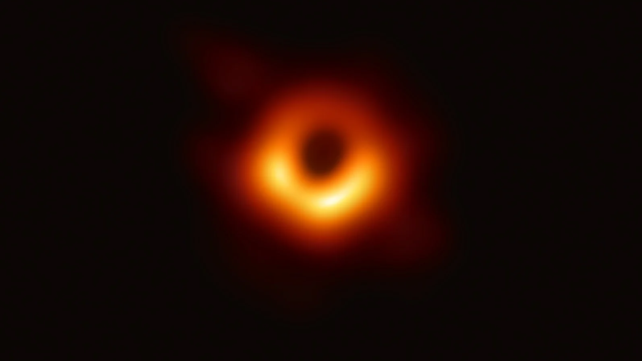
Black holes warp the very fabric of spacetime as easily as one wrings an unruly wet towel, creating an extreme environment so curved that not even light can escape.
The singularities thought to exist at the heart of these blacker-than-ink behemoths seem to be infinitely dense, squeezing the mass of countless devoured stars, planets, and even other black holes – after they've been violently spaghettified – into an infinitely small space.
Of course, when infinity is offered as a cosmological explanation, it may simply represent a breakdown of our understanding, rather than proof that physical infinities can exist.
So, to find out what happens inside the Universe's most massive celestial objects, physicists sent a quantum probe into the heart of a black hole. Mathematically, that is.
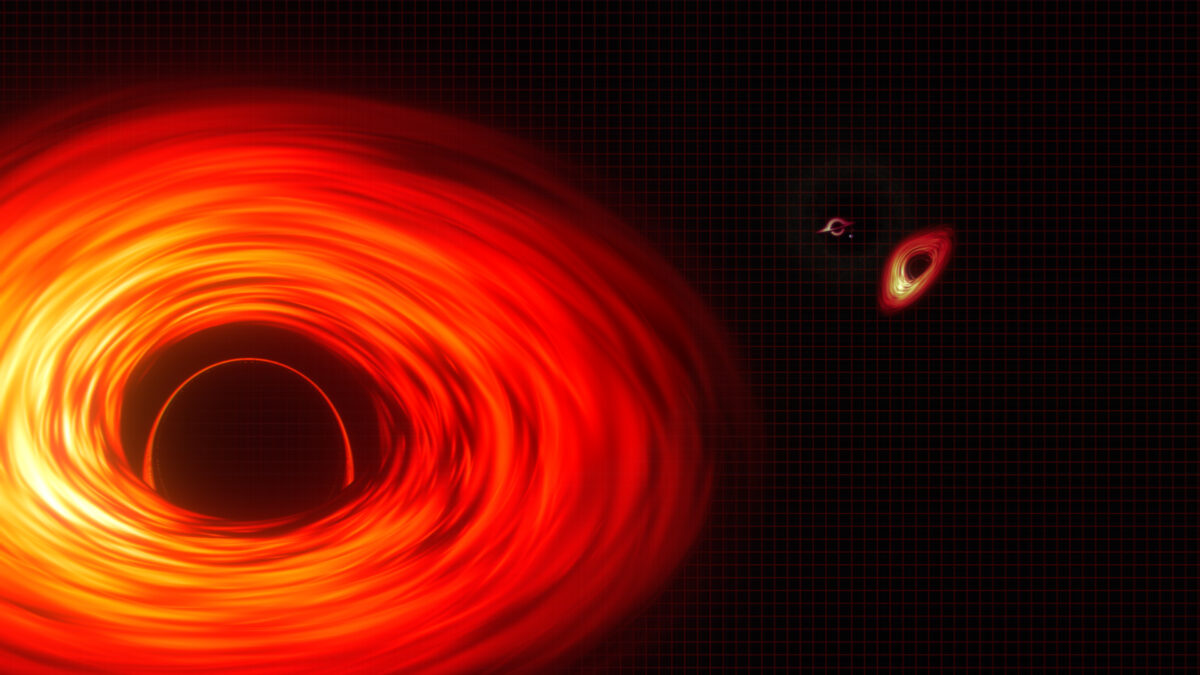
In a study published in the journal Physics Letters B, researchers used a simplified model to explore what a quantum probe would experience while plunging through the intense environs in a black hole's interior.
Such concepts are somewhat tricky, so they found ways to turn this inquiry into a cleanly accessible geometric experiment, sidestepping the quantum weirdness and chaotic physics occurring therein.
In the macroscopic Einstein-ian Universe we see at large scales, probes are treated like particles, or tiny, solid marbles rolling across the voluptuous curves of spacetime.
Yet at the smallest scales things don't act that distinctly, so the researchers treated the probe like a quantum particle, or wave, instead of a discrete little marble.
They then used a specialized mathematical approach to chart the probe's trajectory through the mysterious bowels of the black hole. Because, again, quantum-mechanical waves don't take clear paths, they propagate in all directions like ripples on a lake.
Additionally, entities traveling through classical spacetime follow the shortest path across the fabric of spacetime, which is shaped by the gravitational influence of massive objects.
Yet within the tiniest realms, particle-wave entities follow an altered 'quantum-modified motion'. So the researchers simplified this as well, to model the probe along a more quantifiable path through a black hole.
These tailor-made specifications provide "a purely geometric description of the modified dynamics experienced by the quantum probe".
Furthermore, the motion of the wave-like probe presented in this work is split into two easy-peasy values: amplitude, akin to its strength, and phase, akin to its direction.
These components help provide an accessible way to explore what would happen as it delves deeper into a black hole and approaches the enigmatic singularity.
And what happens is… nothing, because the probe never gets there.
In effect, time stretches away to infinity, so the probe would require an infinite time span to get there, "and the classical singularity is pushed beyond the physical reach of quantum probes," the researchers say.
Future research could ratchet up the complexity, since this work explored a non-spinning black hole and the simplest type of quantum probe.
But real black holes spin, and particles have numerous quantum properties that dictate their interactions. Therefore, it's uncertain if singularities remain unreachable after accounting for 'real-world' factors.
This model also presents an existentially intriguing application: exploring the birth of the Universe.
Since it's extrapolated that the Big Bang began from an unimaginably dense point, potentially like the singularities in black holes, does this suggest that the history of the cosmos would expand to infinity from the perspective of a quantum-cosmic probe? Will the greatest mysteries inherently outpace us forever?
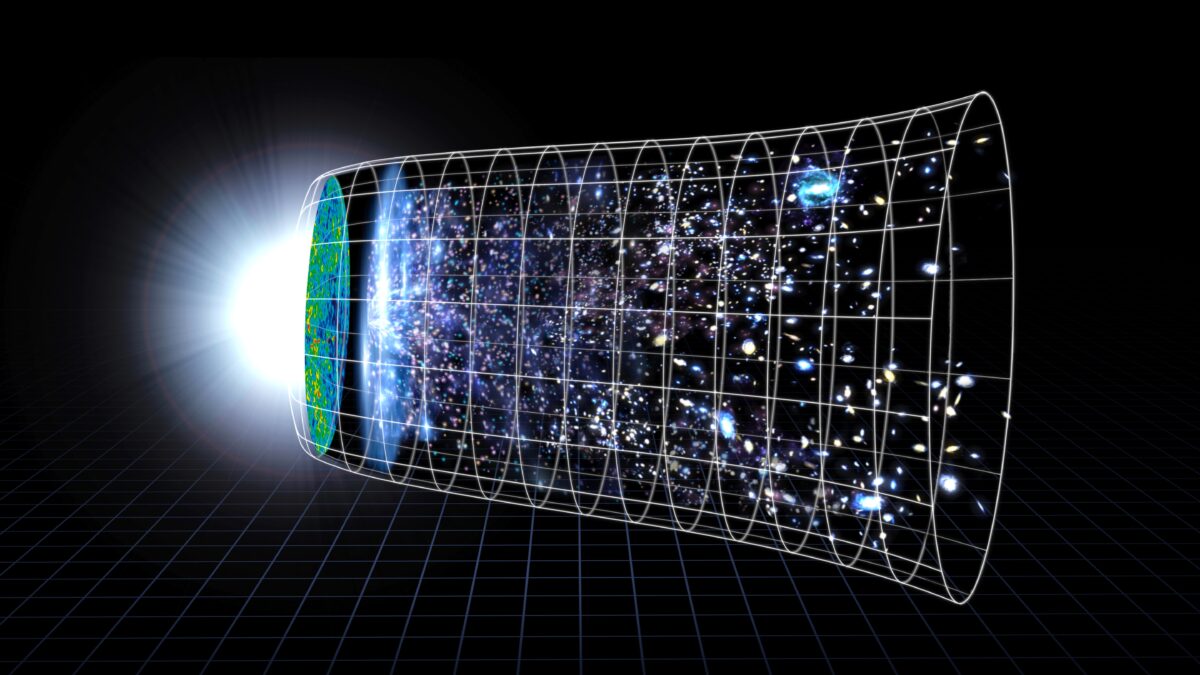
On the other hand, some surmise that this beginning point does not represent a singularity, but, again, a current (and hopefully temporary) hiccup in our physics.
Overall, this work prods at a fundamental cosmic question, asking whether Universal laws prohibit the possibility of exploring things like singularities, the most literally mind-space-and-time-bending phenomena that apparently shape existence itself.
The research has been published in Physics Letters B.