
The Universe, according to theory at least, should not exist.
Every particle in the Universe has a corresponding antimatter counterpart. Should ever a pair of such particles meet, they would immediately cancel each other out – annihilated in a tiny puff of energy.
Theoretically, the birth of the Universe should have produced equal quantities of particles and antiparticles.
Why the current Universe is so heavily skewed in particles' favor is an enduring mystery – one whose solution remains all the harder to find because of antiparticles' tendency to go and collide with particles.
But an extraordinary effort may have finally tamed one of the biggest tricksters of the antiparticle milieu – the positron, the antimatter counterpart to the ubiquitous electron.
In a cryogenic, superconducting vacuum trap, physicists at Northwestern University in the US successfully kept a single positron for months – a breakthrough that, they say, paves the way to the most rigorous probes yet of particle physics.
"The biggest challenge is to persuade a positron that is ejected from a nucleus in a radioactive decay with a very high energy to slow down enough that we can capture it into our particle trap," Northwestern physicist Gerald Gabrielse, the paper's senior author, told ScienceAlert.
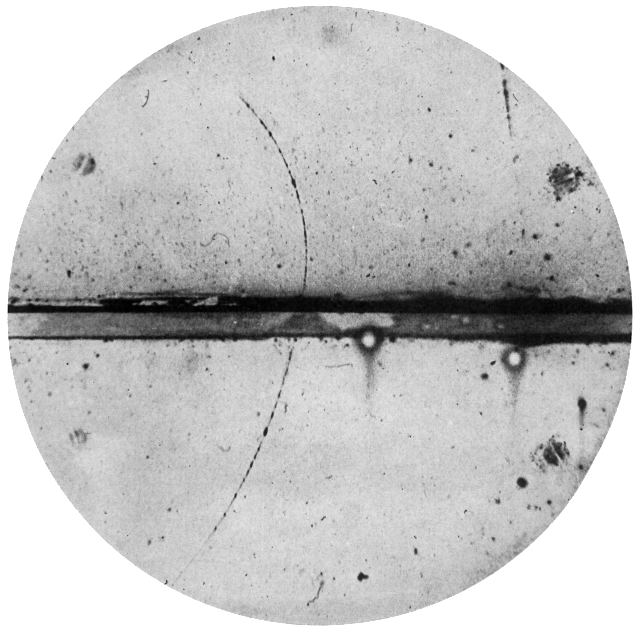

The Universe naturally makes positrons in a variety of ways – cosmic explosions, energetic interactions between particles, and radioactive decay, when an unstable nucleus spits out a positively charged particle otherwise identical to a negatively charged electron.
But the Universe is not kind to positrons. All it has to do to be wiped from existence is encounter a single electron – and electrons are absolutely everywhere.
Physicists have been able to observe positrons since the 1930s, but to study one for any length of time would involve completely isolating it from encountering any other matter.
That's tricky, but not impossible. An electromagnetic trap can keep a single particle hovering in place in a vacuum so that it doesn't accidentally touch another particle.
The problem lies in bringing a particle ejected during the energetic process of radioactive decay to a standstill.
"Most of the positrons that emerge from the source are not successfully slowed and captured," Gabrielse explained. "They end up 'annihilating' with an electron in our apparatus."
The team's solution, spearheaded by Northwestern physicist Tom Myers, had to address both challenges: putting the brakes on the positron, and confining it without bringing it into contact with an electron.
The researchers used a radioactive isotope of sodium as their positron factory, which spits out the antiparticles with an energy of up to around 546 kiloelectronvolts – about 88 percent of the speed of light.
So how do you put the brakes on a relativistic positron?
Well, in this case, the answer is doing the very thing the researchers were ultimately trying to avoid – making it pass through matter. A single crystal of tungsten, to be precise.
The experimental apparatus had three main components: the sodium source, the crystal, and the trap.
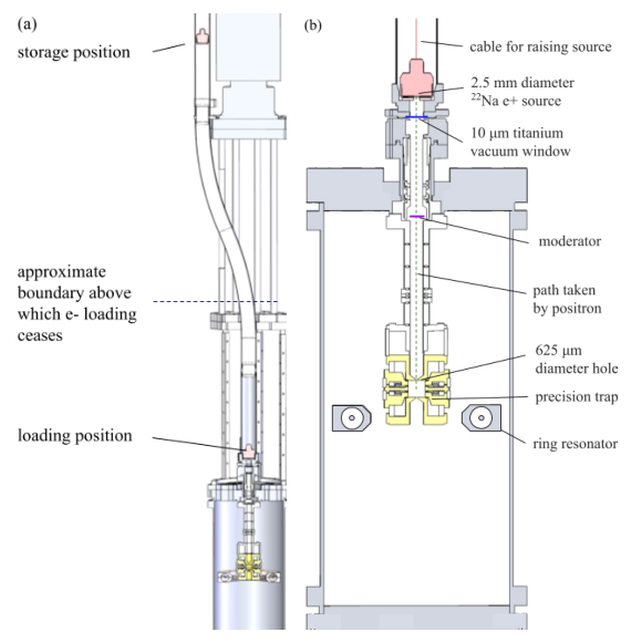
First, some of the positrons emitted by the sodium source flew into the tungsten crystal, where their positive electric charge interacted with the negatively charged electrons in the material. Those interactions can excite or ionize atoms, transferring some of the positron's kinetic energy to the crystal.
Most of the positrons don't make it. They smack into electrons, and both are wiped out. But a scant few survive, emerging from the tungsten's surface significantly slowed, hitched to – but not touching – an electron. This is positronium.
In this particular form of positronium, the electron and positron occupy a highly excited quantum state that keeps them relatively far apart, delaying their inevitable annihilation just long enough to transport the positron where it needs to go – straight into the prepared trap.
That trap is also ingenious. A tiny opening, just 640 micrometers wide, allows the positronium to enter, where an electric field strips away the electron, leaving the positron behind.
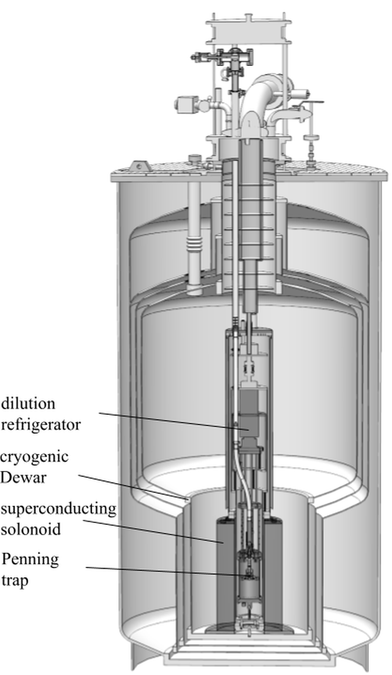
The device, called a Penning trap, uses a combination of electric and magnetic fields to confine the charged particle without allowing it to touch the walls.
Kept in an extraordinarily good vacuum trap cooled to just 300 millikelvins – a fraction of a degree above absolute zero – the positron can remain isolated from the outside world.
For the researchers, it's a tense experience.
"We turn on our detector and wait," Gabrielse said.
"Eventually we see the electrical signal from a captured positron. We then pull the radioactive source away from the trap to keep any additional positron from loading."
The researchers could keep their captive positron for months. But merely preventing it from annihilating was only the beginning.
They also needed to control its motion with extraordinary precision.
Within the trap's powerful magnetic field, the positron moves in tiny circles – a motion called cyclotron motion. By cooling it to its lowest quantum energy state, the researchers could then use carefully tuned microwaves to nudge it between discrete energy levels, one quantum at a time.
And crucially, they could detect those changes, along with flips in the positron's spin, without disturbing the quantum states being measured.
"I and my research group have been pursuing a one-positron quantum cyclotron for many years, so observing a positron making one-quantum energy jumps was extremely satisfying," Gabrielse said.
"It was also great to see Tom's PhD thesis work culminating in a great success. He had worked very hard."
So why would anyone want to trap and measure a positron in the first place?
Actually, there are a lot of very good reasons – and somewhere near the top of the list is a fundamental principle of physics called CPT symmetry.
CPT stands for charge, parity, and time reversal, three transformations that, when applied together, should leave the fundamental laws of physics unchanged.
One consequence of this principle is that particles and their antimatter counterparts should have some properties that match exactly.
An electron and a positron, for example, each behave a little like a tiny bar magnet, with a property called a magnetic moment. Their magnetic moments should have equal magnitude but opposite sign.
Physicists have already measured the electron's magnetic moment with astonishing precision. Now, thanks to their ability to control a single positron, Gabrielse and his colleagues hope to do the same for its antimatter twin.
"If the magnitudes are the same, it will be the most precise confirmation of the CPT invariance of the Standard Model – the most fundamental mathematical description of physical reality," Gabrielse explained.
The researchers are still in the process of obtaining this measurement, and hope to report a result early next year – although given that this is the best opportunity yet to understand a particle so evasive, it could take longer.
Whatever the measurements reveal, they could provide one of the most stringent tests yet of one of the fundamental principles underpinning modern physics.
And even if the results agree perfectly with theory, that would leave physicists with some very big questions.
"It would deepen the mystery of how the Standard Model can make such precise predictions of what we measure, while being inconsistent with basic features of the Universe," Gabrielse said.
The research has been published in Physical Review Letters.
This article was fact-checked by Fiona MacDonald and edited by Fiona MacDonald. While we pride ourselves on our process, we are only human. If you spot a mistake, please let us know.