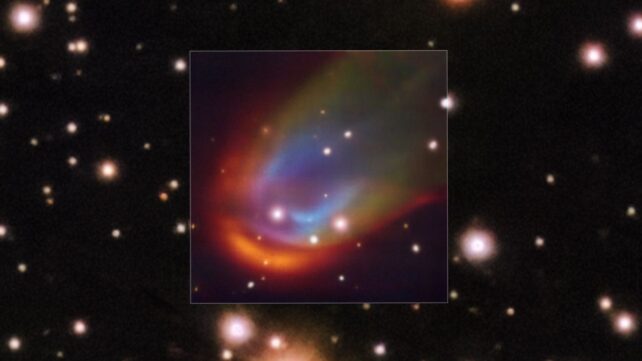
A tiny chunk of dead star just 731 light-years away has presented astronomers with a shimmering puzzle: a powerful, glowing bow shock.
This wouldn't be unusual under many circumstances, but in the case of the white dwarf RXJ0528+2838, there's no observed mechanism that might explain the multi-hued nebula that surrounds it.
"We found something never seen before and, more importantly, entirely unexpected," says astronomer Simone Scaringi of Durham University in the UK. "The surprise that a supposedly quiet, diskless system could drive such a spectacular nebula was one of those rare 'wow' moments."
Related: White Dwarf Star Enters Its Crystallization Era, Turning Into A 'Cosmic Diamond'

White dwarfs are what's left after stars like the Sun have reached the end of their main-sequence lifespan. Having run out of suitable atoms to fuse, their core, no longer supported by fusion's outward pressure, collapses into an ultra-dense remnant that expels the star's outer material.
Although only about the size of Earth, these dead stars have a mass of up to 1.4 Suns. They often hang out in binary pairs, gravitationally slurping mass from their companion star, which results in some interesting behavior, such as repeated thermonuclear eruptions.
Because a white dwarf is no longer fusing atoms, it doesn't have the mechanism for producing stellar winds that a 'living' star has. However, interactions with a companion can create a disk of material that circles the white dwarf like water around a drain.
Collisions between outflows from this swirl of material and the surrounding interstellar medium are what form the energized structures known as bow shocks.
RXJ0528+2838 has a low-mass companion star, but no disk. Moreover, the shape, size, and density of the bow shock – made up of wavelengths indicative of hydrogen, oxygen, and nitrogen – suggests that the outflow has been pouring forth for around 1,000 years, very unlike the explosive outbursts of a thermonuclear event.

The researchers think that the white dwarf's powerful magnetic field may be circumventing the disk formation channel. Instead, material from the companion star could be diverted along the magnetic field lines and dumped directly onto the white dwarf, facilitating outflows without the disk.
"Our observations reveal a powerful outflow that, according to our current understanding, shouldn't be there," says astronomer Krystian Ilkiewicz of the Nicolaus Copernicus Astronomical Center in Poland.
"Our finding shows that even without a disc, these systems can drive powerful outflows, revealing a mechanism we do not yet understand. This discovery challenges the standard picture of how matter moves and interacts in these extreme binary systems."
The discovery has been detailed in Nature Astronomy.