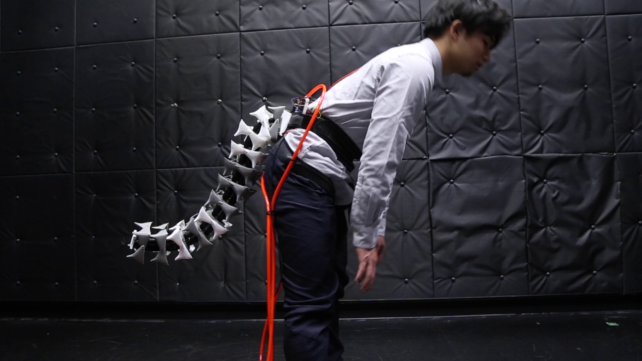
Seven years ago, Japanese researchers developed a wearable prototype robotic tail they said could help older people stay steady on their feet and assist workers carrying heavy loads.
Called Arque, the device was designed to respond to a wearer's leaning by moving in the opposite direction.
Walking sticks and walkers already provide support for people who need help with balance.
Inspired by animal tails, the team at Japan's Keio University investigated another possibility: could a moving appendage attached to the body help people maintain their balance?
Introduced in 2019, Arque was a prototype built to explore that idea. Its creators were Junichi Nabeshima, Yamen Saraiji, and Kouta Minamizawa, researchers at Keio's Graduate School of Media Design.
In August 2019, Reuters described a gray tail about a meter long, while New Atlas listed the prototype at 71 centimeters and 1.6 kilograms. The device was secured around the wearer's waist with a harness.
"The tail keeps balance like a pendulum," Nabeshima said.
The mechanism uses four pneumatic artificial muscles powered by compressed air, allowing the tail to move in eight directions.
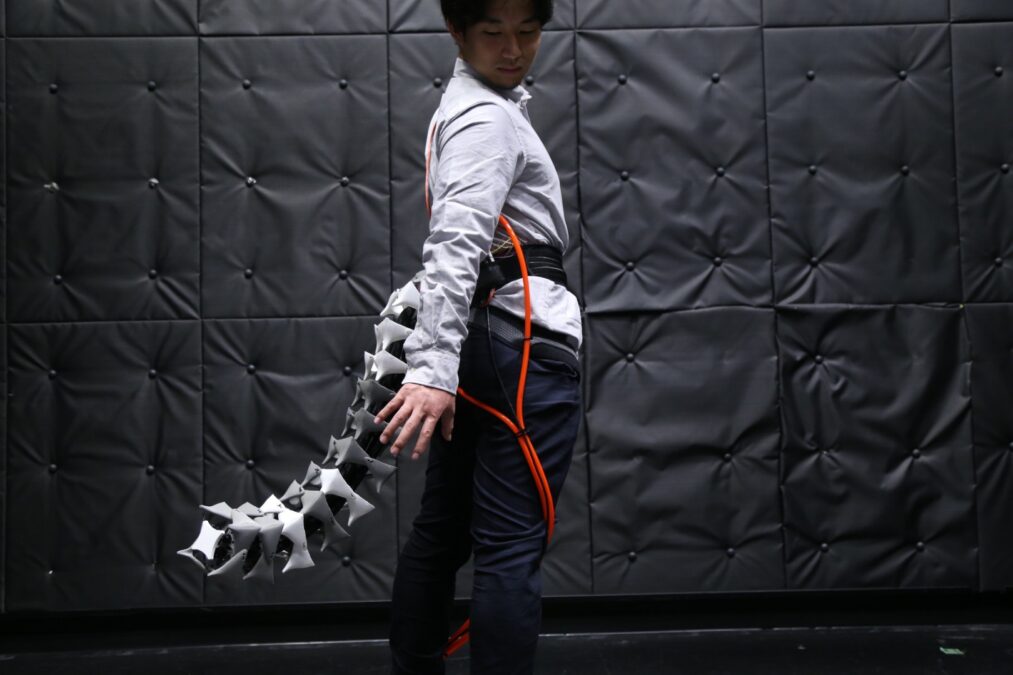
The tail's length and weight can be adjusted for different wearers. Its structure consists of segments, each with four protective plates around a central component with adjustable weight.
Elastic cords connect the plates, while springs link them to the central structure and help accommodate forces generated during movement. The artificial muscles fit into spaces inside the segments, according to the team's poster paper.
In the proposed balance application, measurements from a device worn on the torso would guide the tail's response. The system would use those measurements to estimate the wearer's center of gravity, then move the tail to influence their balance.
An air compressor supplied the pressure needed to operate the muscles, so the prototype still depended on additional equipment and was not yet a stand-alone device.

The Arque paper cites a 2016 pilot study in Primates examining wild bearded capuchin monkeys carrying stone tools on two legs. Its analysis indicated that the animals' tails helped balance the loads.
The capuchin researchers examined the animals' trunk and limb positions, the movement of their center of mass, and the turning effects of forces acting on their bodies.
They found that the monkeys carried loads with their hips and knees bent, and that body mass affected their carrying posture.
For the robotic structure, the Arque researchers drew on a separate 2015 study in Science investigating the segmented skeleton of a seahorse's tail. That work compared 3D-printed tail models with square and round segments.
Researchers bent, twisted, and crushed the models to investigate how their shapes affected performance. The square design performed well at both gripping objects and withstanding compression. Its plates slid against one another under pressure, while the round plates could also rotate.
In crushing tests, the square version could absorb more energy before its structure failed. Even as its segments failed, they kept their outline; the round segments distorted into ovals.
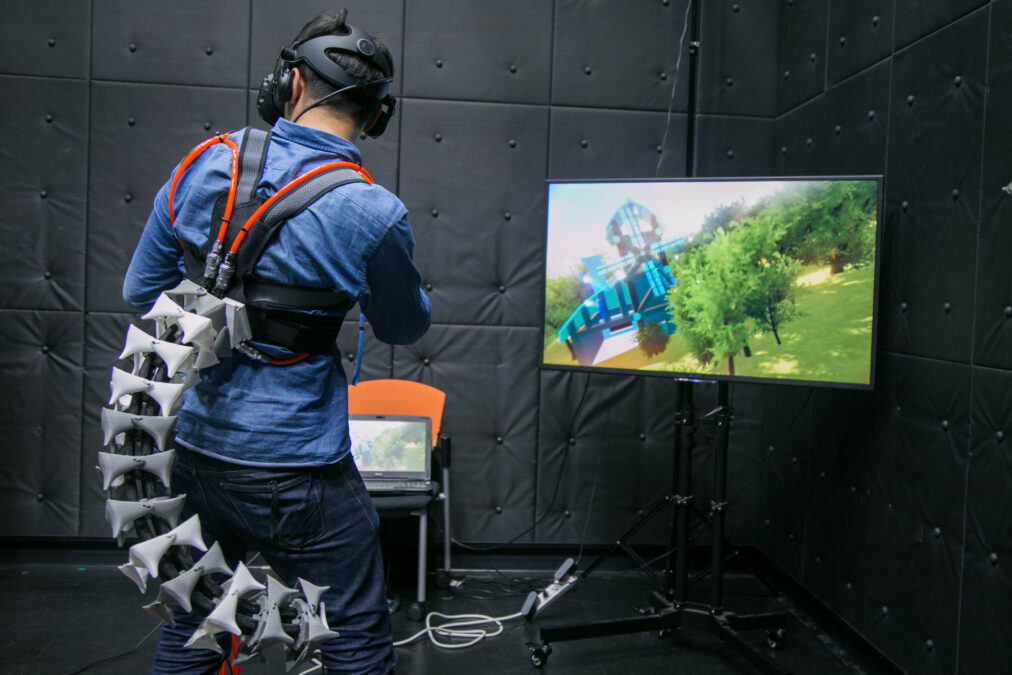
The Arque team also proposed using the tail in virtual reality. In the poster paper's example, its movement would apply forces to the wearer's body to accompany a strong virtual wind, adding a physical sensation to the simulated scene.
The researchers described this as an ungrounded system that needs no fixed external mounting point, although the prototype still required compressed air.
As of its 2019 debut, the researchers were still refining the tail's flexibility in the lab, with helping older people and workers among the applications they hoped to pursue.
What's become of the project since then remains unclear; the researchers did not respond to requests for comment on its current status.
The research has been published in ACM SIGGRAPH 2019 Posters.
This article was fact-checked by Fiona MacDonald and edited by Fiona MacDonald. While we pride ourselves on our process, we are only human. If you spot a mistake, please let us know.