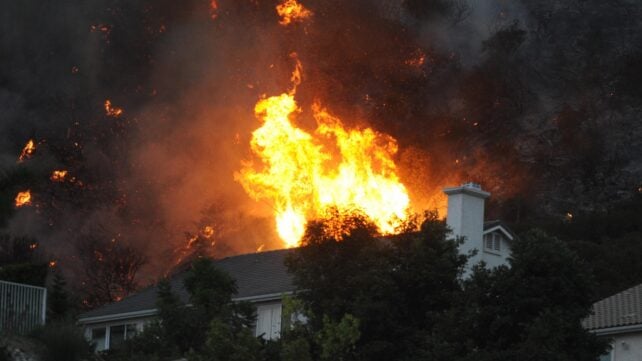
Wildfires that ravage developed areas of the US tend to hit a particular kind of neighborhood: suburban, owner-occupied, and relatively well-off, new research has found.
Wildfires in the US aren't just a problem for communities near remote forests – they are literally in people's backyards, especially for people who live on hillsides near wildlands on the outskirts of urban areas – which is exactly where rich neighborhoods tend to be.
"These urban fires consistently occur in suburban, high-income, owner-occupied development," says co-author Dion Kucera, an urban ecologist at the University of California, Riverside (UCR).
"That hasn't changed in more than 40 years."
Kucera and UCR landscape ecologist Darrel Jenerette analyzed 141 fires that intersected urban areas across the US between 1984 and 2025.
The number of fires each year did not increase significantly.
But the larger fires have been getting larger, with fires burning at least 0.5 square kilometers (0.2 square miles) showing an upward trend in total area burned – though that trend is driven largely by a handful of extreme fire years, and isn't statistically robust under every test.
Meanwhile, more people are living in the path of these fires.
The proportion of the US population living in fire-exposed census tracts has remained remarkably stable, at around 0.9 percent, but the absolute number of people in those areas rose from about 2.1 million in 1990 to 2.8 million in 2023.
The researchers say population growth in general, rather than a major shift of people into increasingly fire-prone areas, appears to explain much of that increase.
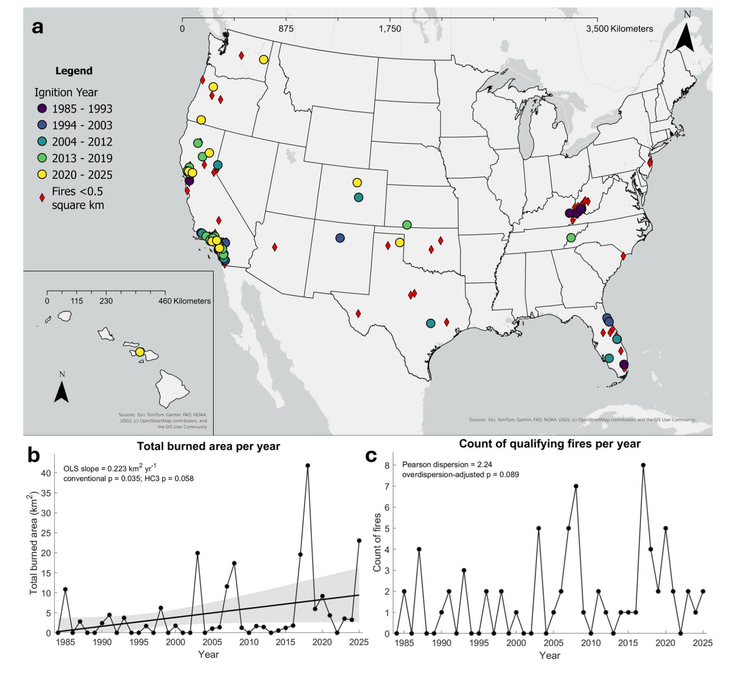
Locations of and temporal trends for all assessed urban-intersecting fires between 1984-
2025. (Kucera & Jenerette, npj Urban Sustainability, 2026)
The fires also weren't necessarily preceded by the kind of prolonged drought that might seem like an obvious warning sign. Instead, they tended to occur after relatively short-term drying – a recent drop in moisture that can arrive after a wetter period.
"That suggests three- to six-month moisture measures may be more important for city managers trying to identify periods of heightened risk, rather than longer-term drought assessments," Kucera says.
In roughly 4 out of every 10 fires examined, the researchers found evidence of this abrupt transition from wetter to drier conditions. That kind of "hydroclimate whiplash" may become more common as weather grows more variable, but it also provides a shorter-term warning signal to watch for.
But the most striking part of the study looked at what happened after the flames were long gone.
Using satellite measurements of vegetation and land-surface temperature, the researchers found that severely burned areas lost substantial greenness and became hotter.
High-severity burn areas warmed by about 2.4 °C in the first three months after the fire.
And recovery was slow: five years later, nearly three-quarters of highly burned areas had still not returned to their pre-fire level of greenness, while about 78 percent had not returned to their previous thermal conditions.
A neighborhood can look green again without necessarily being ecologically back to normal. Vegetation that replaces burned woody plants may be shorter-lived or less structurally complex, potentially providing less shade and carbon storage and altering the local microclimate and future fire risk.
And this is where money comes back into the picture.
Although the neighborhoods exposed to these fires tended to be richer, those higher-income areas showed faster long-term recovery of land-surface temperature.
The researchers suggest that resources for debris removal, rebuilding, irrigation, and landscaping could help explain the difference – creating a kind of second layer of inequality after the fire.
The findings don't mean wealthier residents are uniquely endangered by urban wildfire, nor that poorer neighborhoods are unaffected.
The study looked at census-tract patterns rather than individual households, and its analysis focused on fires large enough to meet its study threshold, potentially missing smaller but highly destructive urban fires.
Kucera also argues that scientists need to stop treating fires that reach developed areas as simple extensions of wilderness fires.
"The urban fire problem isn't just structured by climate like it is in wildlands," Kucera says.
"Adapting to the growing intensity of urban fires requires looking beyond the forest and into the social fabric of our cities."
Read the full study in npj Urban Sustainability.
This article was fact-checked by Rebecca Dyer and edited by Rebecca Dyer. While we pride ourselves on our process, we are only human. If you spot a mistake, please let us know.