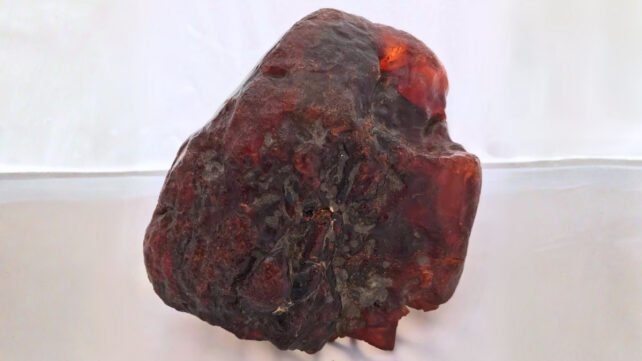
They say one person's trash is another's treasure, but a chunk of 'rock' used to keep a door open for decades is a treasure by almost anyone's standards.
A woman discovered the 3.5-kilogram (7.7-pound) stone in a stream bed in southeast Romania, brought it home, and used it as a doorstop.
Her find turned out to be one of the biggest intact chunks of amber in the world, according to a report by El Pais.
Its value? Somewhere in the region of €1 million – around US$1.1 million.
Watch the video below for a summary:
Related: Man Keeps Rock For Years, Hoping It's Gold. It Turned Out to Be Way More Valuable.
In Romania, pieces of amber can be found around the village of Colti in sandstone from the banks of the River Buzau, where it has been mined since the 1920s.
Known as rumanite, this amber is famed and prized for its wide array of deep, reddish hues.
The elderly woman who found this particular rumanite nugget lived in Colti, where it remained performing a function so humble that it was missed even by jewel thieves who once targeted the home, reports say.
After the woman died in 1991, the relative who inherited her home suspected the doorstop might be more than meets the eye.
On learning what he had, he sold the amber to the Romanian state, which had it appraised by experts at the Museum of History in Krakow in Poland.

According to these experts, the amber is likely around 38 to 70 million years old.
"Its discovery represents a great significance both at a scientific level and at a museum level," Daniel Costache, director of the Provincial Museum of Buzau, told El Pais.
Classified as a national treasure of Romania, the nugget has had a home at the Provincial Museum of Buzau – the county in which the relic was found – since 2022.
The discovery resembles that of a man in Michigan, who kept a large piece of rock as a doorstop, only to find out decades later that he was keeping his doors in place with a meteorite worth $100,000.
A chunk of amber worth over a million dollars isn't a bad score, either, really. Just imagine how many doorstops you could buy.

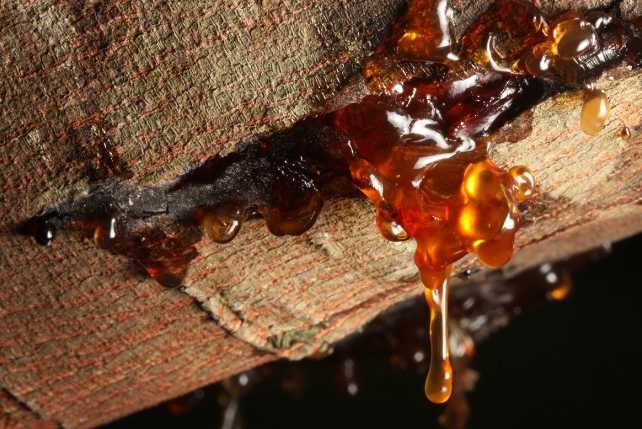
Amber is tree resin from millions of years in the past. Over time, the highly viscous substance fossilizes into a hard, warm-hued material widely recognized as a gemstone.
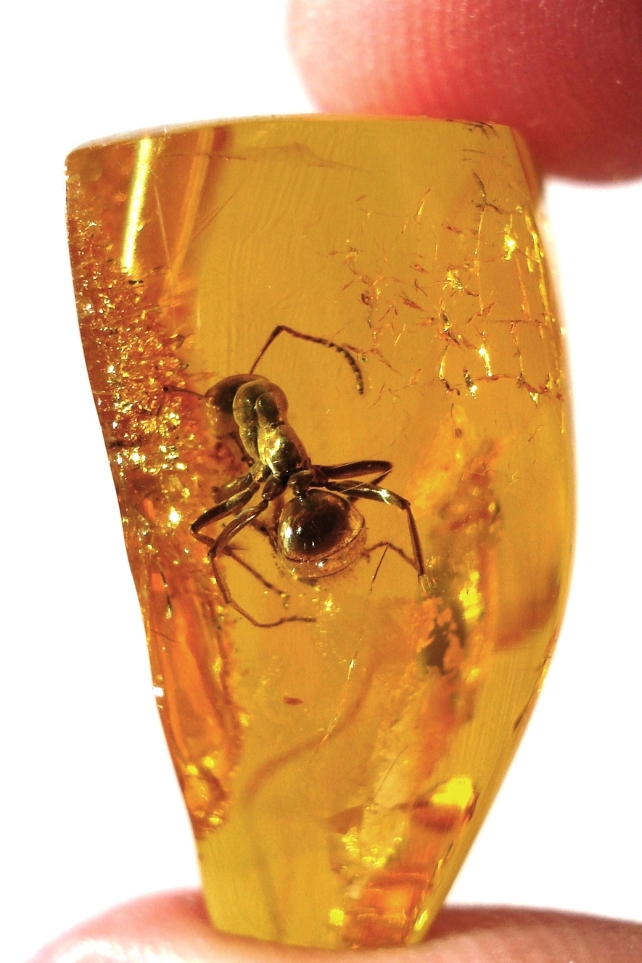
Above ground, tree resin can act like a sticky trap, collecting impressively intact specimens of the invertebrate population for us to study millions of years later.
Though it is fairly common in the Northern Hemisphere, amber has only been discovered intermittently in the southern half of the planet.
During the Barremian period, around 122 million years ago, massive amounts of resin were formed by coniferous trees around the world, which reigned over all plants until about 70 million years ago.
Incredible, 112-million-year-old amber recently found at the Genoveva quarry in Ecuador has preserved at least five orders of insects, including a variety of flies, a fungus beetle, wasps, and a caddisfly.
It also caught evidence of arachnid activity, in the form of a fragment of spider web. The way the strands are oriented suggests the web may have been built in the style of modern orb-weavers, though it lacks the sticky droplets typical of these kinds of webs.
"These findings provide direct evidence of a humid, resinous forest ecosystem and its arthropod fauna in equatorial Gondwana during the Cretaceous Resinous Interval," paleobiologist Xavier Delclòs from the University of Barcelona and colleagues explain in their paper, published in September.
Related: Venus Flytrap Wasp: 99-Million-Year-Old Amber Reveals Bizarre New Species

In 2024, scientists in Germany and the UK discovered amber in West Antarctica for the first time – the fossilized 'blood' of ancient coniferous trees that once grew on Earth's southernmost continent between 83 and 92 million years ago.
Along with fossils of roots, pollen, and spores, the finding provides some of the best evidence yet that a mid-Cretaceous, swampy rainforest existed near the South Pole, and that this prehistoric environment was "dominated by conifers", similar to forests in New Zealand and Patagonia today.
"Our goal now is to learn more about the forest ecosystem – if it burned down, if we can find traces of life included in the amber," said marine geologist Johann Klages from the Alfred Wegener Institute in Germany.
"This discovery allows a journey to the past in yet another more direct way."
Thanks to the magic of amber, there are even a few ancient tardigrades that have been preserved for millions of years.
An earlier version of this article was published in September 2024.