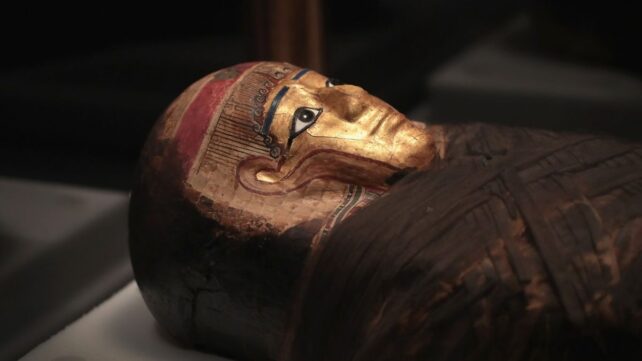
Ancient Egyptian mummies have a distinctive odor known only to those who've gotten close enough for a sniff. Now, scientists have captured these invisible vapors to find clues about the way they were embalmed.
Usually, archeologists take a more invasive approach to mummy analysis by cutting away a piece of bandage and dissolving it to get a read on the molecular makeup of embalming agents.
But this process is inherently destructive. Sometimes the molecules fall apart in the process. And there are only so many pieces of bandage you can take before the entire mummy unravels.
Instead, a team of organic geochemists from the University of Bristol realized they could sample volatile organic compounds (VOCs) from the air surrounding the mummy. VOCs are molecules that rise readily from their source and spread through the air, hitting your nostrils with their unique scent signatures.
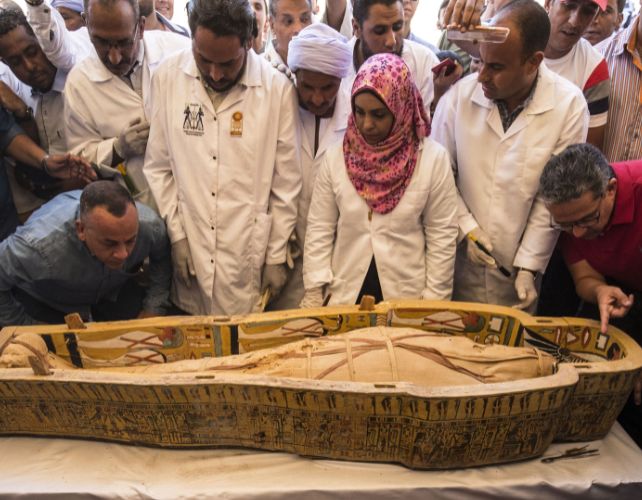
"Scent played a vital role in Egyptian mythology and afterlife," the team explains in their published paper.
"Spices would have been valuable in the embalming process due to their strong aroma, masking the unpleasant odours associated with death. The aromatic components of embalming materials are also a defence against pests and microbial infections to the mummified bodies."
Scientists already got a good whiff of nine mummified bodies at the Egyptian Museum in Cairo back in 2025, describing their fragrance as "woody", "spicy," and "sweet".
The University of Bristol team wanted to go a step further by directly linking these ancient odors to the specific organic embalming agents that emit them. This time, the 'sniffer' was a molecular scanner.

They analyzed 35 physical samples (small pieces of resin, bandage, and human tissue) from 19 mummies, a lineup of undoubtedly important people dating from around 2000 BC to 295 AD, who represent almost the entire duration of Ancient Egypt's mummification craze. All the samples were from mummies housed in museums in Europe and the UK.
Small sections of these samples had been analyzed in 2006, using the dissolving method, which gave the Bristol team a benchmark for comparison, to see whether their 'sniffing' method held up, and what extra insights it had to offer.
Each piece of mummy was placed into a chamber to 'breathe', releasing any VOCs that might have lingered through the ages. The trapped gases were then analyzed using gas chromatography and mass spectrometry. These techniques isolate and identify specific molecules within the sample, revealing which fats, waxes, and resins went into the embalming fluid.
Related: First Traces of Ancient Egyptian Hallucinogens Found in Old Jug
Most often, the key ingredients were fats and oils, beeswax, plant resin, and bitumen. But the study also revealed that these recipes changed across time.
In the early days, Ancient Egyptians embalmed their mummies with simpler recipes of fats and oils. But these recipes became more complex as time went on, incorporating more costly materials like resins or oils from plants like pine, juniper, and cedar, as well as bitumen.
"Mummies from different historical periods exhibit distinct volatile compositions, indicating that volatile analysis may serve as a minimal invasive tool for differentiating the chronology of mummies," the authors write.
"Therefore, VOC analysis can be used as a rapid, non-destructive, preliminary screening method to obtain useful analytical information without compromising the integrity of the sample or to target samples for more convoluted and time-consuming analysis."
The research was published in the Journal of Archaeological Science.