We all love a win-win. Well here's one better–a potential win-win-win.
By using what would otherwise be an industrial waste in new road pavements, the future of highways and byways could reduce impacts on climate change and potentially save lives.
A new analysis suggests that replacing conventional urban pavement with roads made partly from recycled steel slag could substantially cut greenhouse gas and air-pollution emissions, while also reducing road maintenance (so fewer annoying road-repair traffic jams, too!).
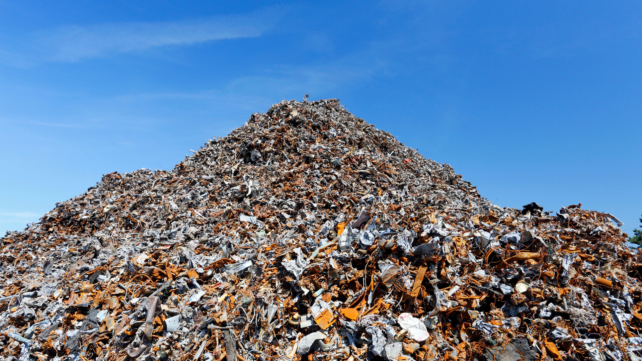
If you've never heard of steel slag, you're not alone. It's actually a waste product that comes out of the process of melting iron ore or scrap metal to make steel.
This leftover stuff is a mix of silicon dioxide and metal oxides and it can be used to make steel slag epoxy asphalt mixture, or SEAM.
Steel slag is kind of ideal for pavement because its high strength and angular structure make it useful for creating a durable road material.
In this study, the researchers combined the SEAM with an epoxy-modified asphalt binder, producing a material designed to withstand wear and deformation better than conventional pavement.
A more durable road reduces the social annoyance and air pollution of road-construction-related congestion.
But also, as pavement deteriorates, vehicles actually use more fuel (costly on its own both financially and in emissions). So if a road deteriorates less often, it also saves the vehicles that ride on it gas, diesel, and wear-and-tear.
In the researchers' model, all these use-phase effects accounted for about 95 percent of emissions and 60 percent of the lifetime costs of the road in the baseline scenarios.
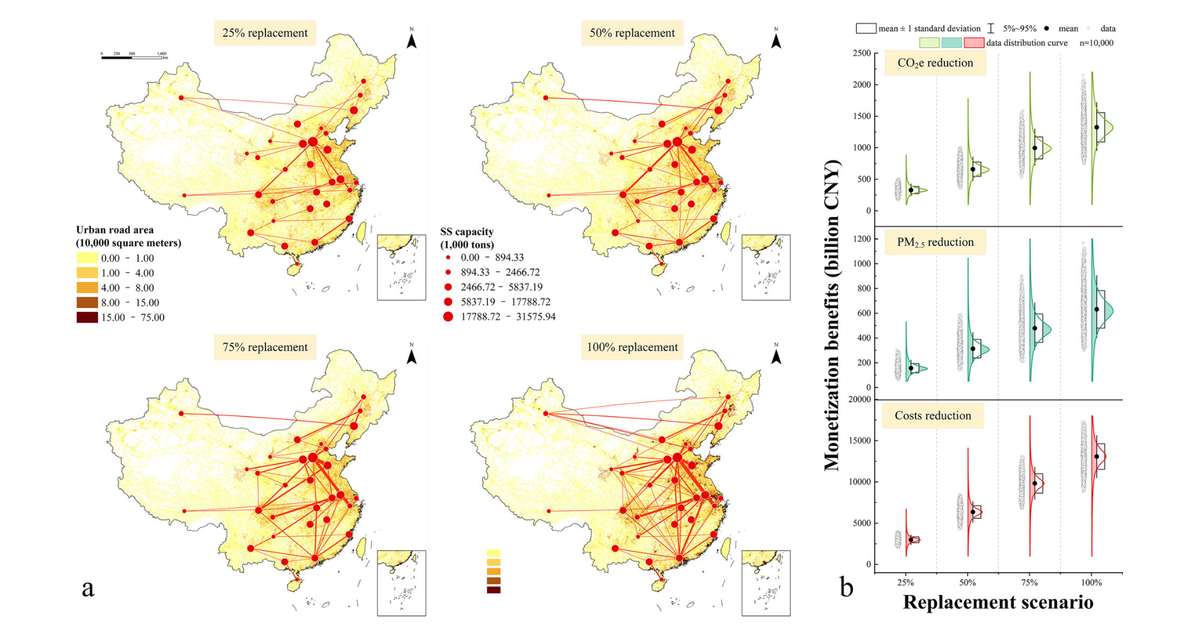
A) National-scale benefits of SEAM deployment in mainland China under specific scenarios. B) Distributions of the monetized benefits associated with reductions in CO2e emissions, PM2.5-related health damages and direct life-cycle costs across the 25%, 50%, 75% and 100% pavement replacement scenarios. (Zhang et al. Communications Earth & Environment, 2026.)
Even though most of the costs for any roadway happen in the use phase, the researchers do show that SEAM costs more to build, produces more emissions and generates more fine particulate pollution during its early years of use. But crucially, just when a conventional roadway surface needs replacement (generating those emissions again), the SEAM-based roadway emissions keep going.
This significant durability of the SEAM-based roadways changes the equation.
The researchers modeled three versions containing 20, 35 or 50 percent epoxy. Conventional pavement and 20 percent epoxy SEAM were assumed to last six years, while the 35-percent epoxy version lasted an estimated 15 years and the 50-percent version 20 years.
By spreading the emissions and costs of construction over a longer service life – and reducing the fuel and maintenance penalties associated with deteriorating roads – the longer-lasting pavement could eventually make up for its higher upfront footprint.
The researchers identified the 35-percent epoxy formulation as the best balance within their modeled scenarios: More epoxy extended pavement life, but beyond roughly 35 percent, the additional environmental gains leveled off while costs continued to rise.
They then scaled the model up to China's urban road network, testing scenarios in which 25, 50, 75 or 100 percent of existing urban asphalt pavement was replaced. At the highest replacement level, the model projected reductions of about 1.74 billion tonnes of CO2-equivalent emissions and 1.23 billion kilograms of PM2.5 over the assessment period.
PM2.5 is the fine particulate pollution that's linked to deaths from heart disease, kidney disease, dementia, hypertension, lung cancer, and other diseases.
Those numbers add up to create a pretty serious impact. Across the replacement scenarios, the researchers estimated 31,802 to 128,980 premature deaths could be avoided as a result of reduced PM2.5 exposure alone.
Those health figures come from a model linking modeled reductions in fine particulate pollution with established relationships between PM2.5 exposure and mortality. The authors explicitly describe the results as system-level estimates rather than precise epidemiological predictions.
Not to be overlooked, SEAM could also save some serious money: It could generate 3.48–15.01 trillion Chinese Yuan ($519.14 billion to $2.24 trillion US Dollars) according to the study.
These kinds of system-level material performance changes could have even larger implications as they're "broadly transferable to other rapidly urbanizing economies with significant steel industries," the study's researchers write.
"Countries such as India, along with several nations in Southeast Asia and Africa, generate large volumes of [steel slag] while facing accelerating transport demand and mounting environmental constraints." Those countries could also benefit from the climate, public health, and economic gains of the SEAM roadways.
There are logistical complications to account for: Steel slag isn't produced evenly across China, so the researchers modeled shipping it between provinces. That adds emissions – but in their model, the additional transport still produced a large net reduction in CO2-equivalent emissions and PM2.5.
The study also doesn't model whether today's industrial infrastructure could immediately produce and distribute enough material to meet nationwide demand. And one of the biggest drawbacks is that this new pavement requires seven days of curing before it can fully open to traffic.
It's interesting to think that a more sustainable roadway may not necessarily be the one that takes the least energy to build. It could be one that spends the longest time being boringly, gloriously roadlike – smooth, durable, and in need of fewer repairs.
The research has been published in Communications Earth & Environment.
This article was fact-checked by Rachel Garner and edited by Fiona MacDonald. While we pride ourselves on our process, we are only human. If you spot a mistake, please let us know.