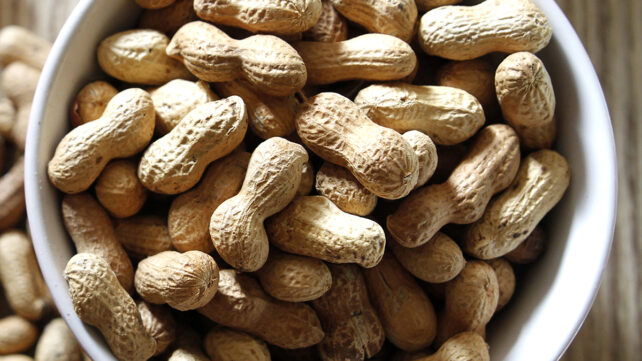
Worldwide peanut production results in more than 10 million tons of waste piling up each year in the form of discarded shells – but now scientists have discovered a method of turning this biomass into graphene-like carbon materials.
Graphene is based on carbon and is often described as a 'wonder' material: it's super strong, super light, and an excellent conductor of heat and electricity. It's already widely used and promises to significantly improve consumer electronics in the future.
However, it's also difficult to produce at scale and expensive to make, so alternative methods for manufacturing graphene could deliver significant boosts to energy systems, data storage, and other modern technologies.
Led by a team from the University of New South Wales (UNSW) in Australia, the new research shows that the humble peanut shell has the potential to boost graphene production, and in a way that's cheaper and more eco-friendly than some conventional graphene synthesis approaches.
"Most of the waste from the shell is either discarded or recycled into low-value applications that don't maximize their full potential," says UNSW mechanical engineer Guan Yeoh.
"What we have shown in this work is that basic peanut shells can be turned into high-quality graphene, using much lower energy than is currently required and therefore at a lower cost. We also do not need to use any chemicals, so there is an added environmental benefit."
Key to the process is the natural polymer lignin, which is packed with carbon and found in most plants. It was already known to be present in peanut shells, but the researchers had to figure out the best way to process it.

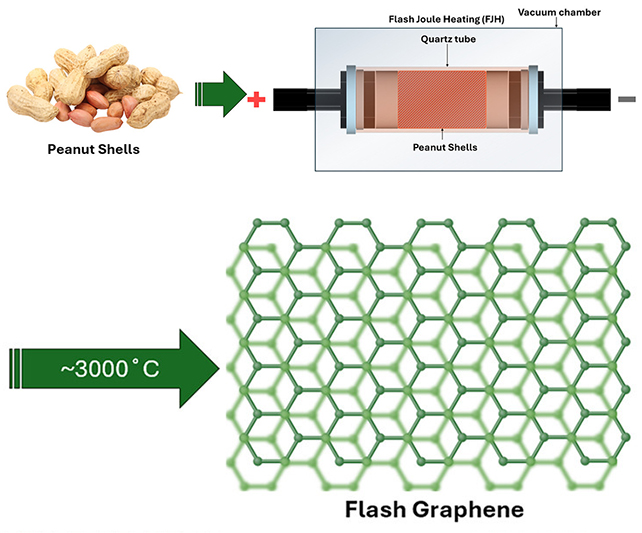
The team tested several methods for preparing the shell waste for unlocking that lignin, ahead of applying a process known as flash joule heating (FJH). This uses a 'flash' of electricity to cook the material up to temperatures exceeding 3,000 degrees Celsius (5,432 degrees Fahrenheit) for mere milliseconds. This instant blast of heat rearranges the carbon atoms into graphitic structures, including few-layer turbostratic graphene.
While FJH did most of the heavy lifting, how the shells were readied for the FJH was crucial. The best option, the researchers found, was a staged pretreatment involving indirect Joule heating at about 500 °C for 5 minutes, followed by a short higher-temperature step.
This removed impurities and turned the shells into char – another carbon-rich material that's much more conductive than the raw shells.
"That process is vital to remove the impurities and give us the best carbon-rich material to help ensure there are minimal defects in the final graphene and that it is indeed just a single layer of atoms," says Yeoh.
"That's what you want and need to ensure that it has the best properties in terms of conducting electricity and heat."
Although the peanut-shell-to-graphene pipeline has been experimented with before, this study highlights how carefully controlling the precursor material can significantly improve the resulting graphene quality.
Related: 'Wonder Material' Graphene Has Been Discovered on The Moon
That's not to say the process is perfect yet, though. The resulting graphene material scores highly in terms of quality but is typically composed of a few graphene layers stacked in a turbostratic arrangement, and the technique could take three to four years to scale up for commercial use, the researchers note.
Work to further refine the process from this lab-based proof of concept will continue. In the meantime, the researchers want to see if their bespoke preparation and heating approach might work with other types of biomass.
"We are planning to also carry out experiments with other materials, such as coffee grounds, or banana peels, or anything else that can give us that good char to then turn into graphene," says Yeoh.
"Considering how much organic material like that is available, our work demonstrates a good balance between the energy efficiency, the quality of graphene we end up with, and the economic viability of the whole process."
The research has been published in Chemical Engineering Journal Advances.