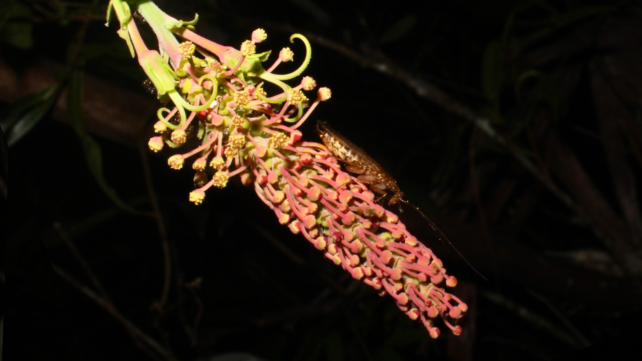
At about a quarter to six in the evening, the flowers on a small shrub in the Brazilian Amazon begin to open. Their scent is faint at first. As it grows stronger, nectar starts to trickle down the stalks of the hanging flower clusters.
Around seven, the first cockroaches arrive.
Bats are among the main pollinators of two related species, and this shrub shares some of their features, including flowers that open around dusk and produce plenty of nectar.
Yet in a new study published in the Brazilian Journal of Botany, the first to examine how this shrub is pollinated, the researchers recorded no bat visits.
The team found no nectar in the flowers from 9 am to 5 pm. After dark, cockroaches appeared to be among the shrub's most important pollinators.
Only about 1 percent of cockroach species are household pests, and wild cockroaches are rarely observed visiting flowers.
"It was never imagined that this type of interaction could occur in the Amazon, let alone contribute to reproduction, as the vast majority of attention goes to bees and bats," Tulio Alex Martins-Silva, a botanist at Brazil's National Institute of Amazonian Research, told ScienceAlert.
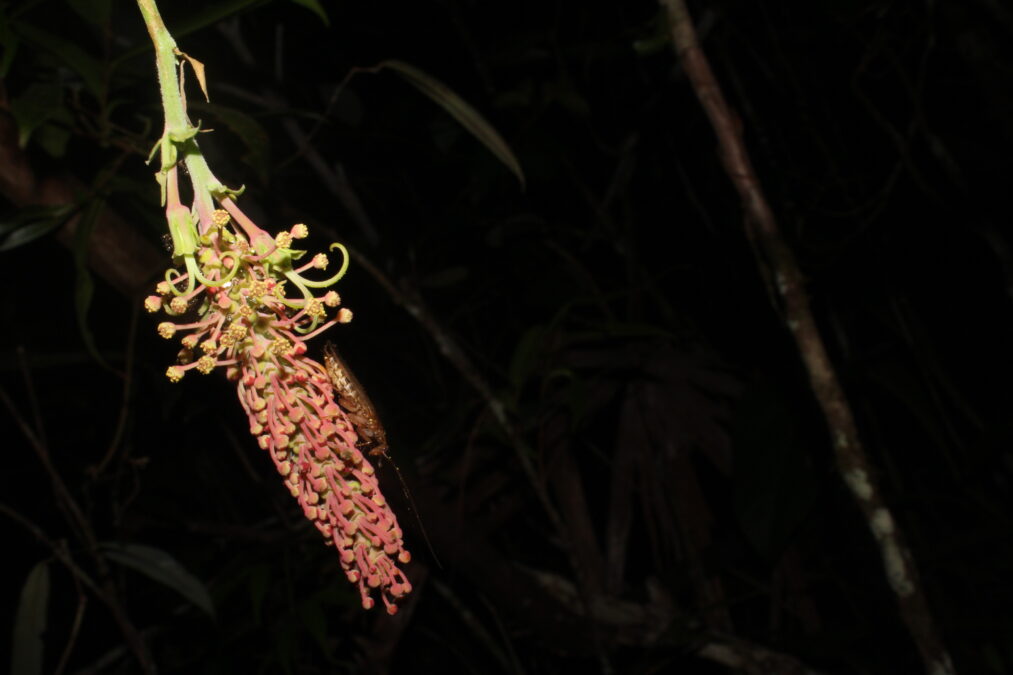
The team wanted to know which animals might carry pollen between shrubs and how much pollen from another plant mattered for fruit production. The cockroaches offered a clue when they stopped to drink.
A cockroach "has to bend its head down to reach the nectar, getting dusted with pollen all over again," Martins-Silva explained.
The shrub, Mabea uleana, belongs to the spurge family and grows only in Brazil's Amazonas state, in patches of vegetation on nutrient-poor white sand.
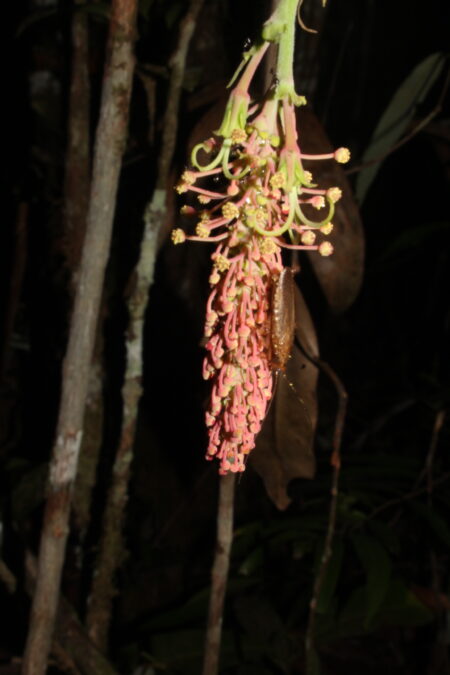
A hanging flower cluster is 4 to 6 centimeters (about 2 inches) long, roughly the length of a thumb. Near the stalk sit one or two female flowers that can develop into fruit. Below them are usually more than 200 tiny male flowers that release pollen.
A cockroach brushes past the female flowers on its way down to feed. By the time it reaches the nectar, pollen from the male flowers has stuck to its legs and belly. On its way out, it climbs back up the same stalk and touches the female flowers again.
If the cockroach is already carrying pollen from another shrub when it arrives, it could leave some behind before it even gets a drink.
"Euphorbiaceae pollen is very sticky," Martins-Silva said, using the scientific name for the spurge family. That helps explain why the grains cling to the insects as they move through the flowers.
Between June 2024 and January 2025, the team spent 252 hours watching flower clusters on six shrubs north of Manaus, dividing its time evenly between day and night.
In a separate experiment, the researchers gave some flowers pollen from their own cluster and others pollen from a different shrub. A third group stayed open to visitors.
Martins-Silva and botanist Layon Oreste Demarchi, a study co-author, analyzed the data.
About 93 percent of the flowers given pollen from another shrub formed fruit, compared with 15 percent of those given pollen from their own cluster. About 73 percent of flowers left open to visitors produced fruit. For this shrub, a visitor that brings pollen from another plant could make a big difference.
There's a precedent. In an earlier study in French Guiana, researchers estimated that cockroaches pollinated about 41 percent of the structures that could develop into seeds in another tropical shrub.
The team in Brazil recorded 18 cockroach visits. Martins-Silva suspects they missed some.
"Cockroaches are very sensitive to light, noise, and human presence, so my own presence may have contributed to the low visitation rate," he cautioned.
Small flies and moths also visited after dark. By day, stingless bees called Trigona almeidae were the most frequent visitors. They touched the female flowers as they gathered leftover pollen, and the researchers identified them as likely daytime pollinators.
The study took place at one site, and the fruit experiment didn't measure how much each group contributed.
Other familiar insects, including crickets and grasshoppers, may also move pollen.
A daytime survey of this Amazon shrub would have caught the bees at work. But to see what the cockroaches were doing on the same flowers, the researchers had to stay after dark.
The research has been published in the Brazilian Journal of Botany.
This article was fact-checked by Rebecca Dyer and edited by Rebecca Dyer. While we pride ourselves on our process, we are only human. If you spot a mistake, please let us know.