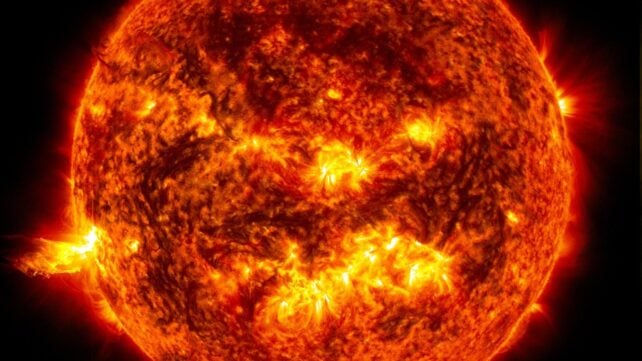
Move away from a fire, and you expect to feel cooler. But with the Sun, something very strange happens.
The Sun's outer atmosphere is hundreds of times hotter than its visible surface. Where does the energy behind that difference come from?
The visible surface is around 5,500 °C, while the outer atmosphere, called the corona, can exceed a million degrees Celsius.
Scientists have spent decades trying to explain how this thin layer stays so hot.
Researchers in China have now demonstrated a process in the laboratory that could help explain some of that heat.
Growing structures in laser-produced plasma brought magnetic fields together, allowing magnetic energy to become heat.
In an experiment, the peak electron temperature was almost twice that measured in a comparison experiment.
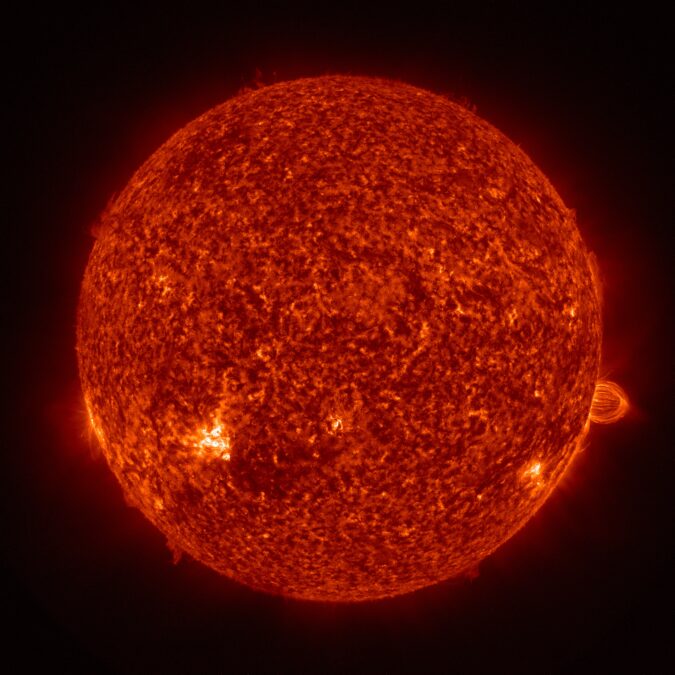
The team, including Wei Sun at the China Institute of Atomic Energy and Yongli Ping at Beijing Normal University, wanted to understand how small energy releases on the Sun might begin.
Scientists suspect that countless tiny flares, called nanoflares, could collectively help maintain the corona's temperature. The new experiment investigates a possible trigger for some of these events.
The Sun is filled with plasma, a state of matter containing electrically charged particles. Magnetic fields thread through this material.
When oppositely directed fields come together and change their connections, stored energy can be released, heating particles. This process is called magnetic reconnection.
To investigate how those fields could meet, the researchers fired four overlapping laser beams at a plastic target with a finely rippled surface at the Shenguang-II laser facility in Shanghai. The pulses lasted a billionth of a second and turned material from the target into plasma.
As the plasma expanded into the much less dense air around it and slowed down, ripples at the boundary grew into fingers and mushroom-shaped structures. This behavior is known as the Rayleigh–Taylor instability.
The plasma also generated its own magnetic fields around the fingers, with neighboring structures carrying fields in opposite directions.
Computer simulations showed how the expanding fingers brought those fields together, allowing them to reconnect and heat the surrounding plasma.
For comparison, the researchers repeated the experiment with a flat plastic target. This produced a smoother plasma flow without the finger-like structures.
By analyzing the X-rays emitted by the plasma, they estimated the temperature of its electrons, the negatively charged particles within it.
With the rippled target, the peak electron temperature reached the equivalent of roughly 820,000 °C. The value measured with the flat target was about half as high.
In a separate computer simulation that prevented magnetic fields from forming, the extra heating largely disappeared, further supporting their role.
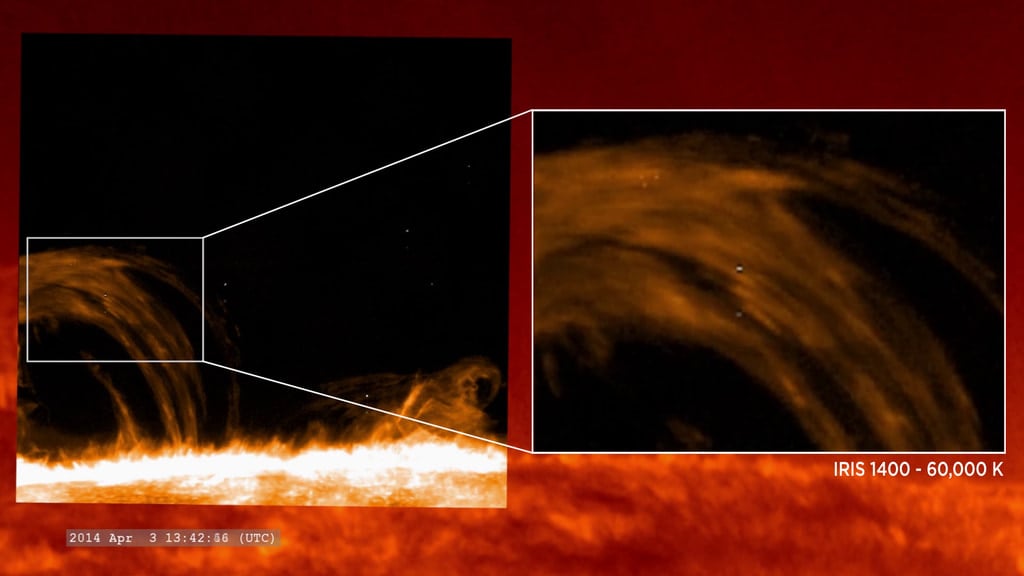
On the Sun, similar conditions could arise where relatively cool, dense plasma falls through the surrounding atmosphere. This phenomenon, called coronal rain, could create boundaries where the instability develops.
The experiment gives scientists a way to investigate processes that are too small and fast to observe clearly on the Sun. They can test which conditions bring magnetic fields together and how efficiently the resulting energy release heats the plasma.
The laboratory plasma was much denser, and the process unfolded on a much shorter timescale than in solar nanoflares. The researchers compared key physical ratios to assess which aspects could apply to the corona, but the setup did not recreate the Sun's full buildup of magnetic energy.
The findings support a mechanism that could help heat the corona. Further observations and experiments will be needed to establish how often it operates on the Sun and how much of the heating it supplies.
The research has been published in Physical Review Letters.
This article was fact-checked by Rachel Garner and edited by Peter Dockrill. While we pride ourselves on our process, we are only human. If you spot a mistake, please let us know.