An Iron Age human skeleton with some unsettling modifications was discovered inside a stone cairn on what is now Scotland's north-western coast.
The cairn – and the two skeletons it entombed – was excavated in 2000, but a re-analysis with modern techniques has revealed just how bizarre this burial really is.
The most unusual of the two skeletons is, according to DNA analysis, female, and the state of her bones raises many questions.
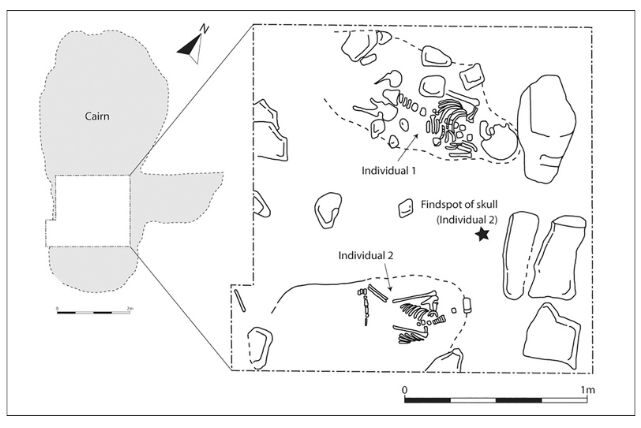
She was at least 30 years old at the time of her death, and mitochondrial DNA trapped inside her inner ear bone confirms she was family to the other skeleton buried within the cairn: a boy of about 15 years old. They were possibly cousins.
But what's more confusing about her remains is that someone seems to have manipulated them after her death.
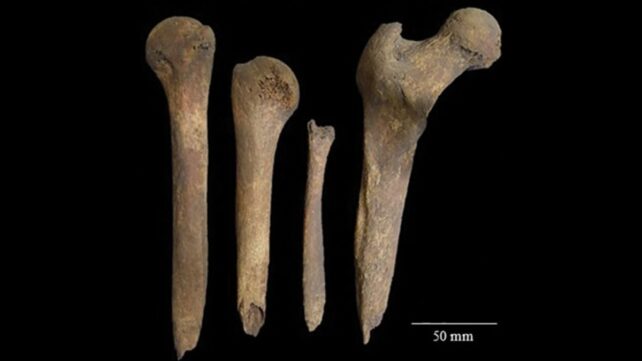
At least four of her limb bones appear to have been whittled into tools, with their ends sharpened into points, a bit like stakes.
"Although the original report suggests that these bones may have been gnawed by rodents, they lack the characteristic striations that would be expected from this process," the researchers explain.
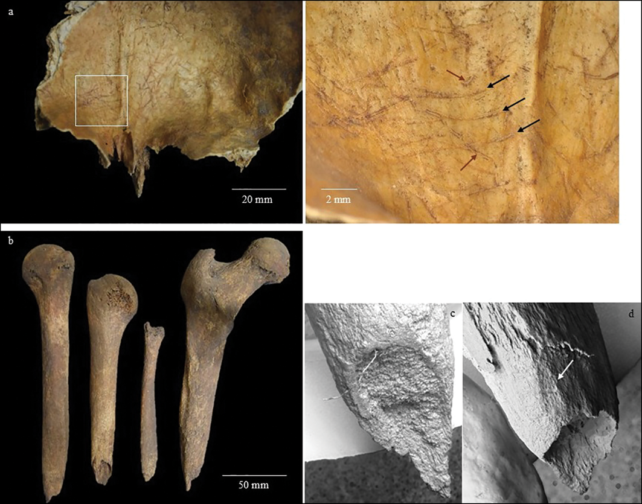
"Instead, the humeri and ulna taper towards the end of the fragment; the outer layers of cortical bone have been removed, and the internal layers have been whittled/worked to a sharp edge and a singular pointed end."
A U-shaped scar on the whittled surface of the left humerus bone (the kind that lives inside your upper arm) provides further evidence that humans, not rodents, shaped the bone, using a sharp implement such as a knife or an edge to work it into a point.
Making tools from human bones is peculiar enough.
But these whittled bones were then buried alongside the rest of the skeleton in their correct anatomical position in the grave – hardly a good place for keeping tools you intend to actually use.
On top of that, the female individual's cranium also bears signs of postmortem manipulation. The archaeologists now think that striations inside the skull, previously thought to be marks of general decay, are signs her brain was deliberately removed after her death.
"The motivation behind the extensive manipulation of the skeletal remains is very difficult to interpret," says Laura Castells Navarro, an archaeologist at the University of York and lead author of the study, "but the care with which she was reassembled and deposited in the cairn possibly suggests she commanded a level of reverence and respect by her community."

Both skeletons are lacking some bits and pieces: The female skeleton is missing most of her lower half, while only a quarter of the boy's skeleton has been preserved.
Some of this can be accounted for by the ravages of time and a bit of local meddling.
At some point, someone pinched some stones from the cairn to build a nearby field wall, and excavations in 2000 began because erosion had exposed the boy's cranium.
Related: Archaeologists Uncover 5,000-Year-Old Foundations of Strange Artificial Island
Meanwhile, DNA analysis also places these two individuals within a wider web of Iron Age maritime communities in the area.
Their family connections to individuals found at other burial sites span some 265 kilometers (165 miles), from a beach at Applecross, south-west of the cairn, to the Orkney Islands in the north.
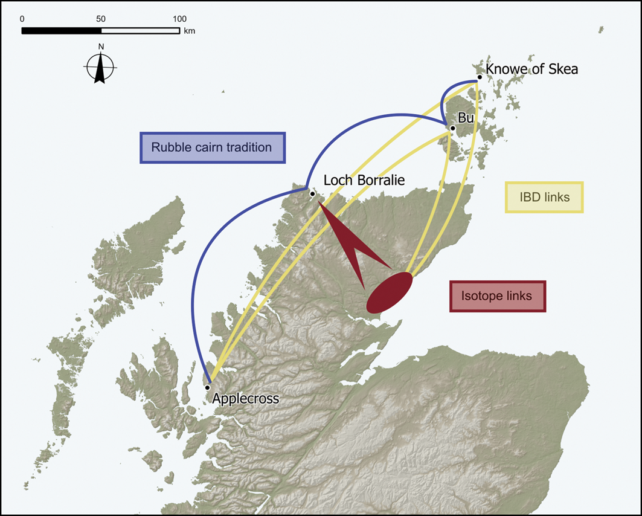
"Our research shows that prehistoric maritime communities periodically moved around the north coast and Northern Isles of Scotland, possibly in small groups," explains Castells Navarro.
"This movement allowed for the spread and maintenance of cultural practices and traditions."
The research was published in Antiquity.