
Exercise doesn't have to be a long, hard slog.
A small new study has now found that bite-sized 'snacks' of physical activity throughout the day can build comparable strength to one big workout.
In the experiment, 45 young male students aged 18 to 25 who already lifted weights regularly took part in an eight-week squatting program.
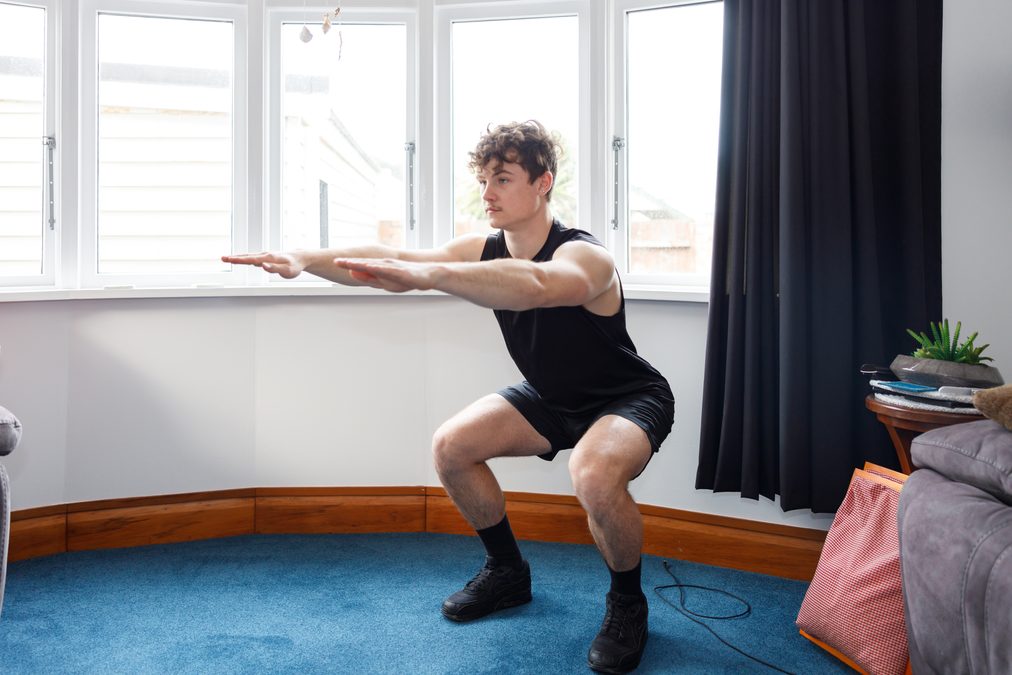
Three times a week, participants either completed three 1-minute bouts of resistance training, each including just 20 weighted squats, or a single continuous session of 60 weighted squats.
The squats were performed using a Smith machine under expert supervision, and the weight squatted became progressively heavier for each individual over the course of two months.
By the end of the trial, researchers found no significant differences between the fragmented resistance training and traditional training in terms of relative muscular endurance or strength.
The only difference was enjoyment.
Participants who 'snacked' on their squats throughout the day reported having more fun than those who completed one big squatting session.
"Dividing the same training volume into several brief sessions may reduce the perceived burden associated with prolonged exercise while allowing individuals greater flexibility to integrate exercise into their daily schedules," the study authors hypothesize.
The research was led by scientists at Tongji University in China, and the results have been published in the Journal of Exercise Science & Fitness.
"The present findings do not support the conclusion that traditional continuous resistance training is superior," the authors conclude.
"Instead, they indicate that distributing resistance training across multiple short bouts throughout the day provides neuromuscular adaptations comparable to those achieved through conventional continuous training."
Further research is now needed to investigate how these exercises compare over longer training periods and across more diverse cohorts.
According to these preliminary results, however, fragmented exercise could be a practical alternative for people who are time-constrained.
Recently, the concept of 'exercise snacking' has gained popularity.
Emerging evidence suggests that even small bouts of physical activity throughout the day can improve cardiorespiratory fitness, glycemic regulation, and several markers of health.
Most of these studies, however, are limited to aerobic activities such as climbing stairs or brisk walking.
But what about resistance training?
A large study suggests that putting in 90 to 119 minutes per week of resistance training is the sweet spot for lower mortality risk, but that doesn't necessarily mean all that exercise has to occur in one big gym session.
Breaking these minutes of physical activity into bite-sized chunks may stop fatigue from setting in, allowing for better-quality reps.

A recent study, for instance, found that holding a squat or plank pose a few times a week can help lower blood pressure, "providing a pragmatic option for individuals with limited time or adherence challenges."
On the flip side, however, continuous training may help build better endurance than smaller 'snacks'.
To test these possible outcomes, researchers in China randomized a small cohort of young male students to either partake in fragmented resistance training, continuous training, or no supervised training at all.
Participants had their strength and endurance tested at the start and end of the trial.
For endurance, participants were asked to squat as many times as possible at 40 percent of their maximum squat weight.
Beforehand, participants were asked to refrain from alcohol, as well as strenuous physical activity, for at least 24 hours.
They were also asked to get enough sleep prior to their testing sessions.
In the end, muscular strength, isometric squat force, and relative muscular endurance improved in both exercise cohorts compared to the control group.
Even though traditional training yielded greater gains in strength and endurance than exercise snacking, the differences were not statistically significant.
"Our hypothesis that traditional resistance training would produce greater improvements in muscular strength and relative muscular endurance than fragmented resistance training was not supported," the authors conclude.
These findings will need to be verified in follow-up trials, but it's possible that exercise snacking could make workouts feel easier to complete.
This, in turn, could enhance feelings of autonomy and achievement, making exercise more enjoyable.
The barrier to exercise can sometimes feel insurmountable.
Biting off a small chunk at a time could make healthy tasks much more digestible.
Eat up!
The research has been published in the Journal of Exercise Science & Fitness.
This article was fact-checked by Rebecca Dyer and edited by Rebecca Dyer. While we pride ourselves on our process, we are only human. If you spot a mistake, please let us know.