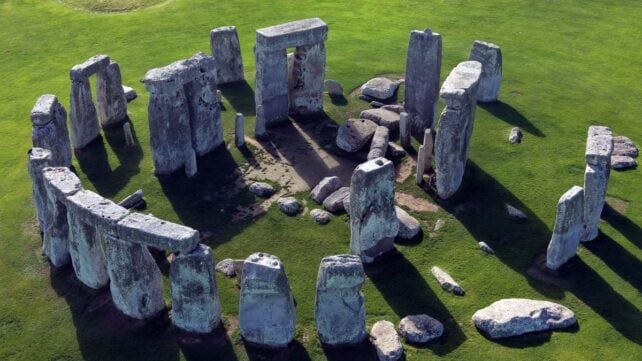
Somber, still, and timeworn, Stonehenge looms large in humanity's mythos – an ancient, enigmatic monument that has stood sentinel over southern England for millennia.
Who built it and why are questions that have mystified us for hundreds of years.
And in 2024, the mystery of the 5,000-year-old monument deepened.
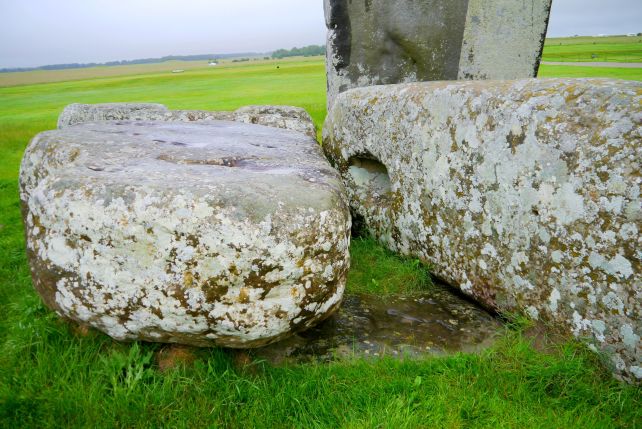
Scientists revealed that Stonehenge's Altar Stone – a mostly buried, 6.6-ton block of grayish-green sandstone – hailed from the far north of Scotland, some 700 kilometers (435 miles) from its current location on Salisbury Plain.
Somehow, it managed to travel that tremendous distance, leading some to ponder whether glacial ice had helped move the stone.
Now, a new analysis shows that at least part of the journey had to be aided by human effort.
"Rather than being carried naturally by ice, the evidence points to a deliberate, carefully planned movement across a challenging and varied landscape," says geologist Anthony Clarke of Curtin University in Australia.
"Our modeling shows glaciers may have transported rocks part of the way during the last Ice Age – potentially as far as Dogger Bank in the North Sea – but not into southern England, meaning the stone would still have needed to be moved hundreds of kilometers by people."
Although we can only guess at the original purpose of Stonehenge, the stones themselves contain clues.
They mostly consist of two kinds – giant local sandstone blocks known as sarsens, and the bluestones that make up the inner horseshoe, quarried from Wales, 230 kilometers away.
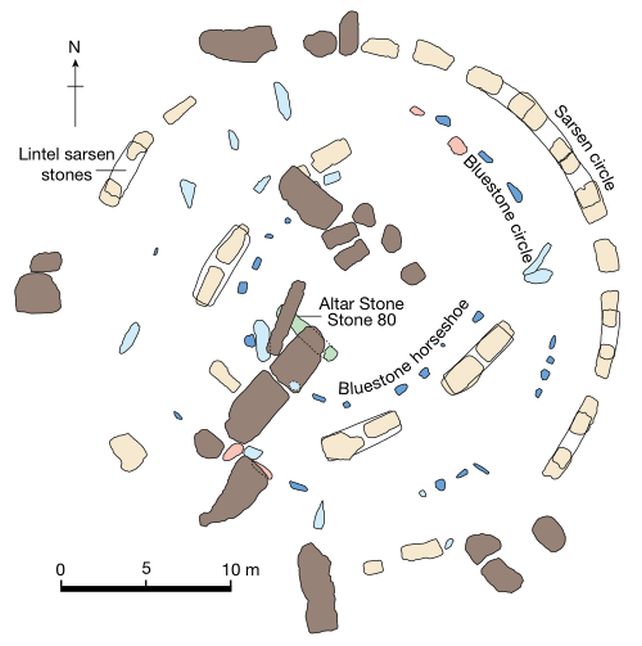
The Altar Stone, or Stone 80, is unique among the monument's stones. It lies almost hidden in the center, with two collapsed sarsens lying atop it, and is made of a type of rock that doesn't match any other stone in the formation.
In 2024, Clarke and his colleagues analyzed tiny zircon crystals in the Altar Stone and traced it to the Orcadian Basin, at the very northeastern tip of Scotland – about as far from Salisbury Plain as one can get on the British mainland.
Then, earlier this year, Clarke and fellow geologist Christopher Kirkland of Curtin University published a follow-up study.
After carefully studying the mineralogy of Salisbury Plain, the pair determined it had not been glaciated during the time period required for transporting the Altar Stone – concluding that, however the rock got there, it could not have been directly deposited by a glacier.
The new work is the final piece of the puzzle.
The first part was refining the origin of the Altar Stone. The zircon crystals most closely matched Caithness, right on the very tip of mainland Scotland.
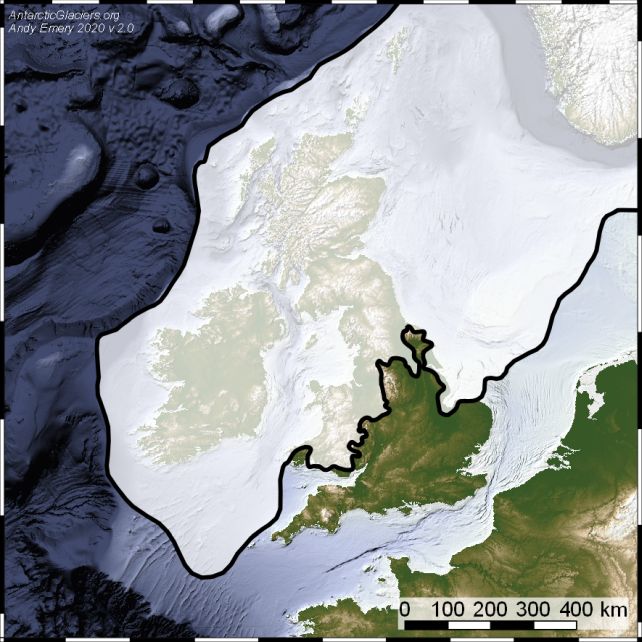
Then, the researchers modeled the flow of the British-Irish Ice Sheet during the Last Glacial Maximum, around 27,000 years ago.
Their conclusion was consistent with their earlier results: There's no way, they found, that ice could have transported the stone all the way from Caithness to Salisbury.
However, there may have been a middle ground.
It was possible, the results showed, that the stone could have been moved atop glacial ice as far as Dogger Bank, a now-submerged region beneath the North Sea that was dry land during the Ice Age.
That would have almost halved the journey to Salisbury Plain, cutting the distance from 700 kilometers down to 400.
The fly in that particular ointment, though, is that Dogger Bank was swallowed by rising seas thousands of years before Stonehenge was erected. So if the Altar Stone had been there, people would have had to have found it before the seas rose, moved it someplace else, kept it a while, and then used it to build Stonehenge millennia later.
That's a complicated chain of events – but perhaps a more plausible one than hauling a 6-ton rock over 700 kilometers.
"The research indicates there were no viable glacial pathways linking the source region directly to Stonehenge, reinforcing the conclusion that human transport was required," Clarke says.

"Instead, this suggests the stone was likely moved in stages, potentially combining overland hauling with river or coastal transport where possible."
Related: Could Stonehenge Be a Copy of This Even More Ancient Monument?
We may never know how that journey played out.
But the silent stones still tell a story of remarkable human ingenuity.
"Transporting a stone of this size over such a long distance would have required planning, coordination, and a deep understanding of the landscape – not to mention tremendous determination," Clarke says.
"The study demonstrates how combining geological analysis with computer modeling can help resolve long-standing questions about how Stonehenge was built."
The paper was published in the Journal of Quaternary Science.