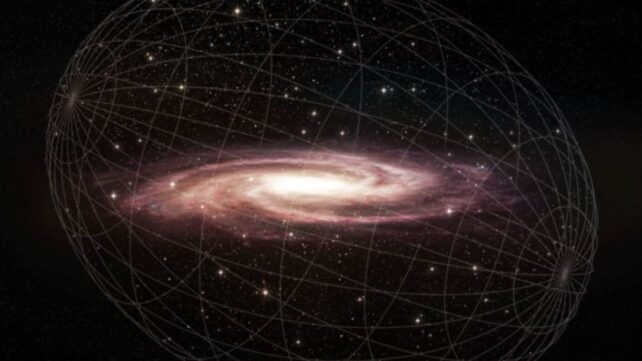
It's easy to think of our home galaxy as a relatively stable place, a neatly ordered disk sailing serenely through space like a frisbee – but it may be a lot more turbulent than it looks.
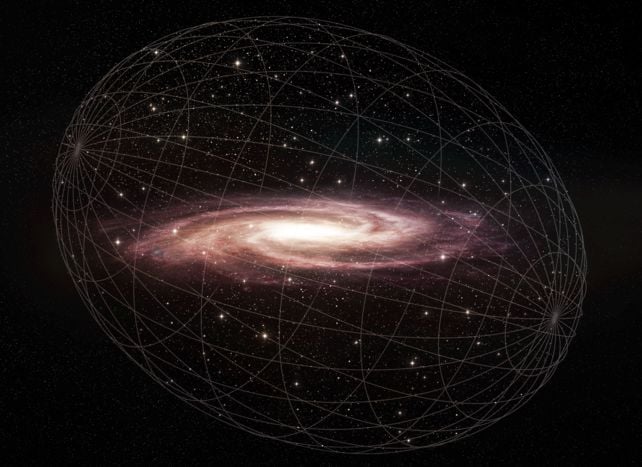
According to new simulation research, the entire disk of the Milky Way may have gradually tipped onto its side over billions of years, reorienting itself within its vast halo of dark matter after ancient collisions with smaller galaxies.
This theory adds to a growing body of evidence suggesting that the Milky Way has undergone a lot of upheaval in its 13.6-billion-year lifespan – and it could help explain some of the galaxy's more puzzling peccadilloes.
"The project started as an investigation of the rotational velocity of the stellar halo," astronomer Kirill Batrakov of Durham University in the UK told ScienceAlert.
"It was a little unexpected for me to find the connection between the rotation of the stellar halo and flips in the disk, which reflects a complex nature of the Milky Way and galaxies in general."
Batrakov and colleagues presented the findings at the 2026 Royal Astronomical Society's National Astronomy Meeting.
The Milky Way's disk is what most people picture when they imagine our galaxy, with good reason.
This thin structure is where most of the normal matter in the Milky Way is concentrated – all the stars and dust and gas and rocks, distributed along spiral arms that revolve around the galactic center like the blades of a fan.
But the disk is not all there is to it, not by a long shot. The Milky Way is roughly spherical, with vast domes above and below the galactic plane that are sparsely populated with ancient stars, known as the stellar halo, all enclosed in a giant bubble of dark matter known as a dark matter halo.
In the last decade, a satellite named Gaia, sent to map the positions and motions of stars in the Milky Way, recorded something odd in the stellar halo. The stars in the galaxy's outskirts appear to be orbiting the galactic center far more slowly than expected for the galaxy's mass.
One possibility for this discrepancy is that previous analyses overestimated the mass of the Milky Way.
Batrakov and his colleagues wanted to investigate a different idea.
Using a suite of cosmological simulations called Auriga, the researchers simulated the rotations of a number of Milky Way-like galaxies earlier in the history of the Universe.
The simulations showed that galaxies that formed early and underwent major mergers tended to have much more slowly rotating stellar haloes.
We actually have a fair bit of evidence that the Milky Way collided and merged with multiple smaller galaxies in the past, from streams of stars with chemistry that indicates they formed in an alien environment, to a wobbly warp in the Milky Way's disk.
One of these collisions took place about 10 billion years ago, involving a galaxy affectionately known as the Gaia Sausage because astronomers think it was sausage-shaped.
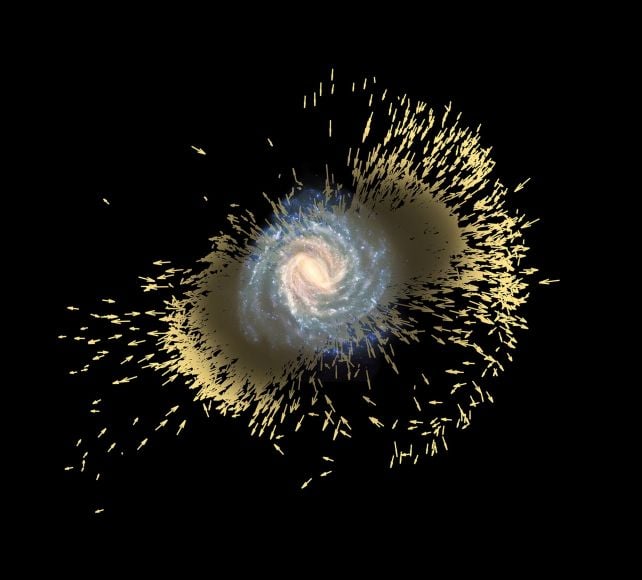
This collision, according to the team's simulations, could have exerted a gravitational torque that slowly reoriented the Milky Way's disk within its surrounding dark matter halo.
The result is a stellar halo that rotates much more slowly than expected.
"We defined the disk flip to be a change in the disk orientation by more than 90 degrees, so it means the whole Milky Way could 'turn on its side', not necessarily 'upside down'! In general, a flip can happen as a relatively gradual tilt of the disk until it reaches 90 degrees," Batrakov said.
"If we think about what a disk flip would look like for observers on Earth (if we could live long enough to see it from start to finish), the biggest change would be the night sky, as new constellations would form as the stars' positions changed!"
Interestingly, Batrakov's team is not the only group to come to this conclusion.
In a paper published earlier this year in Astronomy & Astrophysics, a team of astronomers led by the Chinese Academy of Sciences found evidence that the Milky Way's dark matter halo is oriented almost perpendicular to its stellar disk.

They, too, concluded that the most likely explanation is that the Galactic disk gradually reoriented itself over billions of years.
Disk flips are fairly common in cosmological simulations, although whether that translates into reality is unknown.
However, if the two teams of researchers are correct, perhaps the motion could eventually explain some other odd features of the Milky Way.
"Given the extremely low velocity seen in the Milky Way stellar halo rotation, I think a disk flip is a likely explanation, but it is too early to say with 100 percent certainty," Batrakov said.
"Ideally, we should try to identify alternative signatures of past disk flips to make that claim with full confidence."
The findings have been presented at the 2026 Royal Astronomical Society's National Astronomy Meeting in the UK.
This article was fact-checked by Michael Irving and edited by Rebecca Dyer. While we pride ourselves on our process, we are only human. If you spot a mistake, please let us know.