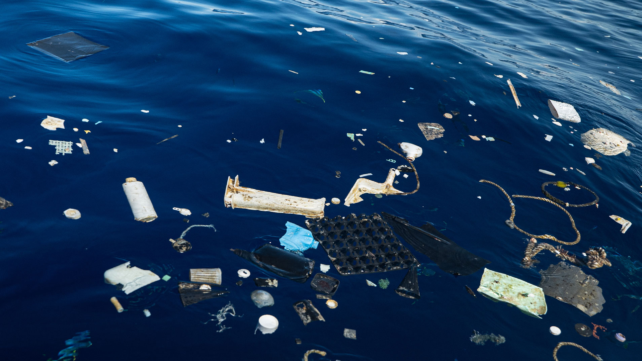
There's a monster lurking in the middle of the North Pacific Ocean, neither kraken nor Cthulhu, but a growing behemoth of humanity's creation.
The Great Pacific Garbage Patch is a vast, drifting accumulation of plastic trash, sprawling across an area roughly twice the size of Texas.
It's carried and concentrated by ocean currents, but it is not, as the description might suggest, a single congealed agglomeration of garbage. It's so diffusely spread that it cannot be detected in satellite images from Earth orbit.
Or so we thought.
The concentration of microplastics in the garbage patch may have become high enough to change the color of the ocean in which they drift, according to a new study by ocean optics specialists Shea Cheatham, Daniel Koestner, and Børge Hamre of the University of Bergen in Norway.
"We were shocked, excited, and a little alarmed to see the same shift in ocean color on the map after we analyzed the first satellite dataset of the garbage patch," Cheatham told ScienceAlert.
"Our first reaction was disbelief, which is what led us to check two other satellite datasets just to convince ourselves that it was even remotely possible that we could be seeing the same signature evident in our models."
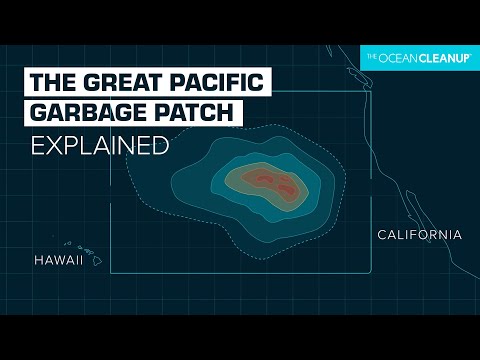
The Great Pacific Garbage Patch lies within a giant circular system of currents in the North Pacific called a gyre, which has become a catchment area for plastic detritus. A 2018 survey estimated that it contained some 1.8 trillion pieces of plastic, weighing around 79,000 metric tons.
Much of that mass consists of discarded fishing equipment, with a later study tracing a substantial proportion of the larger debris to fishing industries in Japan, China, South Korea, Taiwan, and the United States.
But by sheer number, tiny fragments of microplastic dominate, accounting for an estimated 94 percent of the pieces floating in the patch, although only 8 percent of its total mass.
The work of Cheatham and her colleagues began not with the Great Pacific Garbage Patch, but with how similar microplastic fragments interact with light in a marine environment.
Specifically, it grew out of laboratory research examining how microplastics absorb and scatter light, comparing their optical properties with those of naturally occurring materials in seawater, including phytoplankton and minerals.
And something intriguing emerged.
"We observed some unique properties that suggest that microplastics scatter and absorb light differently enough to potentially produce unique optical signatures which may be detectable in some oceanic environments," Cheatham explained.
The researchers then turned to models to see if these signatures might be detectable with current satellite capabilities. Their simulations suggested that the optical effect may occur at microplastic concentrations potentially already swirling around in the Great Pacific Garbage Patch.
So, the next step was obvious.
"We decided to take a look at existing satellite records to see if there were any changes in the ocean's color consistent with the signature of microplastics shown in our simulations," Cheatham said.
And there it was.
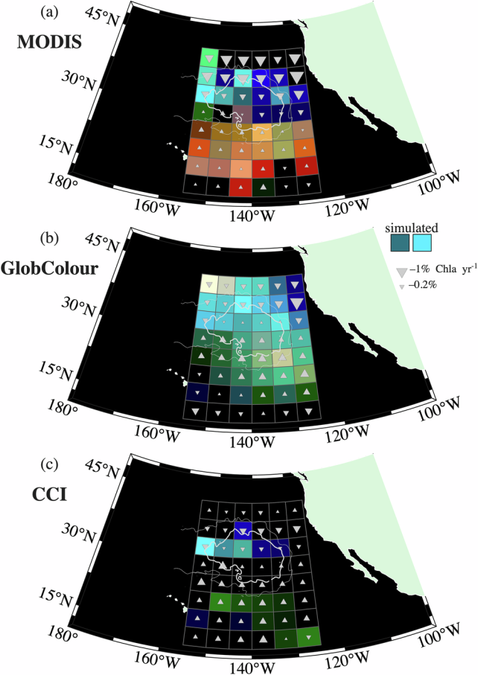
Across satellite observations spanning 2002 to 2022, the researchers identified a subtle but statistically significant brightening of the ocean in blue and green wavelengths near the Great Pacific Garbage Patch – a gradually growing cyan tint.
It was consistent with the optical signature that their simulations had predicted microplastics might produce.
Now, seawater can be pretty mucky. All sorts of particulate and dissolved matter drift around in it, and there's a lot more in the gyre than just trash.
But scientists also have a pretty good handle on what different clouds of marine miscellany look like from space.
Phytoplankton, for example, absorb blue and red wavelengths, leaving the ocean looking greener. Dissolved organic matter absorbs more blue light, giving water a darker or browner appearance.
Microplastics behave differently.
"What's interesting about the optical signature of microplastics is that they generally do not absorb much light at all across the visible spectrum, and are strong scatterers," Cheatham said.
"So they brighten the ocean, and this brightening preferentially occurs simultaneously at blue and green wavelengths."
That combination of blue and green brightening is unusual. Changes in phytoplankton or dissolved organic matter can alter the ocean's color, but their different absorption properties make them unlikely to produce quite the same effect.
Other particles, such as mineral dust, can also scatter sunlight and brighten the ocean. However, these tend to be more abundant in coastal waters, and measurements from a nearby research station showed a stable pattern of dust deposition over the study period.
This doesn't conclusively establish that microplastics are responsible. The researchers found that certain combinations of natural environmental changes could produce a similar signature, although these scenarios were relatively rare in their simulations.
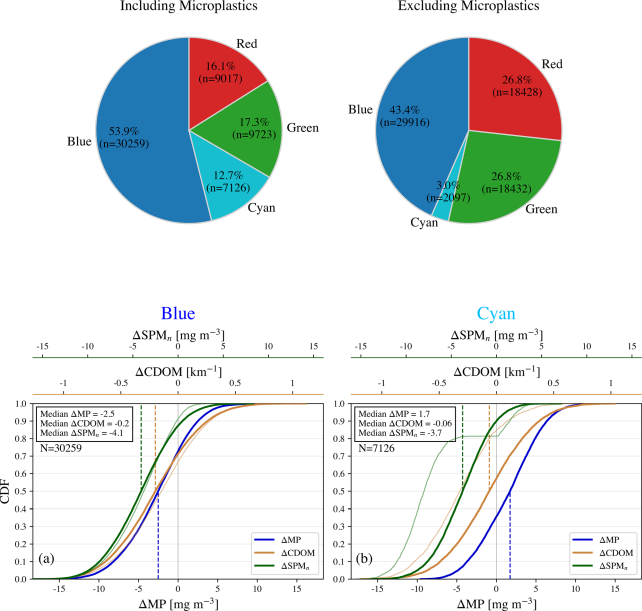
Nevertheless, the correspondence between the predicted signature, the satellite observations, and their location in the Great Pacific Garbage Patch makes microplastics a compelling possible explanation.
If it looks like microplastics in the garbage patch, it would be silly not to investigate the possibility of it being microplastics in the garbage patch.
Which is where the researchers are now. Occam's razor may point toward microplastics, but proper scientific caution requires confirmation – and that means testing the seawater in the Great Pacific Garbage Patch.
"To fully answer the question of whether microplastics themselves are the root cause of this ocean color shift, we will need to go to the garbage patch to make optical measurements of water samples and quantify the microplastics present," Cheatham said.
"We're hopeful that we can do this work in the future."
If those results confirm the researchers' suspicions, we can add yet another tally mark to the list of ways plastic pollution is changing the world on a large scale.
But microplastics may also present the biggest challenge to cleaning up the Great Pacific Garbage Patch, despite accounting for only a small proportion of its mass.
Cleanup efforts have been able to remove larger pieces of junk. There's no such solution for tiny fragments.
"Removing microplastics from the water column, particularly the smallest plastics we focus on in our study, is essentially impossible, and these plastics are the most likely to enter the base of the marine food web and end up on your plate," Cheatham said.
"At present, the only way to reduce microplastic pollution is to prevent them from entering the water in the first place."
The research has been published in Communications Earth & Environment.
This article was fact-checked by Rebecca Dyer and edited by Rebecca Dyer. While we pride ourselves on our process, we are only human. If you spot a mistake, please let us know.