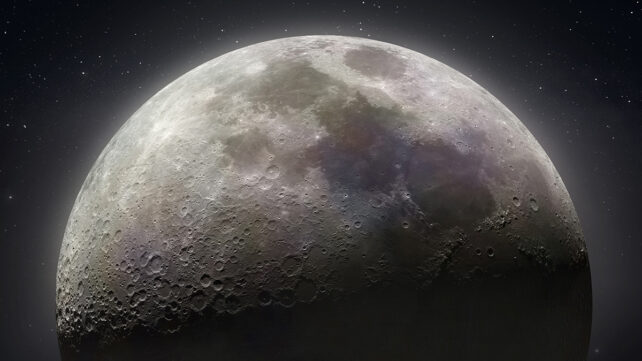
A new study may have solved a long-standing mystery about the Moon's magnetism: Why do lunar rocks brought back by the Apollo missions show evidence of an intense magnetic field sometimes rivaling or exceeding that of Earth today?
Considering the Moon is much smaller than our planet, and doesn't have the same internal energy and core dynamics that power Earth's magnetic field, it's surprising that these 3.5 billion-year-old rock samples have such strong magnetic signatures.
In this new analysis, researchers from the University of Oxford in the UK conclude that these signatures could be evidence of sudden, temporary bursts in magnetism, brought on by ancient geological processes that happened long before the Apollo missions landed and started collecting samples.
"Our new study suggests that the Apollo samples are biased to extremely rare events that lasted a few thousand years – but up to now, these have been interpreted as representing 0.5 billion years of lunar history," says planetary geologist Claire Nichols.
"It now seems that a sampling bias prevented us from realizing how short and rare these strong magnetism events were."
The researchers reexamined lunar rock samples known as the Mare basalts, looking for patterns between their geological ingredients and how strongly or weakly magnetized they were (which indicates the magnetic field strength at the time they were formed).
A clear link emerged: Rocks with stronger magnetism had much higher titanium content.
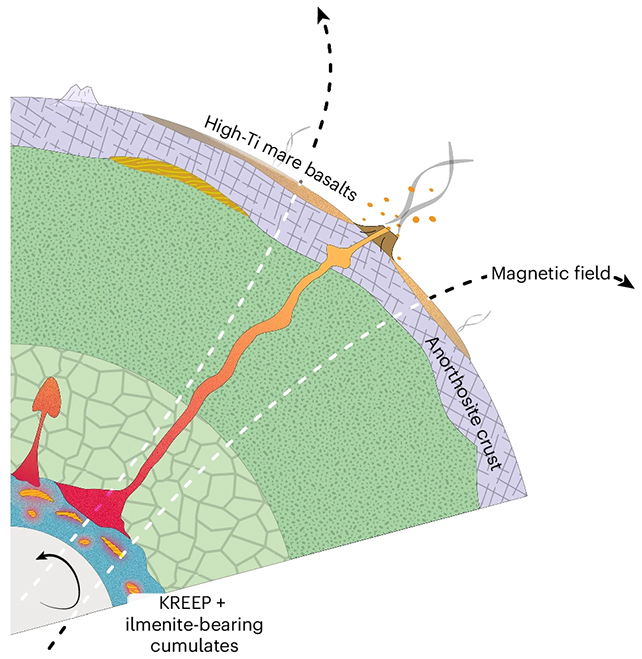
Next, the team ran computer models to explore how the processes that produce titanium-rich rocks could also trigger intense magnetic fields.
The models showed that melting of titanium-rich material near the Moon's core-mantle boundary could briefly increase the heat flow from the core, triggering or enhancing dynamo activity and boosting the magnetic field while also producing titanium-rich lava flows.
Because the Apollo missions sampled similar mare basalt regions of the Moon – close to where the model posits titanium-rich lavas would have flowed – the rock samples gathered by the astronauts therefore have a sampling bias that has baffled scientists for years.

"If we were aliens exploring the Earth, and had landed here just six times, we would probably have a similar sampling bias, especially if we were selecting a flat surface to land on," says earth scientist Jon Wade.
"It was only by chance that the Apollo missions focused so much on the Mare region of the Moon – if they landed somewhere else, we would likely have concluded that the Moon only ever had a weak magnetic field and missed this important part of early lunar history entirely."
These periods of intense magnetism would likely have lasted only a few thousand years, the study team suggests, which are really just blips compared to how old the Moon is.
It's a solid hypothesis that fits the available evidence, but the researchers acknowledge that their models are based on several assumptions to cover gaps that we don't have enough data for – researchers only have a small sample of Moon rocks to work with – and that more modeling will be needed to further validate these results.
Today, the Moon has a very weak and patchy magnetic field compared to Earth's strong global one, and numerous previous studies have given other explanations for these geological records of something much stronger. Asteroids crashing into the lunar surface may be part of the story, for example.
The good news for researchers hoping to finally get some clarity on this issue is that there are plans to put humans back on the Moon before the end of the decade, which will give us invaluable opportunities to run more tests and collect more rock samples.
Related: Scientists Cracked Open a Lunar Rock And Found a Huge Surprise
"We are now able to predict which types of samples will preserve which magnetic field strengths on the Moon," says geoscientist Simon Stephenson.
"The upcoming Artemis missions offer us an opportunity to test this hypothesis and delve further into the history of the lunar magnetic field."
The research has been published in Nature Geoscience.