Your belly button may be more than a mere catchment zone for human detritus.
The divot in your abdomen is a natural reservoir for collecting the dead skin cells, sebum, and sweat that shed from your body – as well as bacteria to feast upon them.
Together, this aggregation of bodily grime can generate quite an interesting aroma – one that, scientists have now discovered, might be an untapped window into your overall health.
In a small proof-of-concept study, researchers found that chemical profiles swabbed from the belly button could distinguish between groups of healthy people and those with Parkinson's disease, mild cognitive impairment, or COVID-19.
Although it involved just 24 participants, the study has identified a potential new non-invasive diagnostic tool to explore – the complicated effluvium produced by the human body at every stage of life.
"The body emits certain odors – from skin sebum or sweat – that serve as early diagnostic warning signs," writes a team including sensor scientist Thorsten Graunke of the Fraunhofer Institute for Integrated Circuits IIS in Germany.

Humans are not inert systems that exist in neatly contained bodies. We all exude a constant miasma of volatile organic compounds, or VOCs – tiny, carbon-containing molecules that evaporate readily on contact with air.
These can reach the world outside the body through a plethora of pathways – such as sweat, breath, urine, saliva, and skin oils – as part of normal metabolic processes.
But the exact profile of those VOCs can vary. What you eat or what medicine you take can make your sweat, breath, or pee smell quite different.
Disease, too, can leave its mark on the human fragrance profile.
One particularly remarkable example is Parkinson's disease. A woman named Joy Milne famously discovered that she could smell the condition, first noticing a strange, musky odor on her husband years before he was diagnosed.
Which, naturally, raises the question – could scientists build a tool that detects the odors of disease reliably enough to help diagnose it?
To answer this question, Graunke and his colleagues turned to a gas-analysis technique called laser-based photoacoustic spectroscopy – and some areas of the human body likely to be particularly ripe.
"Swabs from the anterior part of the nasal cavity, from the navel, and from the concha part of the ear are less exposed to perfume, soap, and other factors," they explain, which makes these sites "an easily accessible source of human body odor volatilome."
The researchers recruited 24 participants: six with Parkinson's disease, six with mild cognitive impairment, six with COVID-19, and six healthy controls.
Each participant was swabbed in three places – inside the nose, around the concha of the ear, and in the belly button – for about 10 seconds using a sterile cotton swab. The samples were then sealed and frozen until they could be analyzed.
Then comes the laser disco.
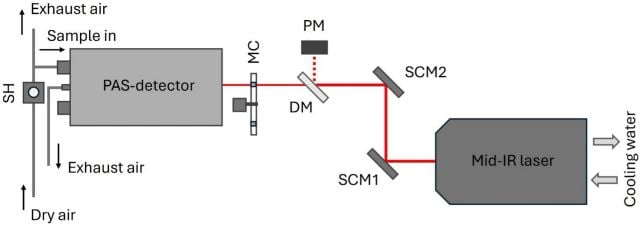
To sample each person's individual bouquet, the researchers placed the swabs in a specially designed holder and flushed them with highly purified synthetic air, which wafted the VOCs into the air above the swab and into the laser-based photoacoustic spectrometer.
When the VOCs absorb the infrared laser light, the absorbed energy heats the surrounding gas, causing it to expand; different molecules absorb infrared light more strongly at different wavelengths. This generates tiny pressure waves – sound – that an extremely sensitive detector can pick up.
The stronger the sound at a particular wavelength, the more strongly the sample is absorbing the laser light, revealing where its mixture of VOCs absorbs most strongly.
By sweeping the laser across a range of wavelengths, the researchers could therefore build up a spectral fingerprint of the complicated cocktail of chemicals wafting off each swab.
They then used a statistical technique called principal component analysis to look for patterns in those fingerprints – and determine whether samples from people with the same condition tended to resemble each other.
And they did.
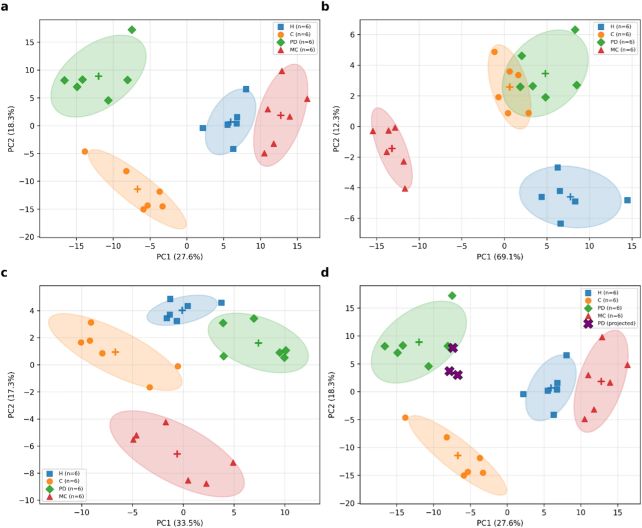
The clearest differences emerged from the nose and the belly button.
In particular, the navel samples produced distinct group-level patterns, with the healthy participants and those with mild cognitive impairment showing the strongest separation. The Parkinson's and COVID-19 samples fell between them, with some overlap.
The researchers even had the opportunity to test whether one of those patterns would persist over time.
Two weeks after the initial measurements, they collected samples from three additional people with Parkinson's disease. When the researchers added them to the existing analysis, they clustered with the original Parkinson's group.
With only three people, the researchers stress that this result is preliminary. But the new samples clustering with the original Parkinson's group suggests the pattern wasn't just a quirk of samples collected from particular people on a particular day.
And the whole laser gamut may not be necessary to identify it, either.
For the initial analysis, the researchers swept across a broad range of infrared wavelengths. But when they looked for the wavelengths carrying the most useful information, they found that just five individual wavelengths could separate the groups almost as well as the most informative stretch of the spectrum.
That means that future equipment could be smaller and less cumbersome – and also less expensive – than the full apparatus used in the initial test.
There are some pretty big caveats, however.
The first is that the sample size is really small. For a proof-of-concept study, it works, but it does mean that, at this stage, no conclusions can be drawn about whether your belly button can help diagnose health issues.
Age also raises a big question mark that will need to be addressed. Age was associated with differences in the spectral fingerprints, and the researchers found that age and diagnosis were too closely associated in this small cohort to disentangle their effects.
With so few participants, the researchers couldn't tease apart how much of the variation was associated with disease and how much with age. Larger studies using age-matched groups will be needed to confirm that the disease-associated patterns persist independently of aging.
Plus, the experiment took place in tightly controlled laboratory conditions. Out in the world, soap, perfume, personal hygiene, and environmental contaminants could all muddy the chemical waters. Real-world validation is another important avenue for investigation.
For now, your personal funk will have to remain just that – so do feel free to keep washing your ears. We're sure everyone else on the subway will thank you.
The research has been published in Scientific Reports.
This article was fact-checked by Rebecca Dyer and edited by Rebecca Dyer. While we pride ourselves on our process, we are only human. If you spot a mistake, please let us know.