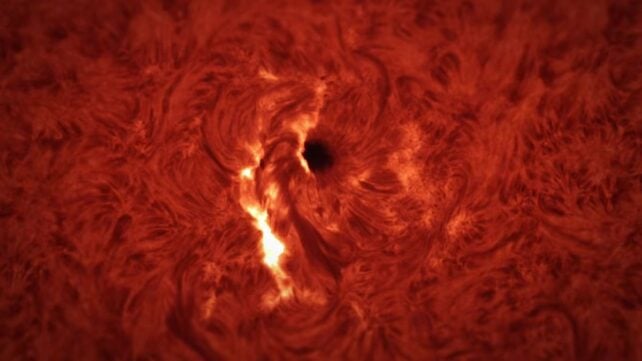
We can now confirm that a sunspot belching out a solar flare is at least as unnerving to listen to as it is to watch.
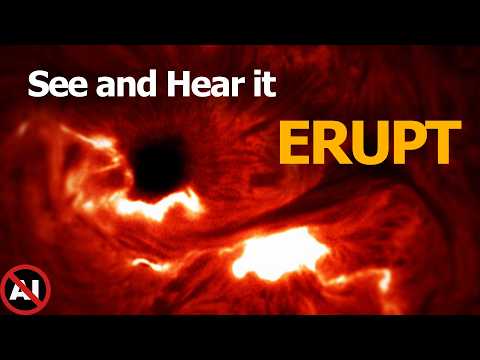
In a video recorded in March 2026, backyard astronomer DudeLovesSpace fortuitously captured an active sunspot region named AR4392 right at the moment it erupted in a flare of radiation.
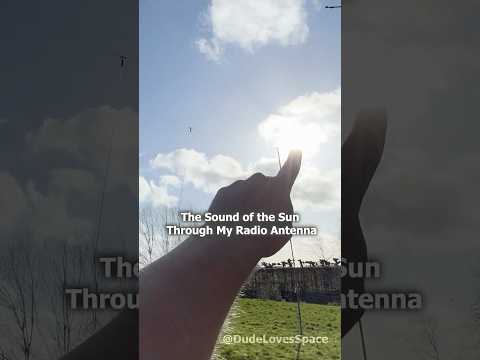
The icing on this particular flambé is that ground-based radio instruments recorded some of the wavelengths in radio light, which DudeLovesSpace converted into an audio signal. The result is a rare audiovisual experience of the Sun.
"What started as a nice clear, cloudless observing day quickly turned into something special," DudeLovesSpace wrote in the video caption. "I didn't expect to get this lucky, but this giant flare erupted from sunspot AR4392 right in view!"
The Sun has been less active in the last few months as it moves away from the peak of its 11-year activity cycle. The peaks of these cycles are characterized by an escalation in sunspot activity, accompanied by solar flares and coronal mass ejections – three solar phenomena that often occur together.
We don't have a comprehensive picture of what drives the solar cycle, but the activity peak – known as solar maximum – is when the Sun's magnetic poles flip, and the activity involved includes an increase in magnetic complexity and chaos.
Sunspots are regions on the visible surface of the Sun where local magnetic fields are temporarily much stronger. They're generated by magnetic activity deep inside the Sun, which makes them a good proxy for tracking solar cycle activity. Solar maximum means lots of sunspots, while solar minimum means very few.
Where there are sunspots, you'll also find solar flares, the colossal flares of light that can disrupt communications on Earth, and coronal mass ejections, which are expulsions of billions of tons of solar particles sneezed out across the Solar System.
These eruptions often occur near sunspots because the engine that drives them is the solar magnetic field. Magnetic field lines tangle, snap, and reconnect, unleashing vast explosions of energy that blast solar material outward.
AR4392 made its first appearance on 12 March 2026 and spent the next two weeks being watched by astronomers before the Sun rotated it away out of view. It wasn't a particularly large sunspot compared to some of the monsters seen during solar maximum last year, but it was one of the more active during its disk passage.

It also belted out two moderate M-class flares, on March 16 and 18, and some weaker C-class flares. The flare recorded by DudeLovesSpace was the strongest, an M2.7 flare that took place on March 18 and lasted about 16 minutes. The astrophotographer sped up the flare in his video.
What you are hearing is not exactly what the Sun would sound like if we could hear it through the near vacuum of space. That sound, scientists predict, could be a constant roar at around 100 decibels.
Related: Space Is Dead Silent – But There Is a Way to 'Hear' a Black Hole
Instead, DudeLovesSpace used a technique called data sonification to convert the Sun's radio waves to an audio signal. Doing this has several advantages. For scientists, it can offer a new way to perceive the data, bringing previously unnoticed features forward.
For us here at home, listening to space gives us a way to appreciate the alien wonders of the cosmos – and, perhaps, feel grateful that we don't have the Sun screaming bloody murder at us all day, every day.
You can follow DudeLovesSpace on YouTube here, and watch a video about how he records his observations here.