There's growing evidence that the number of missing teeth a person has is an indicator of their risk of dying earlier than expected, and new research suggests the condition of their remaining teeth may also be significant.
A team led by researchers at the University of Osaka in Japan studied health and dental records of 190,282 adults aged 75 and older. Each tooth position was marked as missing, sound (healthy), filled (repaired by a dentist), or decayed.
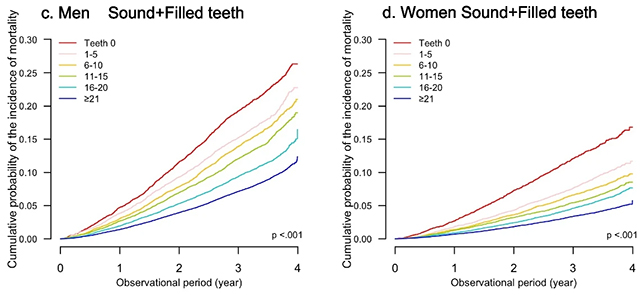
The results showed that sound and filled teeth were about equally associated with lower mortality risk. A greater number of missing or decayed teeth was linked with increased mortality risk, reinforcing previous findings.
Related: 'Toothpick Grooves' in Neanderthal Teeth Aren't What We Thought
"The total number of sound and filled teeth predicted all-cause mortality more accurately than the number of sound teeth alone, or the number of sound, filled, and decayed teeth combined," write the researchers in their published paper.
All-cause mortality measures the likelihood of someone dying earlier than they would typically be expected to, due to any reason. It's thought that oral health is closely linked to overall health – through factors like inflammation.
The researchers suggest that missing or decayed teeth can lead to chronic inflammation that may spread to other parts of the body. Having fewer teeth can also make it harder to chew food and maintain a healthy, nutritious diet.
This study highlights the importance of oral health: Getting teeth fixed and repaired can not only keep your mouth in better shape, but might also protect you against the risk of early death.
"Although multiple studies have identified the number of non-missing teeth as a significant predictor of all-cause mortality, few have assessed the impact of each tooth's clinical condition on all-cause mortality," writes the team.
The team acknowledges that their findings might be influenced by other factors not recorded in the study. A lack of proper dental care could reflect low socioeconomic status, for example, which can also affect how long you live.

The research aligns with another recent study in Geriatrics & Gerontology, by a team at the Institute of Science Tokyo. It looked more broadly at oral frailty, which encompasses missing teeth, problems with chewing and swallowing, dry mouth, and difficulty speaking.
People with three or more of these symptoms were 1.23 times more likely to require long-term care and 1.34 times more likely to die across the study period, based on an analysis of 11,080 older adults. It's another indication that looking after your oral health increases your chances of a longer, healthier life.
Future studies, the University of Osaka researchers say, should examine not only how many teeth people have, but also their condition. There's still lots more to learn about why those of us in older age with fewer teeth are more likely to die sooner.
"The mechanism underlying the association between the number of decayed and filled teeth and all-cause mortality should be carefully investigated in well-designed cohort studies," conclude the authors.
The research has been published in BMC Oral Health.