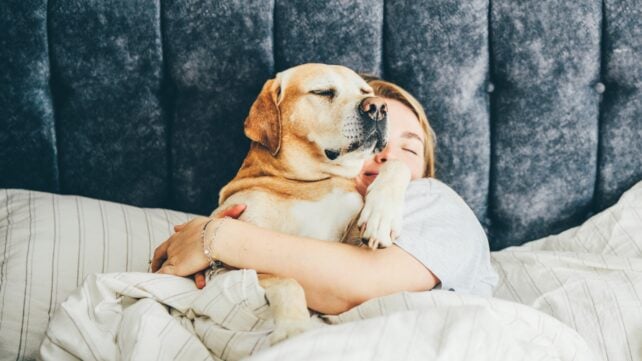
Nearly half of US adults share their bed with a furry friend.
But anyone who has slept with a dog knows they can be a total nuisance.
They can take over your mattress, snore loudly in your ear, and drool on your pillow. Throughout the night, they repeatedly stand up, walk in circles, and plop back down again.
Some studies suggest that having a dog in bed with you can disrupt your sleep, and some pet owners say they sleep worse when they co-sleep.
But are they the problem? Or are we?
Very few studies have turned the tables and considered the reverse: Are we disturbing our dog's sleep?
A new study from anthropologists at the University of Toronto suggests this is a two-way street.
Using survey data and motion trackers, the research team analyzed the nighttime activity of 25 participants in Canada, including 38 human-dog pairs.
Four owners always shared their bed with their dog, 10 sometimes did, and 11 never did.
The researchers found that human and dog nighttime activities are linked, even when the dog is not in bed.
In other words, when one individual is moving at night, the other is likely to move in the next few minutes, too.
Among the 22 human-dog pairs whose activity patterns were linked, human activity tended to precede dog activity in 45 percent of cases.
Dog activity came first in 18 percent of pairs.
The findings suggest that even in sleep, our pets are following our cues. But the study only considered huskies and malamutes, so there may be differences for other breeds.
"We're sharing our space and we're sharing our routines. More often than not, we're creating the routines that we have for our dogs and vice versa," explains one of the lead authors, Lavania Nagendran.
"Our findings show that we're very much in tune with one another, especially during the nighttime."
But the question of "who is disrupting whom?" is a tricky one to answer.
While this study found that human activity more often preceded dog activity than the other way around, the authors point out that both parties impact the nighttime activity of one another.
This demonstrates our species' "inseparable and reciprocal relationship," they write.
Dogs and humans have evolved together for at least 15,000 years now, and in all those millennia, our pets have become highly attuned to our needs.

Our sleep-wake cycles, however, are quite different, so how have we learned to sleep together? And is it good for our sleep, or bad?
No one yet knows.
Some studies have found that sleeping with dogs can cause disturbances, but others have found no significant effect.
Some research even suggests that humans report better subjective sleep when a dog is around, even if they experience more disruptions over the course of the night.
Perhaps the emotional and mental benefits of having a dog around are erasing some of the physiological downsides.
At the start of their study, Nagendran, co-lead author Ming Fei Li, and their team predicted that when humans and dogs slept together, it would negatively impact measures of sleep duration and quality due to increased nighttime disturbances.
But they found no such association.
Larger studies are needed to confirm these results, but they suggest that bed-sharing is not linked to sleep duration or efficiency.
"I would say my dog disrupts my sleep. But it's really interesting to know that maybe that's not actually the case," says Nagendran.
Just under half of the pet owners feel the same as Nagendran. They felt their dogs interrupted their sleep.
Participants with more than one dog also reported poorer sleep quality overall, though the team notes this finding was statistically weak.
"Out of 25 participants, the vast majority did not feel their sleep was interrupted by dog barking (88 percent) or noise caused by dog movements (84 percent)," the researchers write.
If the dogs could fill out a survey, who knows what they would say. But the results do suggest that when a human moves at night, the dog often does, too.
"Considering that we collected data during a period of heightened stress (i.e., lockdown during the COVID-19 pandemic), humans in our study may have experienced more disrupted sleep, characterized by increased nighttime activities, which then disturbed their dogs and contributed to subsequent dog activity," the authors speculate.
Many pet owners like having their dog in bed with them, even if it causes some disruptions.
In the small experiment, about 72 percent of participants reported feeling safer when they co-slept with their dog.
Perhaps our dogs feel the same.
"Thinking more broadly in terms of our shared evolutionary history, we do think this enhanced safety serves a function to bolster our bond with dogs," Li says.
"There's a very special close bond at play here. We're lucky to get to study it."
The research has been published in PLOS One.
This article was fact-checked by Rebecca Dyer and edited by Rebecca Dyer. While we pride ourselves on our process, we are only human. If you spot a mistake, please let us know.