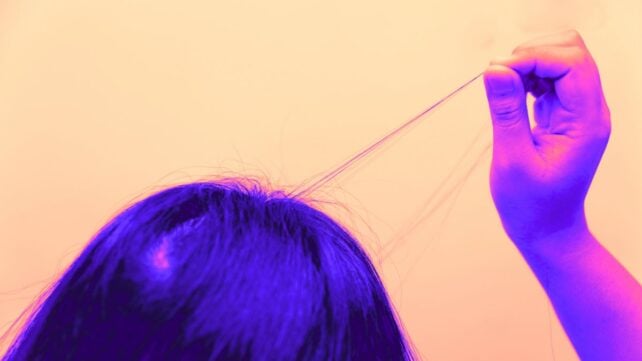
Trichotillomania (pulling out the hairs on your head, eyebrows, lashes, or elsewhere) is not a new condition.
According to historical documents, the earliest written mentions appear in Hippocrates' Epidemics III, in 410 BCE. Around 350 BCE, Aristotle wrote about vices in the Nicomachean Ethics and included "the habit of plucking out the hair or of gnawing the nails."
Also called hair-pulling disorder, trichotillomania is classified as a body-focused repetitive behavior and can lead to hair loss and significant psychological or social impairment.
It affects between 1-2 percent of people in the US, impacts both genders equally, and is often seen alongside other mental-health conditions such as anxiety and depression, PTSD, OCD, and ADHD.
One common explanation for trichotillomania is emotional regulation: that hair pulling helps people cope with unpleasant feelings such as anxiety, tension, or frustration and feel relief after completing the act.
But previous research has produced inconsistent evidence to support the emotional regulation idea, as hair pulling can also happen when someone is distracted or not even aware they are doing it.
To get a better handle on what happens in real time, researchers at Heidelberg University Hospital followed 61 adults with trichotillomania for 10 days.
"The majority of existing studies focus predominantly on the behavior, neglecting the urge and underlying factors that may influence it," the team writes in their new study, published in Comprehensive Psychiatry.
So the researchers set out to discover more about this urge and its repercussions.
Rather than having participants recall their day in a journal entry each evening (a common way to collect this kind of data), the researchers used an ecological momentary assessment instead.
This approach prompts people to record their feelings and actions in the moment rather than recall emotions from hours earlier.
Study participants received seven prompts a day between 8 am and 10 pm, asking them to report their current emotional state, how strong their urge to pull was, and whether they had pulled their hair since the previous assessment. They could also report pulling episodes as they happened.
That produced 2,557 momentary assessments and 702 hair-pulling episodes for the study's analysis.
When people reported stronger urges, they were substantially more likely to report a hair-pulling episode at that assessment. Stronger urges at one assessment also predicted pulling at the subsequent assessment.
Previous pulling episodes likewise made another episode more likely, suggesting some persistence in the behavior over the course of a day.
But emotional states were much less predictive than the urges were.
Negative emotions – including feelings such as anxiety, anger, sadness, guilt, and nervousness – were associated with stronger urges when people were experiencing them. So were rumination, tiredness, and boredom. Positive emotions, meanwhile, were associated with weaker urges.
One emotional or behavioral state stood out: Boredom.
Boredom predicted both subsequent hair-pulling episodes, and pulling at the same assessment. Tiredness, meanwhile, predicted stronger urges, although it was not associated with pulling itself.

So, rather than hair pulling being primarily a response to emotional distress, the behavior may sometimes be related to negative stimulation – but also a lack of it. "States of low energy may contribute to vulnerability for urges," the authors write.
They point to a theory in which repetitive behaviors help regulate internal stimulation levels, potentially making hair pulling more likely during states of under-arousal or boredom.
"The consistent predictive role of boredom and tiredness in particular suggests that models focusing exclusively on emotional dysregulation may be insufficient," the researchers write.
That doesn't mean emotions are irrelevant. Negative emotions and other internal states can be part of the experience of an urge, even if they don't reliably cause the behavior that follows. The researchers also emphasize that trichotillomania may not work the same way for everyone (there may be subtypes).
This study involved a relatively small, predominantly female sample, and participants had to be motivated enough to complete an intensive 10-day monitoring protocol – both of which are significant limitations in the research.
Assessments could be as much as four hours apart, meaning rapid changes in emotions or urges could have happened between them and gone uncaptured.
Related: Hidden Pulses Within Your Brain May Hold Your Thoughts Together
Still, the findings suggest that understanding trichotillomania may require looking beyond the assumption that stress, sadness, or anxiety causes someone to pull.
The more useful question may be what happens between an urge and an action – including boredom, stimulation, sensory experiences, environmental cues, and awareness of the urge itself.
The research has been published in Comprehensive Psychiatry.
This article was fact-checked by Rachel Garner and edited by Rebecca Dyer. While we pride ourselves on our process, we are only human. If you spot a mistake, please let us know.