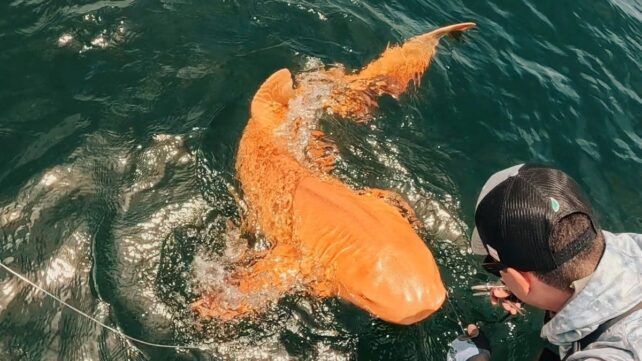
The fearsome silent hunters of the deep – sharks – aren't usually hued like a traffic cone, but now and again, nature goes "Hold my beer."
One spectacular example of this is a nurse shark (Ginglymostoma cirratum) caught and released by sports fishers off the coast of Costa Rica in August 2024. Not only was this shark not its usual brown cookie-dough color, but it was vividly orange-colored – with white eyes, to boot.
The reason for this, scientists determined, is the rare occurrence of two forms of abnormal pigmentation in the same animal – a lack of dark pigmentation, known as albinism, and an excess of yellow pigmentation, or xanthism.
Even more shockingly, this combined condition – known as albino-xanthochromism – doesn't seem to have hindered the shark's survival. It was living quite happily in the warm summer waters of the Caribbean Sea.
Related: First-Ever Footage of a Newborn Great White Shark Has Scientists in a Frenzy
The encounter took place off the coast of Costa Rica near Tortuguero National Park on 10 August 2024. Fisher Juan Pablo hooked the mango menace at a depth of 37 meters (121.4 feet) and was startled by its hue, snapping several photographs and taking its measurements before releasing it unharmed.
The photos were later posted on social media by eco-tourism company Parismina Domus Day.
Intrigued, marine biologists led by Marioxis Macías‑Cuyare of the Federal University of Rio Grande in Brazil got in touch with the fishers and, with the information provided, diagnosed the shark's strange hue.
"The shark exhibited an intense, uniform yellow to orange coloration and white eyes, with no visible iris," they wrote in their report, published in August 2025.
"The presence of white eyes, particularly the lack of the typically black iris (Fig. 1d), suggests that the specimen was most likely displaying an abnormal condition known as albino-xanthochromism, rather than xanthism alone."
While extremely rare, this double quirk of genetics has been documented in nature, mostly in birds. However, it has also been spotted in the oceans.
A speckled hind (Epinephelus drummondhayi) caught off the coast of North Carolina was diagnosed with albino-xanthochromism in 1978, and a bulletin describing an albino-xanthochromic spotted ray (Raja montagui) from the Irish Sea was published in 2018.

One might think such bright coloration would hinder a shark's lifestyle, but the fisher's measurements showed that this was not the case.
The tangerine terror was 200 centimeters (6.56 feet) from nose to tail-tip. That indicates full maturity, a process that usually takes at least a decade for this species.
Related: Blue Sharks May Be Secret Chameleons, Scientists Discover
Abnormal coloration is usually a genetic mutation, and given how inhospitable the ocean is to human exploration, this particular form of it may be far more common than a handful of scattered sightings might indicate.
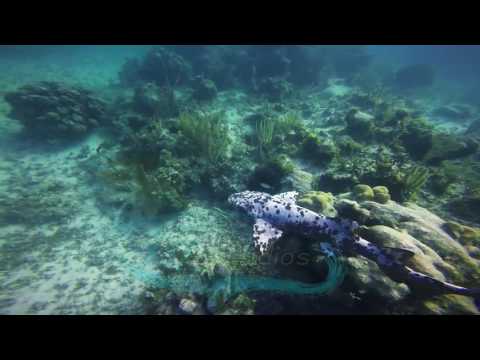
There have also been other cases of unusual pigmentation in nurse sharks, including albinism, piebaldism, and hypomelanosis – a reduction in dark pigmentation.
However, this particular individual is the first ever seen with albinism and xanthism simultaneously, and the researchers note that environmental factors could also play a role, recommending further scrutiny.
"Is this an isolated case? Could it represent an emerging genetic trend within the regional population? Is it related to specific environmental factors in the northern Caribbean of Costa Rica, or does it reflect the natural genetic variability of the species and its capacity to adapt to changing environments?" they wrote.
"Addressing these questions highlights the need for further investigation into how local environmental conditions influence the expression of such genetic traits."
Their analysis was published in Marine Biodiversity.