If you've ever felt that your love is so large, it needs a cosmic analogy to describe it, the Universe has you covered.
Whether it's the serendipitous orientation of space objects, an age-old tale of lovers, or stars whose behavior can be loaded with meaning, space is full of reminders that love is, indeed, all around.
Heartbeat stars
Even stars can seem to beat in sync. So-called heartbeat stars are binary systems that appear to pulse like a heart.
These pairs follow highly eccentric elliptical orbits around each other. As they swing close together and then apart in an intricate orbital dance, the changing tidal forces briefly elongate them into a more football-like shape, altering how their light reaches us.
When mapped into a light curve, this pulsating light resembles the output of an echocardiogram – making them the most romantic star systems in the sky.
The Rosette Nebula
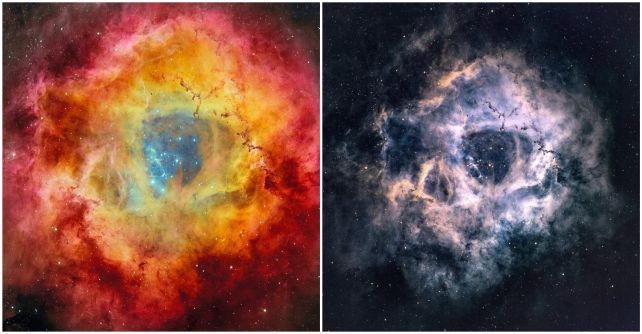
The Rosette Nebula is a marvelous example of how perspective can confer meaning. This star-forming region within a giant molecular cloud resembles, in most images, a glowing, rainbow-hued, multi-petaled rose – the very floral symbol of romantic love.
Slightly alter your focus, however, and the delicate flower transforms into a skull, a shift that gives the romance a much deeper meaning. On one side, the nebula seems to say "I love you"; on the other, "till death do us part".
The Necklace Nebula
If you've ever wanted to hang glittering stars around the neck of your boo… well, it's not the best idea for several reasons. But there is a beautiful arrangement of debris in the sky that you could use as a template.
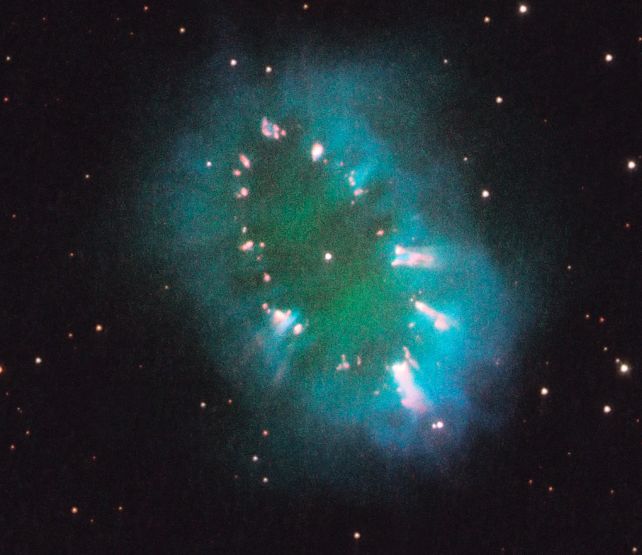
The Necklace Nebula (PN G054.2-03.4) formed when one star in a close binary system expanded into a red giant and engulfed its companion in what astronomers call a common-envelope phase. As the two spiraled closer together, they ejected the giant star's outer layers into space, creating what looks like an expanding ring of glowing diamonds.
It's an object that invokes sparkling fireworks, shedding outer layers, and drawing closer than ever in a tight embrace. Oo-er.
The Heart Nebula
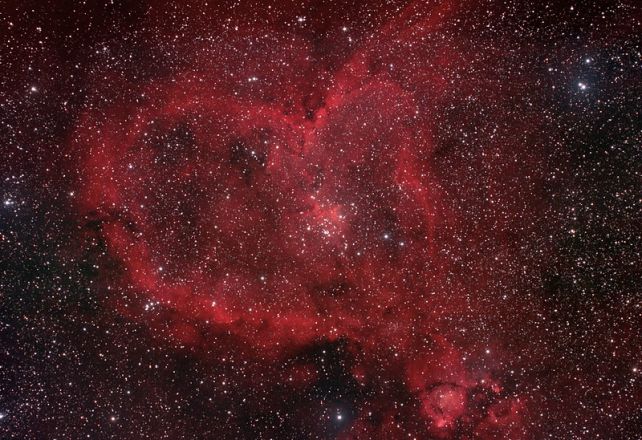
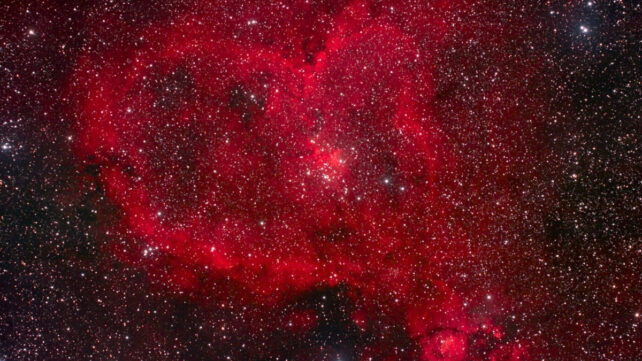
The Heart Nebula (IC 1805) may seem like an obvious inclusion, but it's more apt than its visual resemblance to a heart suggests. It forms part of a large star-forming cloud complex in the constellation Cassiopeia, and its glow is the result of ionization by the cluster of young, hot, blazing stars in its core.
This is the warm, creative power of the cosmos, an active stellar nursery birthing the glittering stars that fill the Universe with light.

The Ring Nebula
If you like it, put a ring on it… and one dying star appears to have done exactly that in the stunning Ring Nebula (NGC 6720). Actually, this object is not a ring at all; it's a three-dimensional shell of gas cast off by a Sun-like star as it transformed into a white dwarf.
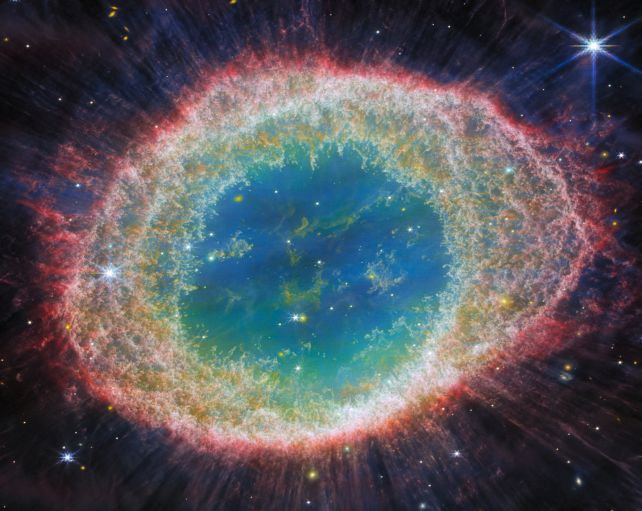
That sphere is still expanding; ultimately, it will dissipate entirely. On cosmic timescales, its lifespan is fleeting: Such nebulae only last for tens of thousands of years, at most. But the tiny white dwarf in its center will linger on; eventually, these stars are thought to crystallize into lumps of carbon – a kind of stellar diamond in the sky.
Perseus and Andromeda
Long ago, love stories were written in the stars. The legend of Perseus and Andromeda tells of a fair maiden, a terrifying monster, a daring rescue by a courageous hero, and ultimately blossoming love.
This tale was mapped onto the sky in a pair of neighboring constellations, so that Perseus and Andromeda would remain together forever, their romance immortalized in starlight.
Tislit and Isli
Not all stars or exoplanets are given true names beyond their official designations. But one special pair is WASP-161 and WASP-161b – a Sun-like star and its closely orbiting gas giant – officially named Tislit and Isli, Amazigh (Berber) words meaning "bride" and "groom".
The legend of Tislit and Isli tells of a couple from feuding tribes who were forbidden to marry. Their tears are said to have formed the neighboring lakes in Morocco that bear their names. Now, perhaps, they are finally united in the sky.
A world of pink
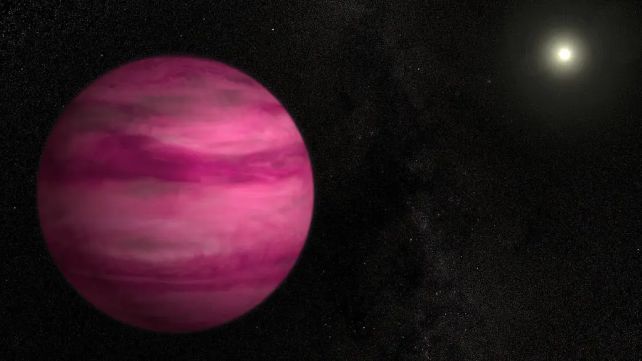
Who would have thought that even planets could blush? One exoplanet fits the bill – at least under the right light. GJ 504 b, about four times the mass of Jupiter, is one of the rare exoplanets that has been imaged directly.
In infrared observations from the Subaru Telescope in Hawaii, GJ 504 b appears vivid magenta, a color assigned to heat radiating from its atmosphere. It's actually far from the hottest exoplanet known… but it may be the most delightfully pink.
A galactic rose
The Universe is teeming with galaxies, and sometimes they come together in an intricate orbital dance that can eventually end in a merger. One such dance that beautifully embodies the romance of this union is a pair of galaxies called Arp 273.
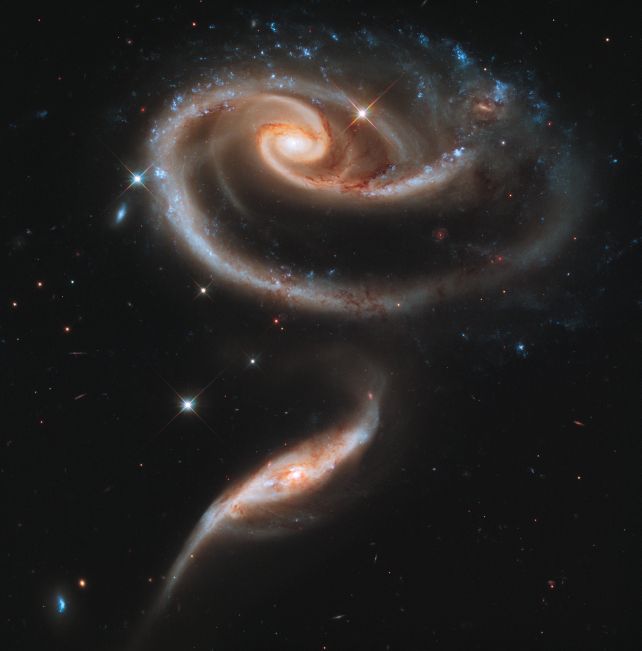
As they swoop around each other, their gravitational interplay stretches and warps their spiral arms. From our perspective on Earth, their current configuration resembles a giant rose blooming in space.
Related: Signal Hidden in a Gamma-Ray Burst Could Be a Strange Newborn's First Heartbeat
It's not love in the human sense, but even astrophysics in action can sculpt scenes that remind us of romance and beauty on truly mind-boggling scales.