The discovery of a Viking-age burial in Trøndelag, Norway, has presented archaeologists with a historical mystery.
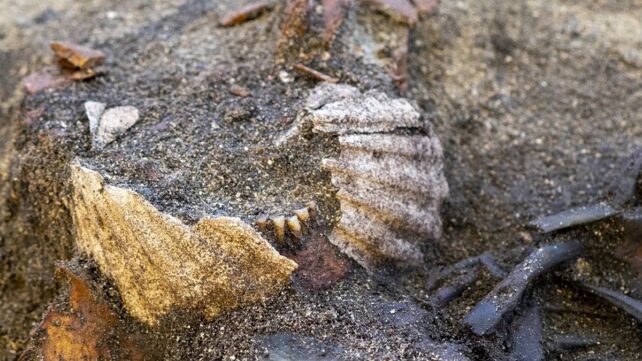
The astonishingly well-preserved grave yielded a woman who was buried with scallop shells neatly and deliberately placed near her mouth.
Not only is this a first for pre-Christian Viking burials, but there appear to be no clear parallels in the published archaeological record.
"The most remarkable thing is two scallop shells placed at the dead woman's mouth," says archaeologist Raymond Sauvage of the Norwegian University of Science and Technology (NTNU).
"This is a practice that is not previously known from pre-Christian graves in Norway. We don't yet know what the symbolism means."
Related: This Viking Burial of a Boat Put in a Larger Boat 100 Years Later Is Pretty Confusing
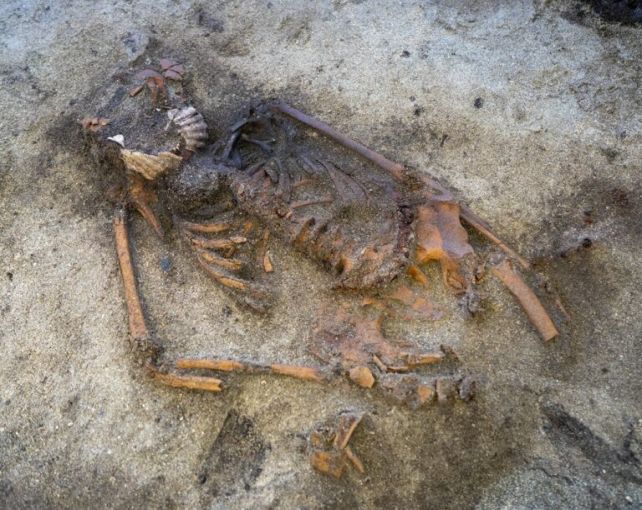
The burial has not yet been formally described in a scientific publication, but an early catalog of its contents makes the shells even more puzzling.
The first inklings of the grave's existence came from metal detectorist Roy Søreng, who discovered a bronze brooch typical of the Viking era, while exploring a field in Bjugn, Trøndelag County.
He and the landowner, Arve Innstrand, alerted the NTNU Museum and Trøndelag County Council, who sent experts to investigate.
Closer inspection of the field revealed the burial of a woman dating back to the Viking age – a rarity in and of itself, since the acidity of Norwegian soil tends to degrade remains pretty quickly and thoroughly.
Although much of the burial had indeed degraded in the centuries since the inhabitant died, enough remained that the archaeologists could determine some key facts about her – namely, two oval brooches that would have been attached to the straps of a dress, and a ring buckle that would have been used to close the woman's petticoat.
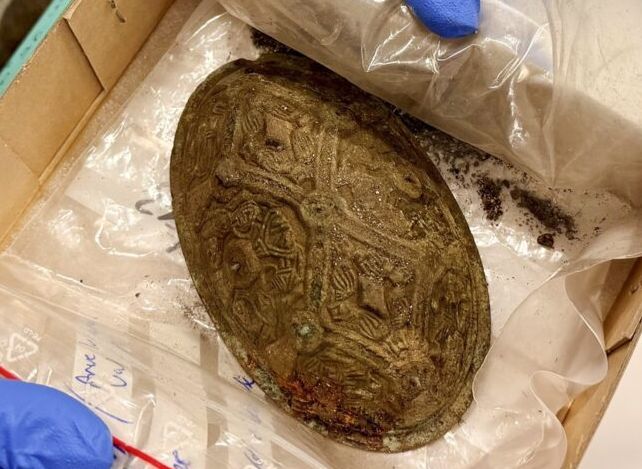
"The Viking Age grave contains what we believe to be a woman, buried with a typical Viking Age costume and jewellery set from the 800s," Sauvage explains.
"This indicates that she was a free and probably married woman, perhaps the mistress of the farm."
The scallop shells, however, have no known precedent. They were placed on either side of the woman's jaw, with the external side of the shell facing outward, the hinge lines pointing to her cheekbones, and the ventral margins closer to her neck.
The grave also included a number of bird bones, carefully arranged, possibly from wings – a burial inclusion that has a little more precedent. Possibly the best-known example is the 6,000-year-old Danish burial of a mother and newborn, in which the infant was carefully laid atop a swan's wing.
There is some symbolic meaning associated with scallop shells at different times and places in history, but none that we know of in 9th-century Scandinavia.
During Greek and Roman antiquity, for example, the scallop shell was associated with Aphrodite/Venus and carried symbolic associations with fertility, birth, and femininity.
It wasn't until around the 11th century that the shell became a powerful Christian symbol of pilgrimage and spiritual journey.
That would be potentially appropriate for a burial rite, but since this particular meaning emerged long centuries after this burial took place, it cannot be applied to 9th-century Norway.

Many other burials around the world have involved shells and shell fragments, sometimes far from the ocean. In burial contexts from Neolithic and Bronze Age Poland, for example, bivalve shells such as Spondylus were associated with wealth, prestige, and long-distance connections.
So, while archaeologists are at a loss to explain why this particular burial included scallop shells, other evidence that marine shells were often meaningful throughout history, as well as their careful placement in this particular burial, suggests a significance to the people who buried her.
The researchers are now working on learning more about the woman, hoping to discover what link, if any, she may have had to a previously discovered burial, dating back to the 700s, in the same field.
"We will examine the skeleton, preserve the objects, and take samples for dating and DNA analysis," Sauvage says.
"The goal is to learn more about the person and about possible kinship to the previous find from the same place."