
As effective as fasting can be for weight loss, it's often thought that depriving the body of sustenance might have a negative impact on brainpower.
But is an impact on cognitive performance really an inevitable part of the fasting experience?
According to a huge, recently published review, it's not always the case.
Based on an analysis of 63 scientific articles representing 71 independent studies, and covering a total of 3,484 participants, the review found that there was no meaningful difference in cognitive performance between people who were fasting and people who were having regular meals.
It's a comprehensive counter to the idea that moderate, short-term restrictions on eating will deplete mental reserves in healthy people, an idea found everywhere from snack adverts ("you're not you when you're hungry") to the mantra that breakfast is the most important meal of the day.
The researchers behind the analysis – psychologist Christoph Bamberg from Paris Lodron University in Austria, and cognitive neuroscientist David Moreau from the University of Auckland in New Zealand – don't want people who could benefit from fasting to be put off by worrying that it'll lead to foggy thinking.
"For most healthy adults, the findings offer reassurance," Moreau explained in a commentary for The Conversation.
"You can explore intermittent fasting or other fasting protocols without worrying that your mental sharpness will vanish."

To dig through all of this data, the researchers used a Bayesian statistics approach, a way of coming up with a probability distribution rather than a black-and-white, yes-or-no answer.
In this case, they were investigating whether or not fasting affected cognitive performance. The approach is particularly useful in weighing up lots of different statistical sources.
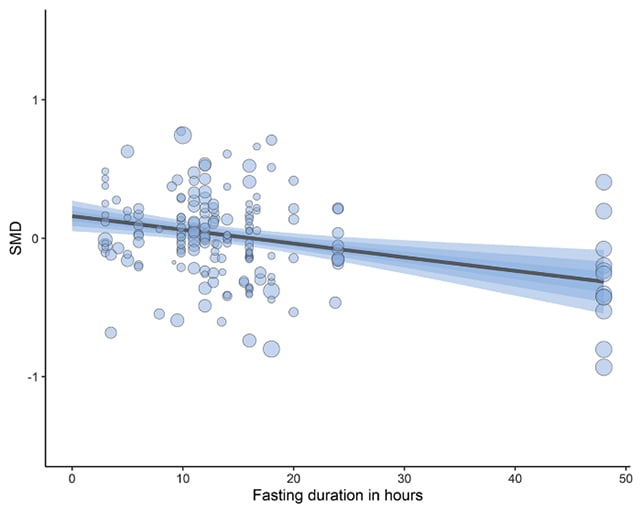
Cognitive skills assessed in the studies included memory recall, decision-making, and response speed and accuracy. When these assessments were taken as a whole, short-term fasting (with a median duration of 12 hours) didn't significantly change the scoring.
There were some nuances though.
The researchers found modest cognitive performance reductions in fasting intervals over 12 hours, and "noticeable declines" in children and teenagers (though kids only made up a small portion of the participants).
That suggests that young and developing brains might be more at risk from going without food for extended periods, and that for kids and teens, three regular meals a day matters a lot.
Interestingly, food-related tasks testing cognitive performance are where impacts showed up the most. It's possible that very specific brain circuits do start to flag during fasting, though further studies will be required to know for sure.
"Performance deficits were often evident only in tasks involving food-related stimuli, such as looking at pictures of food or processing food-related words," Moreau said.
"In contrast, performance on tasks using neutral content was largely unaffected."
"Hunger might selectively divert cognitive resources or cause distraction only in food-relevant contexts, but general cognitive functioning remains largely stable."
The researchers also found that individuals who were fasting tended to do worse in cognitive tests when they were carried out later in the day – perhaps hinting that going without food acts as a sort of amplifier to the natural dips in concentration that can come with our built-in circadian rhythms.
As well as helping some people to manage their weight, fasting has also been associated with other health benefits in scientific studies, including improvements in cardiovascular health and reductions in inflammation levels.
Scientists think that fasting does cause some significant changes in the way the body operates, including the way it switches from tapping energy stores made up of glycogen to using body fat more generally – specifically in the form of packets called ketone bodies.
Related: A 4-Week Diet Change May Turn Back The Clock on Aging, Study Suggests
With all of that in mind, Moreau concludes that "fasting is best seen as a personal tool rather than a universal prescription".
There's no one-size-fits-all approach, and fasting is best done in consultation with a medical professional.
"The primary takeaway is a message of reassurance: Cognitive performance remains stable during short-term fasting, suggesting that most healthy adults need not worry about temporary fasting affecting their mental sharpness or ability to perform daily tasks," Moreau said.
The research was published in Psychological Bulletin.