In the wake of the catastrophic Chicxulub asteroid impact roughly 66 million years ago, three-quarters of the plant and animal species on Earth collapsed into extinction.
This included, most famously, all non-avian dinosaurs
But amidst the ruins of the plant and animal kingdoms, another form of life seized its moment.
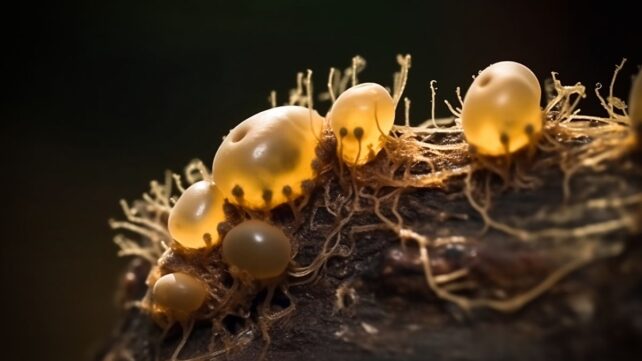
Born to digest the dying flesh of its neighbors, and unfazed by the dimmed Sun and cooled climate, the fungi kingdom flourished.
New evidence from ancient layers of rock in Colorado and North Dakota shows a massive spike in fungi activity immediately after the asteroid smashed into Earth.
In New Zealand, rock layers from the same geological period have captured similar fungi action post-Chicxulub.
Perhaps, a new study's authors suggest, this post-apocalyptic fungal phenomenon was global.
Microbiologists Rosanna Baker and Arturo Casadevall from Johns Hopkins University teamed up to make sense of the prehistoric fungi fossil record, which revealed three major mycological moments surrounding the asteroid impact.
These fungal gardens left their mark in layers of sedimentary rock in Colorado's Denver Basin and North Dakota's Williston Basin.
Sedimentary rock is made of layers of silt and other materials, laid down over thousands of years, and compressed into stone. The layers form a natural record of changes across the ages, which paleontologists and geologists can use to piece together the chronology of Earth's past.
Sedimentary rocks all around the world have a distinctive layer of iridium, at concentrations far higher than seen at other time periods in the geological record.
It's known as the Cretaceous–Paleogene (K–Pg) boundary, formed 66 million years ago, and it's widely accepted that the Chicxulub impact caused this unique signature.
The rocks at North Dakota and Colorado both exhibit this boundary clearly.
"In our analysis, a fungal spike was defined as 50 percent or more fungal spores out of the total fungal and plant spores," Baker told ScienceAlert.
"So when plant life eventually recovered, the balance returned to the normal state of more plant than fungal spores."
In the Colorado sample, an abundance of fungal spores and hyphae in many shapes and sizes appear alongside the K-Pg line, sandwiched right on the boundary layer.
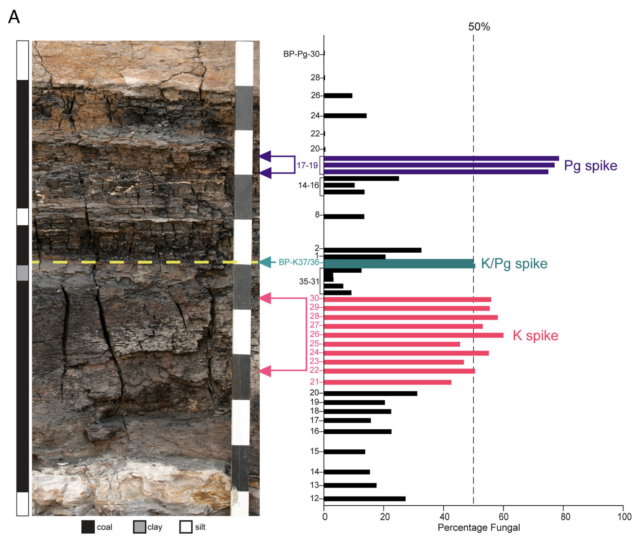
In the layers deposited 2,000 to 10,000 years after the K–Pg boundary, there is evidence of a sustained period of fungal proliferation, as the mycelium multiplied in the cold, dank aftermath of mass extinction.
But the asteroid was not the only catalyst for fungal uprising.
Another, earlier event left a similar signature in the stone: the Deccan Traps volcanic eruptions, which, spanning the K-Pg boundary, were once primarily blamed for the mass extinction event.

This earlier fungal spike, dated around 30,000 to 10,000 years before the Chicxulub impact, correlates with a much cooler climate period, and is "intriguingly coincident" with a particularly prolific phase of the Deccan Traps' eruptions.
Fungi typically prefer cooler temperatures and acidic environments. Perhaps the cooler and darker conditions that arise when geological (or human-made) calamities shade our skies – as Chicxulub and the Deccan Traps eruptions certainly did – could set the scene for a fungal bloom en masse.
"We think the fungal bloom that occurred before the impact is evidence that the intense and prolonged period of volcanic activity in the late Cretaceous was stressing the planet before the meteorite impact," Baker said.
Perhaps, Casadevall added, the Cretaceous extinction was more of a "two-punch hit by volcanism and a bolide", rather than a single catalytic moment.
Further research is needed to place the fossil remnants of these prehistoric fungi – spores and bits of hyphae – amongst their living relatives, in terms of whether they were molds, mushrooms, or some other kind of fungi.
However, Baker and Casadevall have a hunch that the successful fungi were probably saprotrophs, which feed on decaying matter, slowly dissolving the abundance of organic material left behind by unlucky plants and animals affected by the extinction event.
What we do know is that the fungi were extinct members of the phylum Ascomycota. Their better-known living relatives include morels, truffles, baker's yeast, and cup fungi.
The size of the spores embedded in the K-Pg boundary layer, particularly, resembles those of well-fed saprotrophs, while the smaller spores detected in the spikes before and after the impact are typical of leaner, cold- and acid-adapted fungi, equipped to survive through stressful conditions.
The spores were loaded with melanin, which is known to protect fungi from the harmful effects of radiation, "like a suit of armor", as Baker puts it.
Related: Hotter Climate Could Fuel Spread of Dangerous Fungi, Scientists Warn
"Taken together with reports of fungal expansion following prior global calamities, these findings indicate that fungi can often flourish in the aftermath of ecosystem-level collapse," Baker and Casadevall write.
"Given the capacity of fungi to cause disease in both plants and animals, the occurrence of fungal proliferative events has potential implications for the recovery of species surviving global cataclysms."
By thriving in the aftermath of disaster, these fungi probably provided an important role in recycling what was left behind, laying the groundwork (literally) for complex life to thrive on Earth once more.
No job, it seems, is too big for nature's cleanup crew.
The research was published in PNAS.